Pact Protecting Environmentalists Suffers Threats in Mexico

Active Citizens, Civil Society, Conservation, Editors’ Choice, Environment, Global Governance, Headlines, Human Rights, Indigenous Rights, Latin America & the Caribbean, Regional Categories

Environment

A mining waste deposit in the center of the municipality of Topia, in the northern Mexican state of Durango, threatens the air, water and people’s health. The Escazú Agreement, In force since 2021, guarantees access to environmental information and justice in Latin American countries, as well as public participation in decision-making on these issues. CREDIT: Emilio Godoy/IPS

A mining waste deposit in the center of the municipality of Topia, in the northern Mexican state of Durango, threatens the air, water and people’s health. The Escazú Agreement,
In force since 2021, guarantees access to environmental information and justice in Latin American countries, as well as public participation in decision-making on these issues. CREDIT: Emilio Godoy/IPS

MEXICO CITY, Feb 7 2023 (IPS) – In the municipality of Papantla, in the southeastern Mexican state of Veracruz, the non-governmental Regional Coordinator of Solidarity Action in Defense of the Huasteca-Totonacapan Territory (Corason) works with local communities on empowering organizations, advocacy capacity in policies and litigation strategies.


“This participation with organizations that work at the national level and have the capacity to influence not only the legal field is important,” Corason coordinator Alejandra Jiménez told IPS from Papantla. “They are able to bring injunctions, and this is how they have managed to block mining projects, for example.”

“Up to now, the Escazú Agreement is dead letter, that is the history of many laws in Mexico. Environmentalists have clearly suffered from violence, and let’s not even mention access to information, where there have even been setbacks.” — Alejandra Jiménez

She was referring to the collaboration between locally-based civil society organizations and others of national scope.

Since its creation in 2015, Corason has supported local organizations in their fight against the extraction of shale gas through hydraulic fracturing or fracking, a highly polluting technique that uses large volumes of water and chemicals, in Veracruz and Puebla, as well as mining and hydroelectric plants in Puebla.

Cases like this abound in Mexico, as they do throughout Latin America, a particularly dangerous region for environmentalists.

Activists agreed on the challenges involved in enforcing the Regional Agreement on Access to Information, Public Participation and Justice in Environmental Matters in Latin America and the Caribbean, known as the Escazú Agreement, seen as a tool to mitigate dangers faced by human rights defenders in environmental matters.

A case that has been in the hands of Mexico’s Supreme Court since August 2021 is currently addressing the power of organizations to express their disagreement with environmental decisions and will outline the future of environmental activism in this Latin American country of some 130 million people, and of the enforcement of the Escazú Agreement.

The origin of the case lies in two opposing rulings by Mexican courts in 2019 and 2020, in which one recognized the power of organizations and the other rejected that power. As a result, the case went to the Supreme Court, which must reach a decision to settle the contradiction.

In August 2022 and again on Jan. 25 this year, the Supreme Court postponed its own verdict, which poses a legal threat to the megaprojects promoted by the government of President Andrés Manuel López Obrador, a staunch defender of the country’s oil industry.

Gustavo Ampugnani, general director of Greenpeace Mexico, said the case was an alert to the Escazú Agreement, and that it should not represent a setback for the defense of the environment.

“The significance lies in the risks involved in a wrong decision by the Supreme Court on how to resolve this existing contradiction. If the Court decides that the legal creation of an environmental organization is not enough and that other elements are required, it would limit citizen participation and access to justice,” he told IPS.

Environmentalists are waiting for their Godot in the form of the novel agreement, to which Brazil and Costa Rica do not yet belong, to improve their protection.

The treaty, in force since April 2021 and which takes its name from the Costa Rican city where it was signed, guarantees access to environmental information and justice, as well as public participation in environmental decision-making. It thus protects environmentalists and defenders of local land.

Mexico’s foreign ministry, which represented this country in negotiating the agreement, has identified a legislative route to reform laws that make its application possible and promote the integration of a multisectoral group with that same purpose.

Escazú has been undermined in Mexico by López Obrador’s constant attacks against defenders of the environment, whom he calls “pseudo-environmentalists” and “conservatives” for criticizing his policies, which they describe as anti-environmental and extractivist.

For this reason, a group of organizations and activists requested in a letter to the foreign ministry, released on Feb. 2, details of the progress in the creation of inter-institutional roundtables, selection of indicators, creation of protection mechanisms, and training of officials, including courts, while demanding transparency, inclusion and equity in the process.
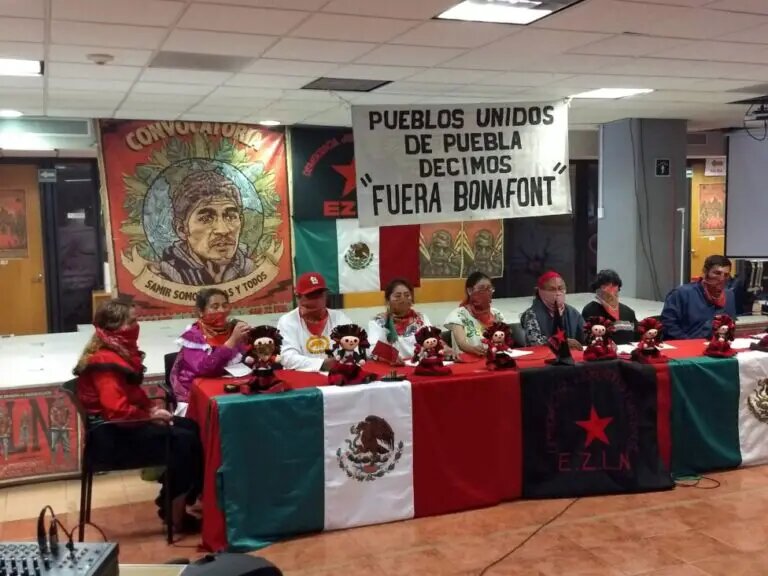
Activists from the southern Mexican state of Puebla protest the activities of a water bottling company, on Apr.19, 2021. Environmentalists face serious threats in Mexico, where the Escazú Agreement, which since 2021 provides guarantees to these activists in Latin American countries, has not been applied. CREDIT: Emilio Godoy/IPS

Activists from the southern Mexican state of Puebla protest the activities of a water bottling company, on Apr.19, 2021. Environmentalists face serious threats in Mexico, where the Escazú Agreement, which since 2021 provides guarantees to these activists in Latin American countries, has not been applied. CREDIT: Emilio Godoy/IPS

High risk

In 2021, there were 200 murders of environmentalists around the world, a slight decrease from 227 the previous year, according to a report by the London-based non-governmental organization Global Witness.

Latin America led these crimes, accounting for 157 of the killings, with a slight decline from 165 the previous year. Mexico topped the list with 54 murders, compared to 30 in 2020. Colombia ranked second despite the drop in cases: 33, down from 65 in 2020, followed by Brazil (26 vs. 20), Honduras (eight vs. 17) and Nicaragua (13 vs. 12).

The attacks targeted people involved in opposition to logging, mining, large-scale agribusiness and dams, and more than 40 percent of the victims were indigenous people.

In Mexico there are currently some 600 ongoing environmental conflicts without a solution from the government, according to estimates by the Ministry of Environment and Natural Resources.

The most recent case was the Jan. 15 disappearance of lawyer Ricardo Lagunes and indigenous activist Antonio Díaz, an opponent of mining in the western state of Michoacán, which the United Nations High Commissioner for Human Rights has demanded be urgently clarified.

One year after it came into force, the Escazú Agreement is facing major challenges, especially in countries such as Brazil, Colombia, Guatemala, Honduras, Mexico and Nicaragua, where environmentalists face particular risks.

Olimpia Castillo, coordinator of the non-governmental organization Communication and Environmental Education, said the context sends out a warning.

“It is a very interesting round, because article 10 (of the agreement) refers to highlighting the participation of the organizations. That article could be violated, which would mean a major limitation. These are things that as a country we are going to have to face up to,” the activist, who participated in the negotiation of the agreement as a representative of civil society, told IPS.

In Mexico, compliance with the agreement has already faced hurdles, such as the November 2021 decree by which López Obrador declared his megaprojects “priority works for national security”, thus guaranteeing provisional permits, in contravention of the treaty.

Dispute resolution

Activists are already planning what to do if the Supreme Court hands down a negative verdict: they will turn to the Escazú Agreement dispute resolution mechanism – although the signatory countries have not actually designed it yet.

“We would consider turning to the treaty to resolve the issue. Environmental activism is highly dangerous. But that should not set aside the right of organizations to intervene in decisions. Activists and organizations must be given tools to use regional agreements, because what is happening in the country is very serious,” said Greenpeace’s Ampugnani.

Castillo’s organization is working to raise awareness about the agreement. “If no one knows it exists and that they are obliged to comply with it, how do we make them do it? There are still informative processes in which an application has not yet received a response. We have to demand compliance. There are conditions to apply the agreement. But we need political will to comply with it and to get the word out about it,” she said.

Corason’s Jiménez questioned whether the treaty was up-to-date. “Up to now, the Escazú Agreement is dead letter, that is the history of many laws in Mexico. Environmentalists have clearly suffered from violence, and let’s not even mention access to information, where there have even been setbacks. There is an environment that hinders progress,” she said.

In her view, it is not in the interest of governments to apply the agreement, because it requires participation, information and protection in environmental issues.

In March 2022, the first meeting of the Conference of the Parties to the Escazú Agreement took place, which focused on its operational issues and other aspects that the countries will have to hash out before the next summit is held in 2024.

The Supreme Court, which has not yet set a date for handing down its ruling, is caught between going against the government if it favors environmental organizations or hindering respect for the agreement. For now, the treaty is as far from land as Mexico City is from Escazú: about 1,925 kilometers.

  Source

Democracy on the Blink

Asia-Pacific, Civil Society, Crime & Justice, Democracy, Featured, Global Governance, Headlines, Human Rights, TerraViva United Nations

Opinion

Food insecurity in Sri Lanka has increased dramatically due to two consecutive seasons of poor harvests, foreign exchange shortages, and reduced household purchasing power. Amidst Sri Lanka’s worst economic crisis since independence, the UN revised its joint Humanitarian Needs and Priorities (HNP) Plan, appealing for more life-saving assistance to aid 3.4 million people. November 2022 Credit: UNICEF/Chameera Laknath

LONDON, Feb 3 2023 (IPS) – On February 4, Sri Lanka commemorates 75 years of Independence. But it will not be the extravaganza of the past years, the minaturised imitations of the grand displays on Moscow’s Red Square or China’s Tiananmen Square.


Still, a critical question has been reverberating in the community ever since the government announced a scaled down celebration to commemorate 75 years since Britain relinquished power in 1948.

After defaulting on the country’s debt servicing last April for the first time in its post-independence history and being forced to resort to massive printing of money to meet state expenditure, does Sri Lanka need to celebrate independence day this year however downsized it would be?

Particularly so, when President Ranil Wickremesinghe’s government itself claims Sri Lanka is struggling economically and it would take years to recover from its current chaos created by leaders who inexorably pushed it to the tip of the abyss with stupid economic policies, wasteful expenditure and wide- scale corruption and fraud.

While imposing unbearable new taxes and other restrictions on the daily lives of the people, driving them further into penury with school children going without meals, fainting in their classrooms and in need of medical treatment which itself is becoming scarce, the country’s leaders don’t seem short of resources for celebrations.

Even the country’s diplomatic missions will be holding their annual independence day celebrations as the invitation I received indicated, feasting their countrymen as best as they could.

Yet over the last couple of months the government has been selling the story that it has no funds to pay for the Local Government elections due in March. A strange enough claim after President Ranil Wickremesinghe, in one of his other roles as finance minister, presenting the budget for 2023 last November allocated funds for the election and parliament, which oversees public expenditure, approved it.

Now, the very persons who allocated money just three months ago claim to lack funds for a constitutionally required election. Punning on the old Harry Belafonte calypso, there is a hole in the budget, said some wag on social media.

It is this contradiction in government conduct that an already enraged people find inexcusable. Having got rid of one elected president– Gotabaya Rajapaksa– who surreptitiously fled the country last July when mounting peoples’ protests demanded the Rajapaksa clan quit the government, they find themselves confronted with what Sri Lankans have come to see as a Rajapaksa clone– and now derisively call him Ranil Rajapaksa– thrust into the presidency to keep the family’s political fires alight.

The Roman poet Juvenal dismissively called the delusionary performances staged by the Roman emperors of the time to distract their discontented citizenry, “panem et circensus”- bread and circuses.

Bread, like some other essentials, might be scarce or priced beyond the reach of many of its 22 million people. A few months back, the UN agency UNICEF reported that 5.7 million Sri Lankans including 2.3 million children, are in need of humanitarian assistance and the numbers are likely to rise in the coming days.

But the country’s leaders are not beyond performing their own circus acts. A few days back President Wickremesinghe appointed two more cabinet ministers bringing the total to 22.

Within hours Sri Lankans with their innate sense of humour were on social media branding the new cabinet “Ali Baba and the 22” with the doors to the cabinet still open for more acolytes chosen not for integrity and competence but loyalty.

Before the two new ministers fattened the cabinet, splicing off the portfolios of two existing ministers, President Wickremesinghe a couple of months ago appointed 37 state ministers leaving room for three more.

Sri Lanka’s bloated ministerial ranks would surely be one of the largest in today’s parliamentary democracies. Not only is it large in numbers but the perks offered to ministers and state ministers is stunningly staggering–salaries, free housing, several expensive vehicles with fuel, free utilities such as electricity, water, telephones up to a point, several personal staff with paid salaries, armed personal security with escort vehicles, a special allowance for each day they attend parliament, state pension after five years and other facilities not generally known.

While the government is prepared to splash state funds on bolstering party cadres and lickspittle who have creamed off state assets, in the last couple of months it has been using every ruse in the books-and some which are not in them- trying to deprive the people of their constitutional right to the franchise, by blocking the Local Government elections due shortly.

This election, last held in 2018, is for 340 municipal councils, urban councils and village bodies is scheduled for March 9—the date set by the independent Election Commission last month.

But as the day for the election, as constitutionally required, neared, the attempts to stymie it began with grandees of President Ranil Wickremesinghe’s United National Party (UNP) and the Rajapaksa clan-run Sri Lanka Podujana Peramuna (SLPP) that is propping up Wickremesinghe with its parliamentary majority, asserting that economic recovery must precede elections.

Ministers and even state officials were trotting out excuses that there was no money to fund elections, expecting the populace to have forgotten the budgetary allocation passed by parliament a few months back.

As this was being written, internationally-known legal academic and former foreign minister Prof GL Peiris was telling the media the government had made seven attempts to try and stop the election including an affidavit to the Supreme Court filed by the secretary to the finance ministry claiming the state of the economy precluded holding elections right now.

The latest ruse was a law called the Election Expenses Bill to control spending for elections hurriedly passed by parliament. If, as Justice Minister Wijeyadasa Rajapaksa said, this proposal has been hanging fire for years, why the rush now, the opposition and anxious voters asked.

Like the opposition, the public too smelled a rotten rat. It was seen as another attempt to derail the elections by calling for the provisions of the bill be incorporated which would call for more time.

Despite all the public bravura, both the Rajapaksa-controlled SLPP and Wickremesinghe-led UNP which was swept into oblivion at the 2020 general elections, fear that given the mood of the country which rose in mass protests for some seven months last year leading to the resignation of President Rajapaksa and three of his brothers from the cabinet, they would suffer ignominious defeat.

Especially so the UNP which lost every single seat including that of party leader Wickremesinghe who managed to creep back into parliament one year later through a clause in the electoral law.

Not only would a poor electoral performance by the SLPP and UNP which have now joined hands make governance difficult and troublesome, it would also strengthen public opposition both to the Rajapaksas and President Wickremesinghe who many argue-and rightly so-as a leader rejected by the country two years ago and lacking a popular mandate to rule the country.

So what one sees now is a symbiotic relationship between the executive headed by Wickremesinghe and the legislature controlled by the Rajapaksas, running the country and using outdated laws- some dating back to British times- to beat back public dissent, employing the security forces to trample on the constitutionally guaranteed freedoms of the people- free speech and expression, of association and assembly and peaceful protest.

It also raises issues about the independence of the Attorney-General and some of the independent institutions set up under the constitution which are believed to have come under pressure during the Wickremesinghe presidency.

With two arms of the state- the executive and legislature under the control of the Wickremesinghe-Rajapaksa- led cabal and backed by the security forces as recent event have shown, Sri Lanka’s increasingly beleaguered populace can only rely for justice on the third arm of the state- an independent judiciary.

Over the years the judiciary has, now and then, been under pressure from dictatorial leaders who have not been averse to tamper with justice and the judicial process, sometimes denying impartial, independent judges their rightful place as chief justice or appointing friends or those amenable to the judiciary.

But two recent judgements by the Supreme Court have resurrected public faith that the judiciary could be relied on to safeguard the constitution and the peoples’ constitutional and human rights against state abuse of the law and the battering and brutality by the security forces.

A few months back the government tried to push through a “Bureau of Rehabilitation Bill” ostensibly to help treat and rehabilitate drug addicts and other drug users. Under cover of that it hoped to incarcerate political dissidents, activists and others which state security would identify those they do not like as ‘trouble makers’.

So, it included among those to be included under the law “ex-combatants, members of violent groups, violent extremist person and any other person or group of persons”.

The Supreme Court saw through this as an attempt to round up any person the authorities considered a political nuisance and hold them without recourse to the law. The court struck down the clause.

Holding that the Bill as a whole violated the constitution, it said it could be acceptable if certain clauses were amended. One of the clauses it found repugnant was the one cited above which the court wanted deleted, leaving rehabilitation open only to drug dependent persons and those identified by law as in need of rehabilitation.

In mid-January the Supreme Court delivered a landmark verdict which held former president Maithripala Sirisena, secretary of the defence ministry, police chief and top- ranking intelligence officers, of dereliction of duty and “failure to act” when valid and clear intelligence was passed on by foreign sources of an impending terrorist attacks by Islamic extremists on churches on Easter Sunday in 2019.

Some 270 persons including foreigners were killed and several hundred wounded in these attacks on churches and Colombo hotels.

Since these were civil cases, President Sirisena was fined 100 million rupees and the others lesser amounts. Sirisena as a former president was no longer entitled to immunity, a lesson for other former and future presidents that they too are liable to civil and criminal action such as corruption and human rights violations once they cease to hold office.

These judicial judgments bring some hope to the people that the citadels of power are vulnerable and could be breached by a strong and upright judiciary, the only institution now left to protect and uphold the country’s democratic traditions and norms.

If the judiciary is badgered, the last resort is too bloody to contemplate.

Neville de Silva is a veteran Sri Lankan journalist who held senior roles in Hong Kong at The Standard and worked in London for Gemini News Service. He has been a correspondent for the foreign media including the New York Times and Le Monde. More recently he was Sri Lanka’s Deputy High Commissioner in London.

Source: Asian Affairs, London

IPS UN Bureau

  Source

Solar Energy Useless Without Good Batteries in Brazil’s Amazon Jungle

Active Citizens, Civil Society, Climate Action, Climate Change, Development & Aid, Economy & Trade, Editors’ Choice, Energy, Environment, Green Economy, Headlines, Human Rights, Indigenous Rights, Integration and Development Brazilian-style, Latin America & the Caribbean, Projects, Regional Categories

Energy

Solar panels with a capacity to generate 30 kilowatts no longer work in the Darora Community of the Macuxi people, an indigenous group from Roraima, a state in the far north of Brazil. The batteries only worked for a month before they were damaged because they could not withstand the charge. CREDIT: Boa Vista City Hall

Solar panels with a capacity to generate 30 kilowatts no longer work in the Darora Community of the Macuxi people, an indigenous group from Roraima, a state in the far north of Brazil. The batteries only worked for a month before they were damaged because they could not withstand the charge. CREDIT: Boa Vista City Hall

BOA VISTA, Brazil, Jan 25 2023 (IPS) – “Our electric power is of bad quality, it ruins electrical appliances,” complained Jesus Mota, 63. “In other places it works well, not here. Just because we are indigenous,” protested his wife, Adélia Augusto da Silva, of the same age.


The Darora Community of the Macuxi indigenous people illustrates the struggle for electricity by towns and isolated villages in the Amazon rainforest. Most get it from generators that run on diesel, a fuel that is polluting and expensive since it is transported from far away, by boats that travel on rivers for days.

Located 88 kilometers from the city of Boa Vista, capital of the state of Roraima, in the far north of Brazil, Darora celebrated the inauguration of its solar power plant, installed by the municipal government, in March 2017. It represented modernity in the form of a clean, stable source of energy.

A 600-meter network of poles and cables made it possible to light up the “center” of the community and to distribute electricity to its 48 families.

But “it only lasted a month, the batteries broke down,” Tuxaua (chief) Lindomar da Silva Homero, 43, a school bus driver, told IPS during a visit to the community. The village had to go back to the noisy and unreliable diesel generator, which only supplies a few hours of electricity a day.

“The solar panels were left here, useless. We want to reactivate them, it would be really good. We need more powerful batteries, like the ones they put in the bus terminal in Boa Vista.” — Lindomar da Silva Homero

Fortunately, about four months later, the Boa Vista electricity distribution company laid its cables to Darora, making it part of its grid.

“The solar panels were left here, useless. We want to reactivate them, it would be really good. We need more powerful batteries, like the ones they put in the bus terminal in Boa Vista,” said Homero, referring to one of the many solar plants that the city government installed in the capital.

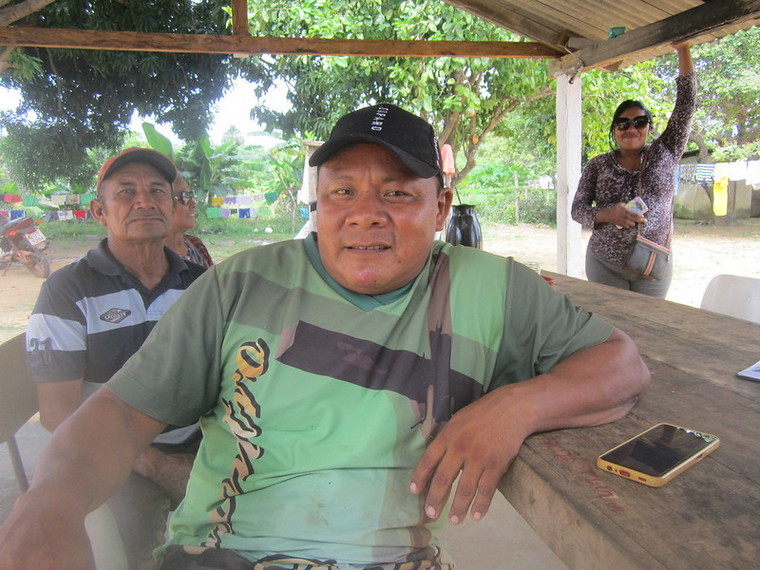
Tuxaua (chief) Lindomar Homero of the Darora Community is calling for new adequate batteries to reactivate the solar power plant, because the electricity they receive from the national grid is too expensive for the local indigenous people. Behind him stands his predecessor, former tuxaua Jesus Mota. CREDIT: Mario Osava/IPS

Tuxaua (chief) Lindomar Homero of the Darora Community is calling for new adequate batteries to reactivate the solar power plant, because the electricity they receive from the national grid is too expensive for the local indigenous people. Behind him stands his predecessor, former tuxaua Jesus Mota. CREDIT: Mario Osava/IPS

Expensive energy

But indigenous people can’t afford the electricity from the distributor Roraima Energía, he said. On average, each family pays between 100 and 150 reais (20 to 30 dollars) a month, he estimated.

Besides, there are unpleasant surprises. “My November bill climbed to 649 reais” (130 dollars), without any explanation,” Homero complained. The solar energy was free.

“If you don’t pay, they cut off your power,” said Mota, who was tuxaua from 1990 to 2020.”In addition, the electricity from the grid fails a lot,” which is why the equipment is damaged.

Apart from the unreliable supply and frequent blackouts, there is not enough energy for the irrigation of agriculture, the community’s main source of income. “We can do it with diesel pumps, but it’s expensive; selling watermelons at the current price does not cover the cost,” he said.

“In 2022, it rained a lot, but there are dry summers that require irrigation for our corn, bean, squash, potato, and cassava crops. The energy we receive is not enough to operate the pump,” said Mota.

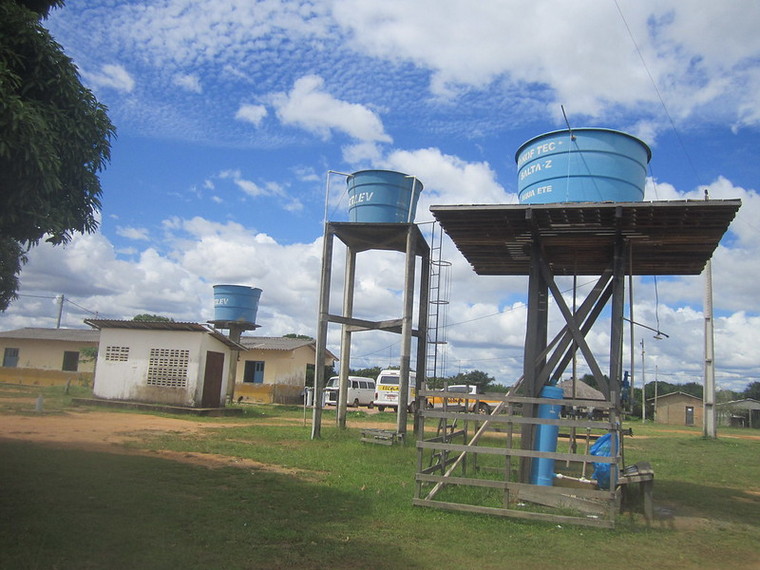
A photo of the three water tanks in the village of Darora, one of which holds water that is made potable by chemical treatment. The largest and longest building is the secondary school that serves the Macuxi indigenous community that lives in Roraima, in northern Brazil. CREDIT: Mario Osava/IPS

A photo of the three water tanks in the village of Darora, one of which holds water that is made potable by chemical treatment. The largest and longest building is the secondary school that serves the Macuxi indigenous community that lives in Roraima, in northern Brazil. CREDIT: Mario Osava/IPS

Achilles’ heel

Batteries still apparently limit the efficiency of solar energy in isolated or autonomous off-grid systems, with which the government and various private initiatives are attempting to make the supply of electricity universal and replace diesel generators.

Homero said that some of the Darora families who live outside the “center” of the village and have solar panels also had problems with the batteries.

Besides the 48 families in the village “center” there are 18 rural families, bringing the community’s total population to 265.

A solar plant was also installed in another community made up of 22 indigenous families of the Warao people, immigrants from Venezuela, called Warao a Janoko, 30 kilometers from Boa Vista.

But of the plant’s eight batteries, two have already stopped working after only a few months of use. And electricity is only guaranteed until 8:00 p.m.

“Batteries have gotten a lot better in the last decade, but they are still the weak link in solar power,” Aurelio Souza, a consultant who specializes in this question, told IPS from the city of São Paulo. “Poor sizing and the low quality of electronic charging control equipment aggravate this situation and reduce the useful life of the batteries.”

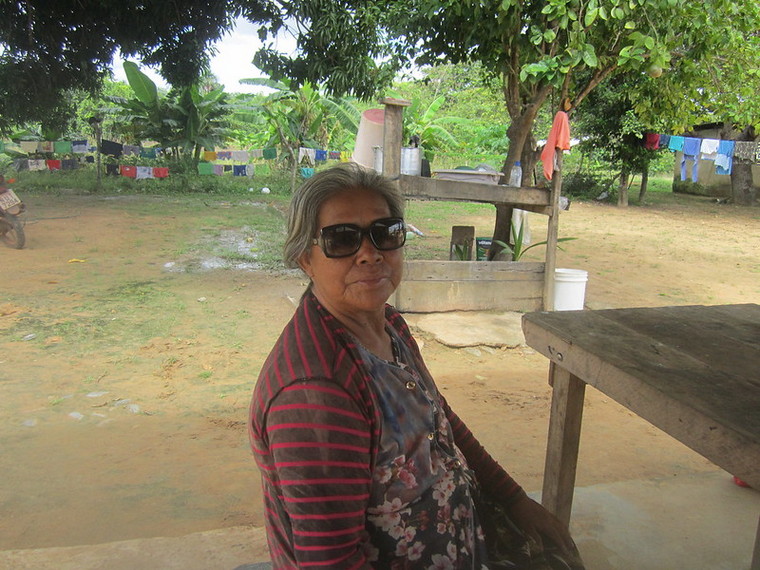
The low quality of the electricity supplied to Darora is due to the discrimination suffered by indigenous people, according to Adélia Augusto da Silva. The water they used to drink was also dirty and caused illnesses, especially in children, until the indigenous health service began to chemically treat their drinking water. CREDIT: Mario Osava/IPS

The low quality of the electricity supplied to Darora is due to the discrimination suffered by indigenous people, according to Adélia Augusto da Silva. The water they used to drink was also dirty and caused illnesses, especially in children, until the indigenous health service began to chemically treat their drinking water. CREDIT: Mario Osava/IPS

In Brazil’s Amazon jungle, close to a million people live without electricity, according to the Institute of Energy and the Environment, a non-governmental organization based in São Paulo. More precisely, its 2019 study identified 990,103 people in that situation.

Another three million inhabitants of the region, including the 650,000 people in Roraima, are outside the National Interconnected Electricity System. Their energy therefore depends mostly on diesel fuel transported from other regions, at a cost that affects all Brazilians.

The government decided to subsidize this fossil fuel so that the cost of electricity is not prohibitive in the Amazon region.

This subsidy is paid by other consumers, which contributes to making Brazilian electricity one of the most expensive in the world, despite the low cost of its main source, hydropower, which accounts for about 60 of the country’s electricity.

Solar energy became a viable alternative as the parts became cheaper. Initiatives to bring electricity to remote communities and reduce diesel consumption mushroomed.

But in remote plants outside the reach of the grid, good batteries are needed to store energy for the nighttime hours.

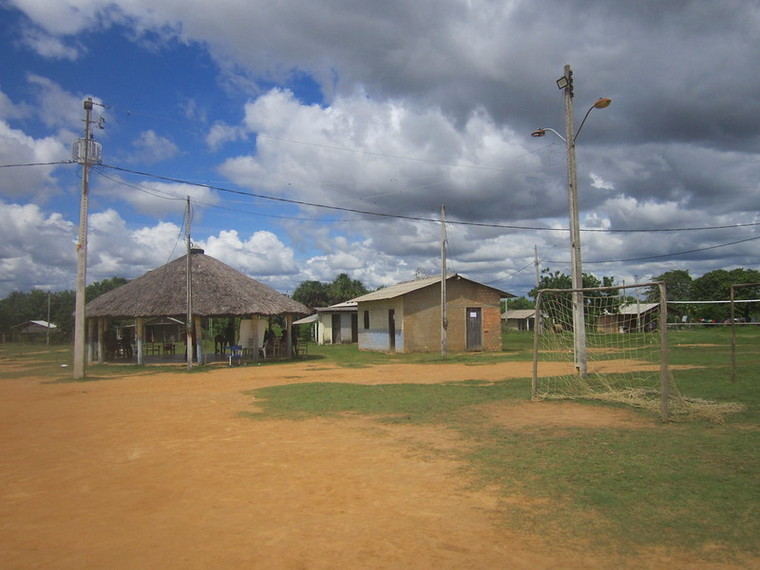
Part of the so-called "downtown" in Darora, which has lamp posts, houses, a soccer field and a shed where the community meets. A larger community center is needed, says the leader of the Macuxi village located near Boa Vista, the capital of the northern Brazilian state of Roraima. CREDIT: Mario Osava/IPS

Part of the so-called “downtown” in Darora, which has lamp posts, houses, a soccer field and a shed where the community meets. A larger community center is needed, says
the leader of the Macuxi village located near Boa Vista, the capital of the northern Brazilian state of Roraima. CREDIT: Mario Osava/IPS

A unique case

Darora is not a typical case. It is part of the municipality of Boa Vista, which has a population of 437,000 inhabitants and good resources, it is close to a paved road and is within a savannah ecosystem called “lavrado”.

It is at the southern end of the São Marcos indigenous territory, where many Macuxi indigenous people live but fewer than in Raposa Serra do Sol, Roraima’s other large native reserve. According to the Special Secretariat for Indigenous Health (Sesai), there were 33,603 Macuxi Indians living in Roraima in 2014.

The Macuxi people also live in the neighboring country of Guyana, where there are a similar number to that of Roraima. Their language is part of the Karib family.

Although there are no large forests in the surrounding area, Darora takes its name from a tree, which offers “very resistant wood that is good for building houses,” Homero explained.

The community emerged in 1944, founded by a patriarch who lived to be 93 years old and attracted other Macuxi people to the area.

The progress they have made especially stands out in the secondary school in the village “center”, which currently has 89 students and 32 employees, “all from Darora, except for three teachers from outside,” Homero said proudly.

A new, larger elementary and middle school for students in the first to ninth grades was built a few years ago about 500 meters from the community.

Water used to be a serious problem. “We drank dirty, red water, children died of diarrhea. But now we have good, treated water,” said Adélia da Silva.

“We dug three artesian wells, but the water was useless, it was salty. The solution was brought by a Sesai technician, who used a chemical substance to make the water from the lagoon drinkable,” Homero said.

The community has three elevated water tanks, two for water used for bathing and cleaning and one for drinking water. There are no more health problems caused by water, the tuxaua said.

His current concern is to find new sources of income for the community. Tourism is one alternative. “We have the Tacutu river beach 300 meters away, great fruit production, handicrafts and typical local gastronomy based on corn and cassava,” he said, listing attractions for visitors.

  Source

Deportees Start Businesses to Overcome Unemployment in El Salvador

Active Citizens, Civil Society, Economy & Trade, Editors’ Choice, Featured, Headlines, Human Rights, Labour, Latin America & the Caribbean, Migration & Refugees, Regional Categories, TerraViva United Nations

Migration & Refugees

Oscar Sosa cooks roast chicken and pork on an artisanal grill set up outside his small restaurant, Comedor Espresso, in the eastern Salvadoran city of San Francisco Gotera. Like many of the returnees, especially from the United States, he set up his own business, given the unemployment he found on his return to El Salvador. More than 10,000 people were deported to this Central American country between January and August 2022. CREDIT: Edgardo Ayala/IPS

Oscar Sosa cooks roast chicken and pork on an artisanal grill set up outside his small restaurant, Comedor Espresso, in the eastern Salvadoran city of San Francisco Gotera. Like many of the returnees, especially from the United States, he set up his own business, given the unemployment he found on his return to El Salvador. More than 10,000 people were deported to this Central American country between January and August 2022. CREDIT: Edgardo Ayala/IPS

SAN FRANCISCO GOTERA, El Salvador, Jan 10 2023 (IPS) – While grilling several portions of chicken and pork, Salvadoran cook Oscar Sosa said he was proud that through his own efforts he had managed to set up a small food business after he was deported back to El Salvador from the United States.


This has allowed him to generate an income in a country where unemployment affects 6.3 percent of the economically active population.

“Little by little we grew and now we also have catering services for events,” Sosa told IPS, as he turned the chicken and pork over with tongs on a small circular grill.

The grill is located outside the premises, so that the smoke won’t bother the customers eating inside.

It’s not easy, he said, to return home and to not be able to find a job. That is why he decided to start his own business, Comedor Espresso, in the center of San Francisco Gotera, a city in the department of Morazán in eastern El Salvador.

“You come back wanting to work and there aren’t any opportunities. The first thing they see in you is your age; when you’re over 35, they don’t hire you.” — Patricia López

In this Central American country of 6.7 million people, “comedores” are small, generally precarious, neighborhood restaurants where inexpensive, homemade meals are prepared.

Sosa’s, although very small, was clean and tidy, and even had air conditioning, when IPS visited it on Dec. 19.

Skills and capacity abound, but opportunities are scarce

Sosa, 35, is one of thousands of people deported from the United States every year.

He left in 2005 and was sent back in 2014. He worked for eight years as a cook at a Mexican restaurant in the city of Pensacola, in the southeastern state of Florida.

A total of 10,399 people were deported to this country between January and August 2022, which represents an increase of 221 percent compared to the same period in 2021, according to figures from the International Organization for Migration.

The flow of undocumented Salvadoran migrants, especially to the United States, intensified in the 1980s, due to the 1980-1992 civil war in El Salvador that left some 75,000 dead and around 8,000 forcibly disappeared.

At the end of the war, people continued to leave, for economic reasons and also because of the high levels of violent crime in the country.

An estimated 3.1 million Salvadorans live outside the country, 88 percent of them in the United States. And 50 percent of the Salvadorans in the U.S. are undocumented.

Despite the problem of unemployment, Sosa was not discouraged when he returned to his country.

“I feel that we are already growing, we have five employees, the business is registered in the Ministry of Finance, in the Ministry of Health, and I’m paying taxes,” he said.

Obviously, not all deportees have the support, especially financial, needed to set up their own business.

The stigma of deportation weighs heavily on them: there is a widespread perception that if they were deported it is because they were involved in some type of crime in the United States.

A government survey, conducted between November 2020 and June 2021, found that 50 percent of the deportees manage to open a business, 18 percent live off their savings, their partner’s income or support from their family, and 16 percent have part-time or full-time jobs.

In addition, seven percent live on remittances sent home to them, two percent receive income from property rentals, dividends or bank interests, and seven percent checked “other” or did not answer.

Apart from some government initiatives and non-governmental organizations that provide training and funds for start-ups, returnees have faced the specter of unemployment for decades.

Many return empty-handed and owe debts to the people smugglers who they hired to get into the United States as undocumented migrants.

In the case of Sosa, his brothers supported him to set up Comedor Espresso.

He also received a small grant of 700 dollars to purchase kitchen equipment.

The money came from a program financed with 87,000 dollars by the Salvadoran community abroad, through the Salvadoran Foreign Ministry.

The initiative, launched in 2019, aims to generate opportunities for returnees in four municipalities in eastern El Salvador, including San Francisco Gotera.

This region was chosen because most of the deportees reside here, according to Carlos Díaz, coordinator of the program on behalf of the San Francisco Gotera mayor’s office.

But the demand for support and resources exceeds supply.

“There was a database of approximately 350 returnees in Gotera, but there was only money for 55,” Díaz told IPS.

More than 200 people benefited in the four municipalities.

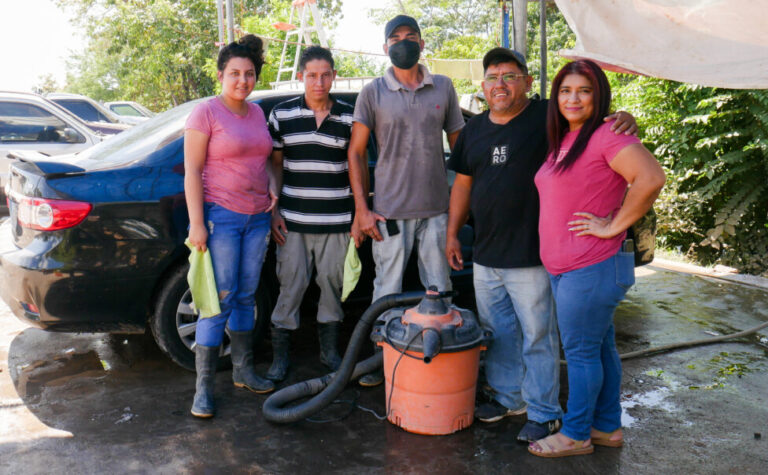
David Aguilar and Patricia López (right) set up their own business, El Tuco King Carwash, after they decided to return to El Salvador. Their business is located in the eastern part of the country, a region where more than 50 percent of returnees live. CREDIT: Edgardo Ayala/IPS

David Aguilar and Patricia López (right) set up their own business, El Tuco King Carwash, after they decided to return to El Salvador. Their business is located in the eastern part of the country, a region where more than 50 percent of returnees live. CREDIT: Edgardo Ayala/IPS

Hope despite a tough situation

Out of necessity, David Aguilar and Patricia López, 52 and 42, respectively, also set up their own business, in their case a car wash, after deciding to return to El Salvador. It’s called Tuco King Carwash.

Like Sosa, they are from San Francisco Gotera. Aguilar left the country in November 2005 and López three months later, in February 2006.

They made the risky journey to try to give their young daughter – six months old at the time, and today 17 years old – a better future.

One leg of the trip was by sea, on the Pacific Ocean off the coast of Mexico.

“I spent 12 hours at sea, in a boat carrying about 20 people, who were all undocumented like me,” Aguilar said.

He added: “The only thing they gave us as lifesavers were a few plastic containers, in case the boat capsized.”

It was in Houston, in the state of Texas, that Aguilar found work in a car paint shop. The experience has been useful to him back in El Salvador, because in addition to washing cars, he offers paint jobs and other related services.

Aguilar and López were not deported; they decided to return because her father died in 2011. They came back in 2012, without having seen many of their dreams come true.

“You come back wanting to work and there aren’t any opportunities. The first thing they see in you is your age; when you’re over 35, they don’t hire you,” López said.

Before embarking on the trip to the United States, she had finished her degree as a primary school teacher, in 2005. But she never worked as a teacher because she left the following year.

“When I returned I applied to various teaching positions, but no one ever hired me,” she said.

Today, their carwash business, set up in 2014, is doing well, albeit with difficulties, because the couple have found that there is too much competition.

But they do not lose hope that they will succeed.

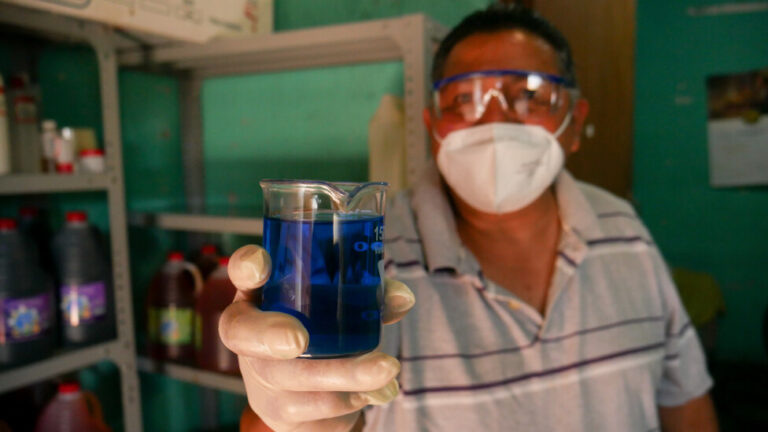
Former Salvadoran guerrilla David Henríquez, deported from the United States in 2019, shows the quality of the disinfectant he has just produced in his small artisanal workshop in San Salvador. With no chance of finding formal employment after deportation, he worked hard to set up his disinfectant business to generate an income. CREDIT: Edgardo Ayala/IPS

Former Salvadoran guerrilla David Henríquez, deported from the United States in 2019, shows the quality of the disinfectant he has just produced in his small artisanal workshop in San Salvador. With no chance of finding formal employment after deportation, he worked hard to set up his disinfectant business to generate an income. CREDIT: Edgardo Ayala/IPS

An ex-guerrilla chemist

David Henríquez, a 62-year-old former guerrilla fighter, was deported in 2019.

During the civil war, Henríquez was a combatant of the then insurgent Farabundo Martí National Liberation Front (FMLN), but when peace came he decided to emigrate to the United States in 2003 as an undocumented immigrant.

With no hope of finding a formal sector job here, he began to make cleaning products, a skill he learned in the United States.

In the 12 years that he lived there, he worked for two years at the Sherwin Williams plant, a global manufacturer of paints and other chemicals.

“It was there that I began to discover the world of chemical compositions and aromas,” Henríquez told IPS during a visit to his small workshop in the Belén neighborhood of San Salvador, the capital.

Henríquez was producing a 14-gallon (53-liter) batch of blue disinfectant with the scent of baby powder. He also makes disinfectant smelling like cinnamon and lavender, among others. His business is called El Dave de los aromas.

His production process is still artisanal, although he would know how to produce disinfectant with high-tech machinery, if he had it, he said, “as I did at Sherwin Williams.”

He used a baby bottle to measure out the 3.5 ounces (104 milliliters) of nonylphenol, the main chemical component, used to produce 14 gallons.

Henríquez dissolved other chemicals in powder, to get the color and the aroma, and the product was ready.

He produces about 400 gallons a month, 1,514 liters, at a price of 3.50 dollars each.

“The important thing is to have discipline, work hard, to shine with your own effort,” he said.

  Source

Thoughts for 2023: Promoting Innovation & New Technologies

Civil Society, COVID-19, Development & Aid, Featured, Global, Global Governance, Headlines, Human Rights, TerraViva United Nations

Opinion

Patients seeking treatment at the Redemption Hospital in Monrovia, Liberia. Credit: World Bank/Dominic Chavez

 
The UN agency devoted to ending AIDS as a public health threat has called on top politicians and governments across the world to ensure the right to quality healthcare is upheld, and not just a privilege to be enjoyed by the wealthy.

NEW YORK, Dec 20 2022 (IPS) – Promoting innovation and technology to promote inclusive development means using new technologies to enhance equal access to services, eliminate discrimination, increase transparency, and create a stable and just future for all – especially the most vulnerable and marginalized.


Obviously, the rule of law is a key driver of inclusive, equitable, and sustainable development, and empowers people from all strata of life to seek and obtain justice. Doing more with less is posing a challenge here. We are operating in an increasingly connected yet complex global and national settings and fiscally fragile environment.

Our traditional structures, systems and processes are proving to be inadequate to deal with new developmental challenges, pandemics, inaccessibility and exclusions, conflicts, and humanitarian crisis. Our governance and justice systems are not the most transparent and data friendly domain. Bringing that information to light is no easy task.

Barriers to Governance and Rule of Law

As indicated before, there are many barriers to accessing public services and ensuring accessible public health, rule of law, especially where there are high levels of poverty, marginalization, and insecurity. Governance institutions – formal and informal – may be biased or discriminatory. Public governance systems may be ineffective, slow, and untrustworthy.

In the last 3 years of pandemic, we also realized our public health system is often crippled by lack of investment, inclusive and accessible initiatives, and innovation. Discriminatory decision making and exclusivity further complicated the situation at all levels. People may lack knowledge about their rights.

Often legal assistance and consumer protection are out of reach, leaving people with little recourse to formal mechanisms for protection and empowerment. There may be a culture of impunity for criminal acts, unacceptable level of tolerance for exclusionary practices.

Other discriminations, injustices, and abuses in the family, or through deprivation and labour exploitation, may go unaddressed. Despite all these, more can be done to ensure that they benefit from the inclusive governance and public health work, and, rule of law practices, which expand their opportunities and choices.

Quest for New Ideas …

Despite all these, more can be done to ensure that the most vulnerable and disadvantaged groups benefit from inclusive public health, legal empowerment, and access to justice, which expand their opportunities and choices.

We need fresh ideas, resources, and unconventional ways of collecting and analyzing data, such as using micro-narratives or innovative, accessible public hearings, targeted consultations, to complement traditional mechanisms including surveys. But innovation is rapidly becoming the new buzzword, so I would be careful in applying it here:

    • Innovation is not cost-free and takes time so it should be mainstreamed:
    • Innovation is both science and arts. And it should be seen as a standalone practice. one of the biggest problems that public sector innovation faces today is that governments have de facto created a ‘class of innovators,’ rather than making innovation an inclusive process that is open to anyone who has the motivation and capacity to influence change. This must change.
    • Repackaging or reproduction is not innovation unless it caters to the specific needs of vulnerable and marginalized communities which are not supported by existing mechanisms and services.
    • What is innovative in Bangladesh, Turkey, and Tanzania may not be so in India, Turkmenistan, Senegal, or Mexico;
    • Big data is important but harnessing it for the right cause should be central consideration. Linking it with better evidence base is of critical significance. The COVID-19 challenges amply demonstrated it.
    • Going beyond social networking is key – while Facebook, Twitter and other Social Media outlets play an admirable role in connecting people, these are not enough to solving a protracted problem and sustaining a solution. We must also be mindful of the recent trend of using social media to silence public defenders, journalists, and whistle blowers. The twitter is a case in point (December 2022).
    • Innovative ideas, while refreshing, need to be pragmatic so that they can be implemented. They mast be part of a solution, not the overall problem.
    • Evidence of impact is more important than the novelty factor.

Innovation and New Technologies for Solutions

My own take is that ideas do not need to be always transformational or revolutionary. Our platforms can replicate or even recycle what already works by introducing successful models to new actors and environments.

Even seemingly ordinary things can become innovative in different terms, approaches, or settings. linking inclusion to innovation is not only about looking at how it can advance policies and create better impact for governments, but also about giving people, public servants, and citizens alike, the self-efficacy, power, and freedom to direct change in the way they see necessary. This contributes directly to the making of inclusive development.

New technologies are changing the lives of people around the world. In the same way that they make daily tasks simpler, they can make official and routine interactions with government institutions, service providers easier and can provide innovative solutions to a host of public sector governance, public health, and rule of law challenges.

Technology has an immense untapped potential to strengthen inclusive practices for governance including public health governance, and the rule of law. Technological innovation must provide equal access to services, help to eliminate discrimination, and assure more transparency and accountability. They must not be used to silence voices, deny human rights, or create justifications for maladministration, inaccessibility, and exclusions.

As we are approaching 2023 in a few days, let us hope for a more inclusive and diverse public sector governance rooted in human rights values and practices.

Dr. A.H. Monjurul Kabir, currently UN System Coordination Adviser and Global Team Leader for Gender Equality, Disability Inclusion/Intersectionality at UN Women HQ in New York, is a thought leader, political scientist and senior policy and legal analyst on global issues and regional trends. For policy and academic purpose, he can be contacted at monjurulkabir@yahoo.com. He can be followed in twitter at mkabir2011

IPS UN Bureau

  Source

Digital Treatment of Genetic Resources Shakes Up COP15

The executive secretary of the Convention on Biological Diversity, Elizabeth Maruma Mrema, highlighted on Friday Dec. 16 the results of the Nagoya Protocol on access to genetic resources and fair benefit sharing at an event during COP15 in the Canadian city of Montreal. But the talks have not reached an agreement on the digital sequencing of genetic resources. CREDIT: Emilio Godoy/IPS

The executive secretary of the Convention on Biological Diversity, Elizabeth Maruma Mrema, highlighted on Friday Dec. 16 the results of the Nagoya Protocol on access to genetic resources and fair benefit sharing at an event during COP15 in the Canadian city of Montreal. But the talks have not reached an agreement on the digital sequencing of genetic resources. CREDIT: Emilio Godoy/IPS

By Emilio Godoy
MONTREAL, Dec 16 2022 (IPS)

In addition to its nutritional properties, quinoa, an ancestral grain from the Andes, also has cosmetic uses, as stated by the resource use and benefit-sharing permit ABSCH-IRCC-PE-261033-1 awarded in February to a private individual under a 15-month commercial use contract.


The permit, issued by the Peruvian government’s National Institute for Agrarian Innovation, allows the Peruvian beneficiary to use the material in a skin regeneration cream.

But it also sets restrictions on the registration of products obtained from quinoa or the removal of its elements from the Andean nation, to prevent the risk of irregular exploitation without a fair distribution of benefits, in other words, biopiracy.”The scientific community is willing to share benefits through simple mechanisms that do not unfairly burden researchers in low- and middle-income countries.” — Amber Scholz

The licensed material may have a digital representation of its genetic structure which in turn may generate new structures from which formulas or products may emerge. This is called digital sequence information (DSI), in the universe of research or commercial applications within the CBD.

Treatment of DSI forms part of the debates at the 15th Conference of the Parties (COP15) to the United Nations Convention on Biological Diversity (CBD), which began on Dec. 7 and is due to end on Dec. 19 at the Palais des Congrès in the Canadian city of Montreal.

The summit has brought together some 15,000 people representing the 196 States Parties to the CBD, non-governmental organizations, academia, international bodies and companies.

The focus of the debate is the Post-2020 Global Framework on Biodiversity, which consists of 22 targets in areas including financing for conservation, guidelines on digital sequencing of genetic material, degraded ecosystems, protected areas, endangered species, the role of business and gender equality.

Like most of the issues, negotiations on DSI and the sharing of resulting benefits, contained in one of the Global Framework’s four objectives and in target 13, are at a deadlock, on everything from definitions to possible sharing mechanisms.

Except for the digital twist, the issue is at the heart of the Nagoya Protocol on Access to Genetic Resources and the Fair and Equitable Sharing of Benefits Arising from their Utilization, part of the CBD, signed in that Japanese city in 2010 and in force since 2014.

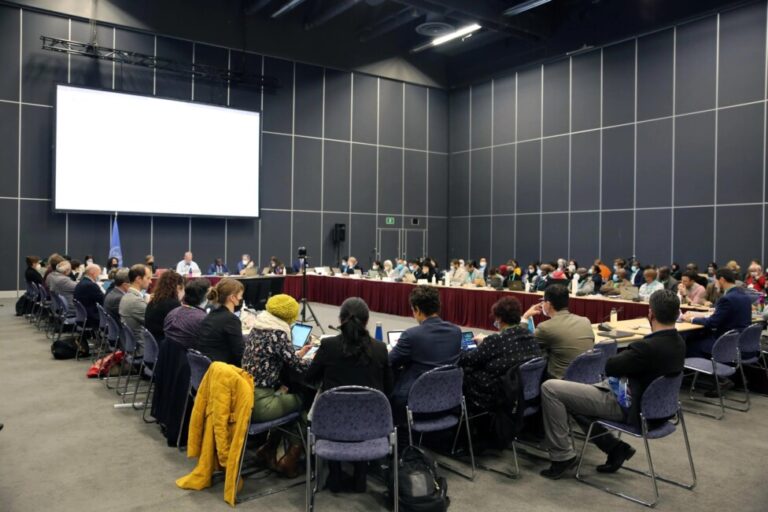
The delegations of the 196 States Parties to the Convention on Biological Diversity have failed to make progress at COP15 in the negotiations on new targets for the protection of the world's natural heritage, in the Canadian city of Montreal. In the picture, a working group reviews a proposal on the complex issue. CREDIT: IISD/ENB

The delegations of the 196 States Parties to the Convention on Biological Diversity have failed to make progress at COP15 in the negotiations on new targets for the protection of the world’s natural heritage, in the Canadian city of Montreal. In the picture, a working group reviews a proposal on the complex issue. CREDIT: IISD/ENB

Amber Scholz, a German member of the DSI Scientific Network, a group of 70 experts from 25 countries, said there is an urgent need to close the gap between the existing innovation potential and a fair benefit-sharing system so that digital sequencing benefits everyone.

“It’s been a decade now and things haven’t turned out so well. The promise of a system of innovation, open access and benefit sharing is broken,” Scholz, a researcher at the Department of Microbial Ecology and Diversity in the Leibniz Institute’s DSMZ German Collection of Microorganisms and Cell Cultures, told IPS.

DSI stems from the revolution in the massive use of technological tools, which has reached biology as well, fundamental in the discovery and manufacture of molecules and drugs such as those used in vaccines against the coronavirus that caused the COVID-19 pandemic.

The Aichi Biodiversity Targets, adopted in 2010 in that Japanese city during the CBD COP10, were missed by the target year, 2020, and will now be renewed and updated by the Global Framework that will emerge from Montreal.

The targets included respect for the traditional knowledge, innovations and practices of indigenous and local communities related to the conservation and sustainable use of biological diversity, their customary use of biological resources, and the full and effective participation of indigenous and local communities in the implementation of the CBD.

Lack of clarity in the definition of DSI, challenges in the traceability of the country of origin of the sequence via digital databases, fear of loss of open access to data and different outlooks on benefit-sharing mechanisms are other aspects complicating the debate among government delegates.

Through the Action Agenda: Make a Pledge platform, organizations, companies and individuals have already made 586 voluntary commitments at COP15, whose theme is “Ecological civilization: Building a shared future for all life on earth”.

Of these, 44 deal with access and benefit sharing, while 294 address conservation and restoration of terrestrial ecosystems, 185 involve partnerships and alliances, and 155 focus on adaptation to climate change and emission reductions.

Genetic havens

Access to genetic resources for commercial or non-commercial purposes has become an issue of great concern in the countries of the global South, due to the fear of biopiracy, especially with the advent of digital sequencing, given that physical access to genetic materials is not absolutely necessary.

Although the Nagoya Protocol includes access and benefit-sharing mechanisms, digital sequencing mechanisms have generated confusion. In fact, this instrument has created a market in which lax jurisdictions have taken advantage by becoming genetic havens.

Around 2,000 gene banks operate worldwide, attracting some 15 million users. Almost two billion sequences have been registered, according to statistics from GenBank, one of the main databases in the sector and part of the U.S. National Center for Biotechnology Information.

Argentina leads the list of permits for access to genetic resources in Latin America under the Protocol, with a total of 56, two of which are commercial, followed by Peru (54, four commercial) and Panama (39, one commercial). Mexico curbed access to such permits in 2019, following a scandal triggered by the registration of maize in 2016.

There are more than 100 gene banks operating in Mexico, 88 in Peru, 56 in Brazil, 47 in Argentina and 25 in Colombia.

The largest providers of genetic resources leading to publicly available DSI are the United States, China and Japan. Brazil ranks 10th among sources and users of samples, according to a study published in 2021 by Scholz and five other researchers.

The mechanisms for managing genetic information sequences have become a condition for negotiating the new post-2020 Global Framework for biodiversity, which poses a conflict between the most biodiverse countries (generally middle- and low-income) and the nations of the industrialized North.

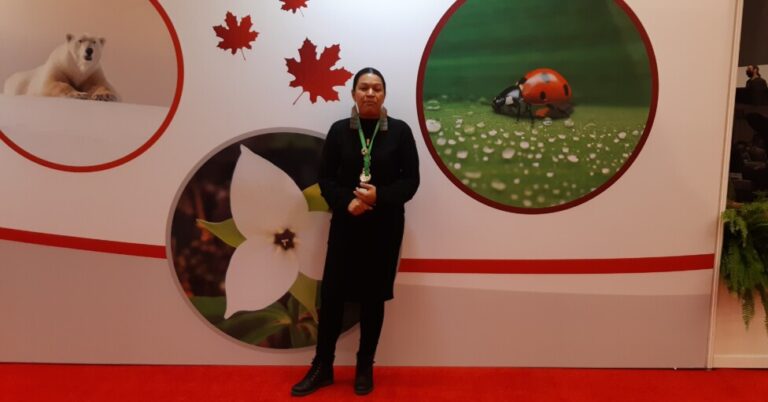
Brazilian indigenous activist Cristiane Juliao, a leader of the Pankararu people, calls for a fair system of benefit-sharing for access to and use of genetic resources and their digital sequences at COP15, being held at the Palais des Congrès in the Canadian city of Montreal. CREDIT: Emilio Godoy/IPS

Brazilian indigenous activist Cristiane Juliao, a leader of the Pankararu people, calls for a fair system of benefit-sharing for access to and use of genetic resources and their digital sequences at COP15, being held at the Palais des Congrès in the Canadian city of Montreal. CREDIT: Emilio Godoy/IPS

Indigenous people and their share

Cristiane Juliao, an indigenous woman of the Pankararu people, who is a member of the Brazilian Coordinator of Indigenous Peoples and Organizations of the Northeast, Minas Gerais and Espírito Santo, said the mechanisms adopted must favor the participation of native peoples and guarantee a fair distribution of benefits.

“We don’t look at one small element of a plant. We look at the whole context and the role of that plant. All traditional knowledge is associated with genetic heritage, because we use it in food, medicine or spiritual activities,” she told IPS at COP15.

Therefore, she said, “traceability is important, to know where the knowledge was acquired or accessed.”

In Montreal, Brazilian native organizations are seeking recognition that the digital sequencing contains information that indigenous peoples and local communities protect and that digital information must be subject to benefit-sharing. They are also demanding guarantees of free consultation and the effective participation of indigenous groups in the digital information records.

Thanks to the system based on the country’s Biodiversity Law, in effect since 2016, the Brazilian government has recorded revenues of five million dollars for permits issued.

The Working Group responsible for drafting the new Global Framework put forward a set of options for benefit-sharing measures.

They range from leaving in place the current status quo, to the integration of digital sequence information on genetic resources into national access and benefit-sharing measures, or the creation of a one percent tax on retail sales of genetic resources.

Lagging behind

There is a legal vacuum regarding this issue, because the CBD, the World Intellectual Property Organization and the International Treaty on Plant Genetic Resources for Food and Agriculture, in force since 2004, do not cover all of its aspects.

Scholz suggested the COP reach a decision that demonstrates the political will to establish a fair and equitable system. “The scientific community is willing to share benefits through simple mechanisms that do not unfairly burden researchers in low- and middle-income countries,” she said.

For her part, Juliao demanded a more inclusive and fairer system. “There is no clear record of indigenous peoples who have agreed to benefit sharing. It is said that some knowledge comes from native peoples, but there is no mechanism for the sharing of benefits with us.”

IPS produced this article with support from Internews’ Earth Journalism Network.