Simita Devi, whose daughter spent days in hospital recently suffering from typhoid caused by contaminated water, collects clean water brought to the surface by a solar pump. Credit: Umar Manzoor Shah/IPS
By Umar Manzoor Shah Champad, India, Jul 4 2023 (IPS)
Simita Devi spent over ten days in a government-run hospital a year ago anxiously watching her critically ill nine-year-old daughter, Gudiya, who was diagnosed with typhoid.
Gudiya was so sick she even went into a coma for a day. Medical staff attending to the child said she contracted the disease from drinking contaminated water.
After being discharged, Devi’s main worry was to get safe drinking water for her ailing daughter.
She was advised not to consume water from village wells or untested sources like river streams or springs.
Hailing from Champad, a tribal village in India’s Jharkhand state, Devi works as a daily wage labourer alongside her husband. With a limited income, Devi couldn’t afford packaged drinking water for her daughter.
She then decided to boil the water using firewood to make it safe to drink. But to get the firewood, she had to trek the treacherous terrains of the nearby forests – a long, difficult work and the fear of wild animals loomed.
It was not Devi alone impacted by contaminated water, it was making many people in her village ill, and there was nothing the inhabitants could do about it.
According to government records, 80% of India’s rural drinking water comes from underground sources. One-third of India’s 600 districts do not have safe drinking water because fluoride, iron, salinity, and arsenic concentrations exceed tolerance levels. India’s water quality is poor, ranking at 120 of 122 nations.
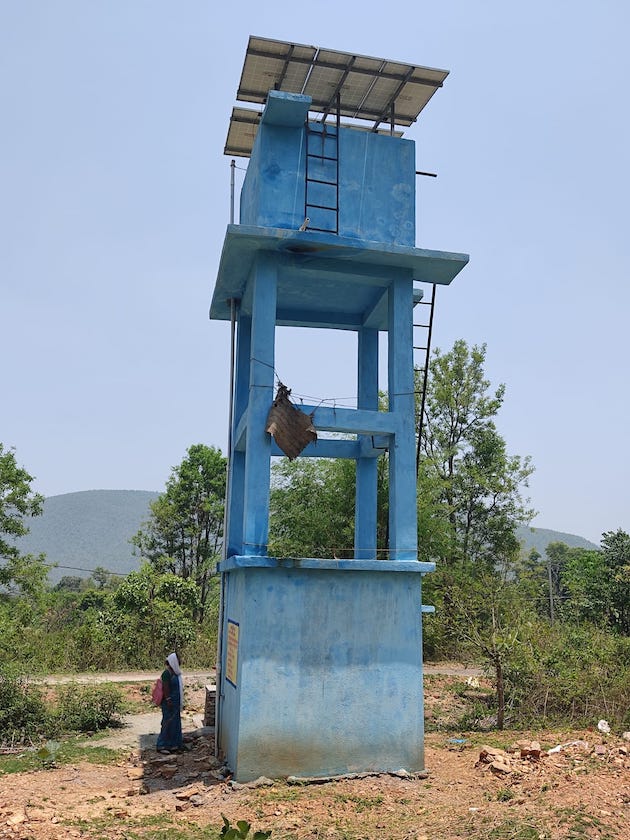
The solar panels on the water tower have meant clean waters for the villagers of Champad, a tribal village in India’s Jharkhand. Credit: Umar Manzoor Shah/IPS
Experts believe that the source of these heavy metals is industrial waste being dumped untreated into water systems and nitrates which surface due to excessive and prolonged use of fertilizers. The government estimates that every year, over one lakh (100,000) people die of waterborne diseases in the country.
Champad, a village inhabited by a tribal community, has 105 households per the 2011 census. Until 2022, the community depended on only two tube wells as their source of drinking water. However, these tube wells often experienced malfunctions, leaving the villagers with no choice but to fetch water from a nearby river or pond. Consequently, there has been a rise in waterborne diseases, particularly affecting the health of women and children. The need to travel long distances for safe drinking water has increased women’s workload, increasing their workload.
Perturbed by the threat of waterborne diseases, the village locals congregated earlier this year to try to find a solution. They at first visited the local politicians for help. Then they headed towards government offices. “Nothing happened—absolutely nothing. We were virtually left high and dry. Except for God, no one is there to help us. At times, we were told to wait, and at times, we were told that government funding wasn’t available. But we were slowly dying. Our children are suffering in front of our own eyes,” Ram Singh, a local villager at Champad, told IPS.
Earlier this year, a team from a non-governmental agency working to uplift rural areas in India visited the village to assess the villagers’ hardships.
The agency then mooted the idea of a solar water tower in the village. The villagers were made aware of the process involved in the tower’s construction and that government approval for the facility was needed.
The village representatives were taken on board, and a proposal was submitted to the water department of the district.
“Government liked the idea, and it was readily approved. The entire village worked together to make the project a success story,” says a member of the humanitarian agency who wished to remain anonymous.
The towers were equipped with solar panels, enabling them to operate sustainably and with minimal environmental impact. The selection of sites for the towers was a collaborative effort involving the village communities. The first solar water tower was constructed in February 2023, while work on the other two towers is still ongoing. As a result, 45 families now directly benefit from the convenience of having clean drinking water channelled to their homes through pipelines. The water provided is of good quality and considered safe, in contrast to the open well water that was previously relied upon. This development has significantly alleviated the burden on women, who no longer have to travel long distances to fetch water from various sources.
The impact of this intervention was significant. The community’s health improved, and they were no longer at risk of waterborne illnesses. The women and children, who were often responsible for collecting water from distant sources, could now spend their time on other activities. The community’s overall quality of life improved, and they could focus on their livelihoods and education.
For Simita Devi, the facility is no less than a major solace in her life. She excitedly uses this water for drinking and thanks God for such an endeavour.
“Safe water means life for us. The solar tower has become a messiah for poor villagers like us. We will cherish the moments for life when we find its water coming to our homes,” Devi told IPS.
Yohei Sasakawa, WHO’s Goodwill Ambassador for Leprosy Elimination, speaks at the two-day Bergen International Conference on Hansen’s Disease. The conference coincided with the 150th anniversary of the discovery of Mycobacterium leprae by Norwegian doctor Gerhard Armauer Hansen. Credit: Thor Brødreskift/Sasakawa Leprosy (Hansen’s Disease) Initiative
By Joyce Chimbi NAIROBI, Jun 22 2023 (IPS)
The 1873 discovery of Mycobacterium leprae, the causative agent of leprosy by Norwegian doctor Gerhard Armauer Hansen, remains one of the greatest paradigm shifts in medical history, a true revolution.
“Before the great discovery, even in the days when communication and transportation technologies were not as developed as today, leprosy was detested by the entire world. Leprosy was believed to be a divine punishment or a hereditary disease; once affected, patients were segregated to remote areas and islands for life,” says Yohei Sasakawa, WHO’s Goodwill Ambassador for Leprosy Elimination.
Sasakawa, who also serves as chairperson of The Nippon Foundation, spoke during a two-day conference in Bergen, Norway, to commemorate the 1873 discovery. In attendance were over 200 people, including medical, human rights, and historical preservation experts, researchers, NGOs, and organizations of persons affected by the disease.
The Bergen International Conference on Hansen’s Disease, held on June 21 and 22, 2023, was organized by the Sasakawa Leprosy (Hansen’s Disease) Initiative and the University of Bergen. It focused on medical efforts against leprosy, human rights, and dignity issues and preserving the history of leprosy for the lessons it can teach future generations. All three are pillars of the Sasakawa Leprosy (Hansen’s Disease) Initiative’s activities for a world free of leprosy and the discrimination it causes, in line with the UN’s Resolution on Elimination of discrimination against persons affected by leprosy and their family members.
In his speech to delegates, Sasakawa acknowledged the extraordinary advances made by medical professionals since Dr Hansen’s discovery that leprosy was neither a curse nor a punishment from God but a chronic disease caused by a bacillus.
With the 1873 discovery, leprosy went from being a mythological divine disease shrouded in mystery to something one could observe and explain—although it would take more than half a century before a cure was found.
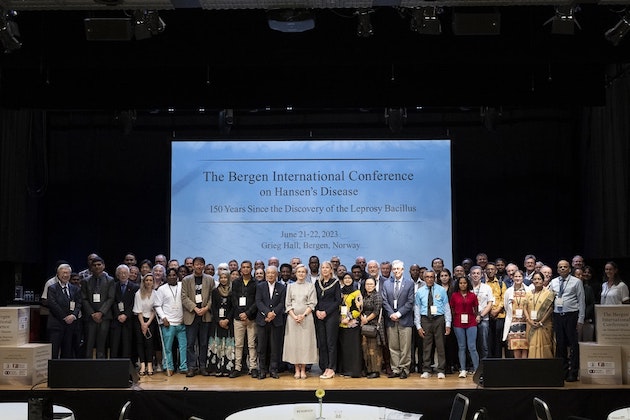
Delegates at the Bergen International Conference on Hansen’s Disease held on June 21 and 22, 2023. The conference was organized by the Sasakawa Leprosy (Hansen’s Disease) Initiative and the University of Bergen. Credit: Thor Brødreskift/Sasakawa Leprosy (Hansen’s Disease) Initiative
Margareth Hagen, Rector, University of Bergen, said there was a clear shift in the scientific discourse about leprosy before and after the discovery.
Sasakawa said the journey towards a cure started with a single anti-leprosy drug to more effective drug regimens and, ultimately, a recommendation from WHO’s medical team that leprosy patients receive drug regimens consisting of multiple drugs.
“A single anti-leprosy drug tended to increase drug resistance. Since the development of multi-drug therapy, with early detection and treatment, leprosy has become totally curable. About 60 million patients have been cured over the last 40 years,” he said.
Abbi Patrix, the great-grandson of Dr Hansen, now responsible for his great grandfather’s history, spoke about the man behind the science in a session titled, ‘My grandfather, my mother, the documents and me.’
Patrix, a European performance storyteller, talked about the day his mother, the only direct descendant of Dr Hansen at the time, learned that leprosy was named Hansen’s disease after her grandfather.
She was moved and wondered why? His mother was informed that Dr Hansen’s discovery had put a name to a disease that had confounded scientists and society alike and that labeling it ‘Hansen’s disease’ meant freedom for those afflicted because a cure could now be found.
The conference venue was, therefore, a recognition of his renowned great-grandfather because he was born in Bergen, and this was the site for his landmark 1873 discovery at only 32 years of age.
WHO Director-General Dr Tedros Adhanom Ghebreyesus told the audience: “WHO was born halfway between 1873 and today, 75 years ago. Much progress has been made since the two major milestones in the fight against leprosy. But much remains to be done toward our shared goals of zero disease, zero disability, and zero discrimination. Cases of leprosy have decreased significantly in recent decades, but more effort is needed to recover from the health system disruptions of the COVID-19 pandemic and move further ahead.”
Ghebreyesus said the WHO was committed to supporting countries in their bid to eliminate leprosy in line with the roadmap for neglected tropical disease for 2021 to 2030.
“So far, 49 countries have eliminated at least one neglected tropical disease, including Human African trypanosomiasis, rabies, and trachoma. With your support and those of our global partners, we can achieve that goal for leprosy too.”
Other dignitaries who spoke at the conference include United Nations High Commissioner for Human Rights Volker Türk, who said the conference celebrated medical innovations over the last 150 years.
“But when leprosy was eliminated as a global public health problem in 2000, it did not mean that the disease disappeared. Over 250,000 people suffer from leprosy every year, 15,000 of them are children. The actual figures are likely far higher,” he emphasized.
“Around three to four million people who have already been cured still bear varying degrees of impairment. The burden of leprosy is heaviest in countries with the greatest inequality, poverty, and marginalization.”
Türk further said that to better the lives of people affected by leprosy, “We need to address the physical symptoms, but we also need social and behavioral measures to address stigma and discrimination. We need comprehensive strategies with access to quality care, education, and social protection,” and told participants that “together we can make a real difference in ending leprosy, which causes immense preventable and unjustifiable suffering for thousands of people.”
Against this backdrop, Sasakawa stressed that further action is needed to combat stigma and discrimination, pointing out that as many as 130 discriminatory laws against leprosy are still in place in more than 20 countries.
“When respect for human rights is a must, it is unacceptable to leave such a large-scale and serious human rights violation unaddressed,” he said.
As the curtain fell on the Bergen conference of a remarkable journey to end leprosy over the last 150 years, Dr Takahiro Nanri, executive director of Sasakawa Health Foundation, noted that this was the third international conference that the foundation has helped to organize since launching its “Don’t Forget Leprosy” campaign in 2021 to help to ensure that the disease and those affected by it are not overlooked amid the coronavirus pandemic.
“Our purpose in organizing these conferences is to make the world aware that there are still many people who have Hansen’s disease and its consequences; to build momentum for collaboration toward the realization of a leprosy-free world; and to provide a setting for both formal and informal exchanges that can be a catalyst for innovative solutions that we as a foundation are ready to support,” he said.
Irene Grace says human rights defenders hiding in Kenya fear harassment and intimidation due to a decline in civic rights. Credit: Joyce Chimbi/IPS
By Joyce Chimbi NAIROBI, Jun 20 2023 (IPS)
While leaving one’s country and becoming a refugee is a last resort, it is a decision that many, like Steve Kitsa, have had to make. As conflict becomes increasingly protracted in many African countries, many others will take this step.
“In a matter of life and death, I fled the Democratic Republic of Congo (DRC) five years ago and left my elderly mother behind. One day we were seated in a group of young men, chatting and enjoying the morning sun, when a lone gunman in uniform approached us and started firing away unprovoked. Such incidences had become too common in the eastern region, and some of my friends were killed,” Kitsa tells IPS.
Kenya hosts one of the largest refugee populations in Africa. Kitsa is one of more than 520,000 registered refugees and asylum seekers. But human rights defender Irene Grace, who fled Uganda two years ago, says the number is much higher because borders are porous.
Nevertheless, official records show that about 287,000 refugees come from Somalia, 142,000 from South Sudan, 50,000 from DRC, and 32,000 from Ethiopia; many live in Dadaab and Kakuma camps.
Others, like Kitsa, have found their way into the urban centers of Nairobi, Kisumu, Mombasa, and Eldoret. Outdated statistics from 2017 indicate that more than 67,267 refugees live in Nairobi.
“There is a lot of exploitation because we need the locals to survive. Along the highways, you will find many young men hawking peanuts. You can tell they are from DRC because of the kind of Swahili they speak. They sell these peanuts under the hot sun, all day, every day, in exchange for a plate of food and somewhere to sleep as the profits go to the host. Most of us are desperate to go to France,” he explains.
Irene Grace fled Uganda for promoting the rights of the LGBTQI community as the country clamped down on their rights. As the government-endorsed crackdown against the community intensified, so did threats against her life.
“The issue of human rights defenders in exile is one aspect of the refugee situation that is hardly ever talked about. The risk is very high because you are under an alias in a foreign country, and if murdered, you are likely to remain unidentified for a long time, and it might take years to connect the dots. The question of who bears the duty of protection for us remains unanswered,” Grace says.
Her fears and concerns reflect the 2022 report findings by the global civil society alliance, CIVICUS, and the Kenya Human Rights Commission (KHRC), highlighting the decline in civil rights in Kenya. According to the report, the government was using excessive force to quieten dissent.
Kenya was placed on the CIVICUS Monitor’s human rights ‘Watchlist’ in June 2022. The Watchlist highlights countries with a recent and steady decline in civic freedoms, including the rights of free speech and peaceful assembly.
Kenya was rated Obstructed by the CIVICUS Monitor. There are 42 countries in the world with this rating. The rating is typically given to countries where power holders heavily contest civic space and impose a combination of legal and practical constraints on the full enjoyment of fundamental rights.
In 2021, Front Line Defenders released a report accusing the governments of Uganda and Kenya of giving the South Sudanese National Security Service (NSS) intelligence agency the freedom to target refugee human rights workers who fled the country.
“It is very difficult to continue with activism in such a hostile environment, on top of the many other challenges confronting us, such as a lack of documentation and access to services. Some of us left our families behind, exposed and unprotected. Over the eight years, I have lived in Kenya, I have received many threatening calls from South Sudan, but I know the information of my whereabouts came from within this country,” Deng G, an activist from South Sudan, tells IPS.
“Our situation worsens when local activists are targeted. In exile, you must connect with local networks to survive and continue with your activism. I am aware of activists in Kenya currently being held without trial for protesting against the high cost of living.”
KHRC continues to express concerns over the misuse of laws to undermine peaceful protest and recently responded with speed when five activists from the Social Justice Center, a Nairobi-based grassroots group, were arrested during a peaceful protest against the controversial Finance Bill 2023.
A pre-independence Public Order Act requires activists to notify authorities of protests at least three days in advance. Police have mistakenly understood the provision as a requirement for protests to be approved or denied, using it as an excuse to deem protests ‘unpermitted.’ Even though the right to peaceful assembly is guaranteed in Kenya’s constitution, it is continually undermined, says CIVICUS and KHRC.
Irene Grace says ongoing hostilities have derailed efforts to promote the safety and security of LGBTQI asylum seekers and refugees in the Kakuma Refugee Camp complex in northwestern Kenya whose lives are at risk. She says they are experiencing discrimination, and physical and sexual violence, among other forms of human rights violations.
“I am unable to travel there to determine how we can mobilize and improve their safety, working hand in hand with grassroots activists in Kenya. There are corrupt security officers, and once they discover you are hiding in the country, you become a target. They want you to pay them to turn a blind eye as you go on with your activities,” she says.
Kitsa says the issue of bribes is a most pressing challenge for many refugees seeking to integrate with the locals.
“They usually threaten to send you to the refugee camps despite having refugee documentation allowing you to live among the locals. They can create many problems for you.”
Against this backdrop, Irene Grace says activism is being suppressed from multiple angles, and human rights activists, local and those operating from exile, must now go back to the drawing board to find safer, impactful ways to speak truth to power and take the powers that be head-on.
IPS UN Bureau Report
Home Away From Home is the theme of World Refugee Day 2023. However, for many, including human rights activists who have fled their homes, a decline in civil rights in their host countries means their lives are often endangered and their activism curtailed. Source
Conscious Food Systems Alliance (CoFSA) promotes consciousness as a key evidence-based practice to support systemic change – reframing how people think about food to unlock food systems transformation, nourishing all people, and regenerating planet Earth. Pictured here a farmer in Katfoura village on the Tristao Islands in Guinea benefits from opportunities to generate income and improve community life. Credit: UN Women/Joe Saade
NAIROBI, Jun 12 2023 (IPS) – Deep in the Egyptian desert, the SEKEM community celebrates its first wheat crop – grown to alleviate shortages and price increases caused by the war in Ukraine, and the latest crop in a 46-year history of regenerative development, which has effectively made the desert bloom. On another continent, a consumer who buys acai collected and produced by the Yawanawá in Brazil helps protect 200,000 acres of land.
Food connects people, cultures, and planet Earth. But rather than nourishing global health and well-being, food systems remain at the heart of the global community’s social and environmental crises today.
Massive investment and efforts to transform food systems and existing policy and technical solutions are not delivering the desired impact. In the face of the global food systems crises manifested in food insecurity, unsustainable agricultural practices, and climate change, re-examining the origins of ongoing crises and barriers to transformation is critical.
Reframing How People Think About Food
Against this backdrop, the Conscious Food Systems Alliance (CoFSA) promotes consciousness as a key evidence-based practice to support systemic change. The alliance is built on the premise that reframing how people think about food is the key to unlocking food systems transformation, nourishing all people, and regenerating planet Earth.
“We know our food systems are in a critical state and sit at the core of the regeneration process this world greatly needs, and we believe this can only happen with a change of mindsets and heart-sets, with different values and worldviews,” says Thomas Legrand, CoFSA Lead Technical Advisor.
Convened by UNDP, CoFSA is a movement of food, agriculture, and consciousness practitioners united around a common goal: to support people from across food and agriculture systems to cultivate the inner capacities that activate systemic change and regeneration.
The alliance aims to leverage “the power of consciousness and inner transformation, including proven approaches such as mindfulness, compassion, systems leadership, indigenous and feminine wisdoms, to support systemic change towards sustainability and human flourishing in the food and agriculture sector.”
CoFSA Challenge Fund to Support Regenerative Food System Projects
The CoFSA Challenge Fund, which is about to be launched, intends to support the development of strategic, innovative ideas and solutions to scale up and accelerate progress toward the 2030 Agenda for Sustainable Development through the transformation of food systems, which is critical to achieving the UN’s SDGs.
The Challenge Fund focuses on cultivating inner capacities for regenerative food systems. This constitutes a new field of practice that requires testing and innovation to identify, develop and nurture potentially transformative solutions.
In this first round of calls for proposals, UNDP will support approximately four pilot projects of up to USD 20,000.
[embedded content]
Conscious Food System Links Supply Chain
A conscious food system is a holistic approach to the well-being of people and ecosystems, and where there is a connection and awareness between stakeholders across the whole supply chain, says Helmy Abouleish, SEKEM’s CEO. He heads the holistic, sustainable development community established in 1977 by his father, Dr Ibrahim Abouleish, in the Egyptian desert.
According to UNDP, to transform the systems that harm people and the planet and how food is produced and consumed, “We need to look beyond the problems’ symptoms and even systems’ patterns and structures, at what fundamentally drives the systems.”
Consciousness and mental models, or regenerative mindsets and cultures, are increasingly recognized as the key to unlocking systems change in food and agriculture. To this end, CoFSA applies consciousness approaches to technical solutions to support the cultivation and consideration of inner capacities based on the premise that sustainable change comes from within.
Christine Wamsler, Professor of Sustainability Science at LUND University, emphasizes that there is “increasing scientific consensus that creating sustainable, regenerative systems do not only require a change in our external worlds. Instead, it has to go hand-in-hand with a fundamental shift in our relationships — in the way we think about ourselves, each other, and life as a whole.”
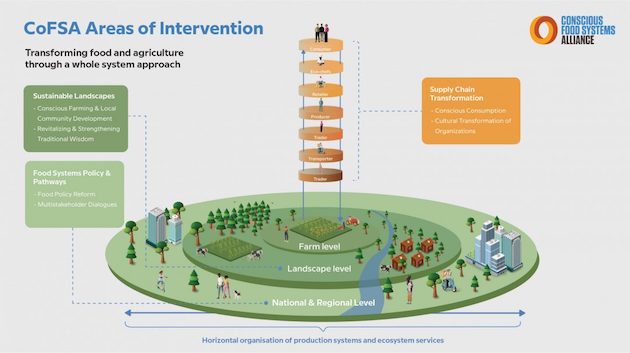
Graphic representation of the Conscious Food Systems Alliance (CoFSA) concept. Credit: UNDP/CoFSA
Similarly, senior lecturer at the Massachusetts Institute of Technology, Otto Scharmer, stresses, “You cannot change a system unless you change the mindsets or the consciousness of the people who are enacting that system.”
At the heart of it, mindful eating and activating transformation from the inside is a recognition that changing behavior is, at times, more about identity, emotions, and connections than data and analyses in the same way elections are campaigned and won against a backdrop of long-held beliefs and opinions.
Question Impact of Consumer Choices
“I think today, whatever you eat, however you dress, you need to ask yourself where they come from, what kind of impact they are giving back to the Mother Earth, cultural, economic, and spiritual environment,” says Tashka Yawanawá, Chief of the Yawanawá that has survived for centuries in the Brazilian rainforests.
Awareness of the people and processes in food and agriculture systems aligns with indigenous wisdom and is at the heart of the approach taken by the Yawanawá people. For instance, Tashka Yawanawá says: “When somebody drinks the acai collected and produced by the Yawanawá, they’re helping protect 200,000 acres of land.”
“They are also supporting the preservation of our language, our culture, our cultural and spiritual manifestation. Making that link gives value to where you source these products from … when you buy acai made by Yawanawá, you have an awareness that you’re supporting conscious food.”
UNDP stresses that farmers’ lives depend on being seen as human beings, not just economic agents, and says it is “Time to build safe, reflective and connecting spaces to engage in the deep conversations we need for right relationships to replace market rules.”
In the world of conscious thinking and mindful eating, everyone has a role.
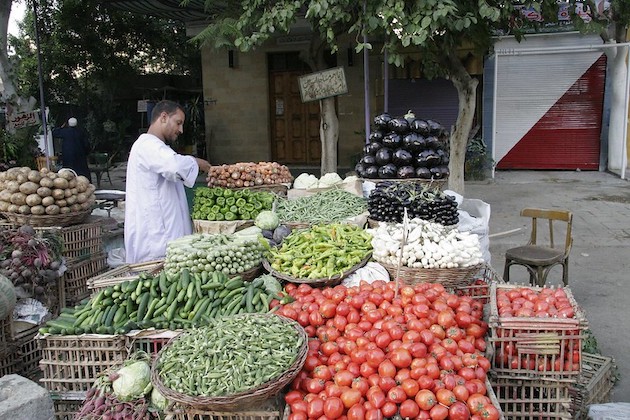
A marker trader at a vegetable stall in the village of El-Maadi near Cairo with heaps of fresh vegetables. CoFSA aims to renew lost ties between producers, the foods they grow, cooks, and consumers. Credit: Gavin Bell
Teresa Corção, founder of Instituto Maniva, a non-profit in Brazil that values traditional food knowledge and renews the ties lost between producers, the foods they grow, cooks, and consumers, says chefs have a critical role in listening more to the people who grow the food.
“I think we all see now more and more we need other ways of both changing ourselves and helping others change the way they think in order for us to have the right mindsets to make choices that are more sustainable,” says Andrew Bovarnick, UNDP’s Food, and Agricultural Commodity Systems, Global Head.
CoFSA is built on bringing consciousness to food systems to support the transition to a holistic, bio-regional approach and creating productive landscapes of regeneration.
That consciousness can help restore the balance in food systems between food production, conservation, and well-being, support the uptake of agroecological practices which regenerate the soil, and strengthen the capacity of food to distribute wealth and well-being in communities.
The world’s news media — both under authoritarian regimes and democratic governments– continue to come under relentless attacks and political harassment.
“Freedom of the press is the foundation of democracy and justice. It gives all of us the facts we need to shape opinions and speak truth to power. But in every corner of the world, freedom of the press is under attack,” UN Secretary-General Antonio Guterres said on World Press Freedom Day May 3.
Journalists and media workers, he said, are directly targeted on and offline as they carry out their vital work. They are routinely harassed, intimidated, detained and imprisoned.
At least 67 media workers were killed in 2022 — a 50 per cent increase over the previous year. Nearly three quarters of women journalists have experienced violence online, and one in four have been threatened physically, according to the UN.
But there is also an increase in non-physical attacks, including defamation lawsuits against media organizations challenging their legitimate right to free expression.
The Washington-based US Agency for International Development (USAID) last week launched Reporters Shield, a new membership program that protects journalists around the world– who report in the public interest– from defamation lawsuits and legal threats.
Established as a U.S.-based nonprofit organization by the Organized Crime and Corruption Reporting Project (OCCRP) and the Cyrus R. Vance Center for International Justice, Reporters Shield has been described as “a first-of-its-kind global program that defends investigative reporting around the world from legal threats meant to silence critical voices”.
USAID, which has a long history of fostering the growth of independent media across the world, plans to work with Congress to contribute up to $9 million in seed funding for this groundbreaking new program to support media outside the United States, according to a May 2 press release.
In a statement released last week, USAID said investigative journalists and civil society organizations reporting in the public interest are increasingly facing lawsuits that aim to harass and silence them by burdening them with the cost and time of a legal defense until they abandon their stories or go out of business entirely.
Reporters Shield will help to reduce these risks through training and pre-publication review, as well as funding legal representation to fight lawsuits and other legal actions meant to intimidate and financially burden reporters.
In order to keep the program sustainable, member organizations participating in Reporters Shield will pay reasonable annual fees that are based on a variation of factors, including location of the outlet and how many stories they produce a year.
“To be considered for membership in Reporters Shield, an organization must be legally registered and focus primarily in news, public interest, and/or investigative reporting; publish reporting in print and/or online; have non-profit status or transparent ownership; be independent from political, commercial, or other undue influence or interference; and have editorial independence and adhere to professional editorial standards”.
Reporters Shield is accepting applications worldwide and will be reviewing them in a phased approach, with some regions receiving benefits in the coming months, and others added later this year and in 2024.
Interested organizations can find more information and apply for membership by visiting reporters-shield.org.
The development of Reporters Shield has been supported by the generous pro bono legal support of the law firms of Proskauer, Primmer Piper Eggleston & Cramer PC, and Weil, Gotshal & Manges LLP.
Mandeep S. Tiwana, Chief Programmes Officer at CIVICUS, a global alliance of civil society organizations (CSOs), told IPS “these are hard times for media freedoms due to disinformation and attacks on civic space spurred by deepening authoritarianism, denigration of democracy through populism and consolidation of wealth by oligarchs”.
Uncovering serious human rights violations and high-level corruption, he pointed out, is becoming increasingly dangerous and costly for investigative journalists and civil society activists.
When few companies are ready to sign the Anti- Strategic Lawsuits Against Public Participation (SLAPP) pledge and crafty politicians are busy undermining the independence of judiciaries, this initiative comes at a critical time,” he declared.
According to the Anti-SLAPP pledge by Global Citizen, an international education and advocacy organization, strategic lawsuits against public participation, or SLAPPs, are not a legitimate business strategy for companies.
“The private sector thrives in functioning democratic societies, where the right to freedom of expression is a respected bedrock principle and where everyone can express their views without fear of intimidation or reprisal”.
“Lawsuits and legal tactics meant to silence civil organizations and human rights defenders aren’t just bad for societies, they’re also damaging to companies. When companies stifle free expression, they limit their ability to manage risk related to their operations and global supply chains.”
As companies that are committed to operating in societies where people are able to exercise fundamental rights, said Global Citizen, “we pledge to: define Strategic lawsuits against public participation, or SLAPPs, as both lawsuits and legal tactics that are designed to silence critics and abridge citizens’ ability to exercise fundamental rights.”
— Refrain from engaging in SLAPPs against human rights and environmental defenders and civil society organizations that support affected rights-holders.
— Recognize the critical role that civil society organizations and human rights defenders play in creating a profitable enabling environment for the private sector.
— Encourage partners and suppliers within our value chain to refrain from engaging in SLAPPs to silence legitimate activism.
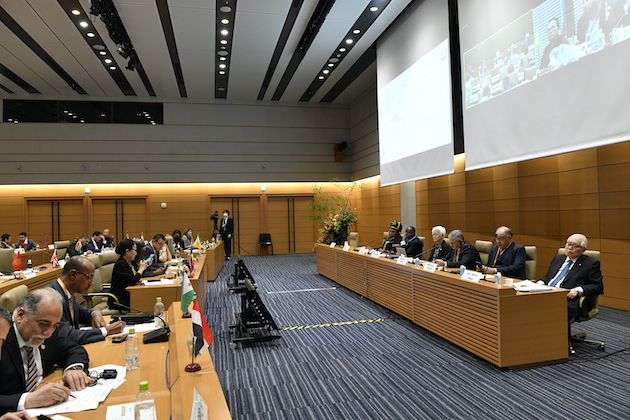
Parliamentarians attending the Global Conference of Parliamentarians on Population and Development Toward the 2023 G7 Hiroshima Summit. Credit: APDA
By Cecilia Russell JOHANNESBURG, May 9 2023 (IPS)
Parliamentarians from more than 30 countries agreed to send a strong message to the G7 Hiroshima Summit in Japan later this year, focusing on human security and support of vulnerable communities, including women, girls, youth, aging people, migrants, and indigenous people, among others.
The wide-ranging declaration also called on governments to support active political and economic participation for women and girls, enhancing and implementing legislation that addresses gender-based violence (GBV) and eradicating harmful practices like child, early, and forced marriages. During discussions and in the declaration, a clear message emerged that budgetary requirements for Universal Health Care (UHC) should be prioritized and the exceptional work done by health workers during the pandemic be recognized.
In his keynote address, Japan’s Prime Minister Kishida Fumio reminded delegates that Covid-19 had exposed the “fragility of the global health architecture and underscored the need for UHC.”
Kishida said that the central vision of the G7 Hiroshima Summit was to emphasize the importance of addressing human security – through building global health architecture, including the “governance for prevention, preparedness, and response to public health crises, including finance. We believe it is important for the G7 to actively and constructively contribute to efforts to improve international governance, secure sustainable financing and strengthen international norms.”
Apart from contributing to resilient, equitable, and sustainable UHC, health innovation was needed to promote a “more effective global ecosystem to enable rapid research and development and equitable access to infectious disease crisis medicines … and to support aging society,” Kishida said.
Former Prime Minister of Japan Fukuda Yasuo, Chair of APDA, and Honorary Chair of JPFP said this conference and its declaration would follow in a tradition of delivering strong messages to the G7 that improving reproductive health was crucial to the development and the future of a planet which now had 8 million people living on it.
“International Community is becoming increasingly confrontational and divided, and there is the emergence of a national leader who is threatening the use of nuclear weapons. No nuclear weapons have been used in the nearly 80 years since Hiroshima and Nagasaki. We must work together to prevent the use of nuclear weapons, which can take many precious lives and people’s daily lives. In this instance, I would like you to search for the path toward appeasement and not division. We must keep all channels of dialogue open so as to ease tension,” Fukuda asked of the conference.
While calling on parliamentarians to work together to address challenges, Fukuda also expressed concern about the widening inequities caused by Covid-19 and climate change and noted: “This network of parliamentarians on population and development has been a vital resource for parliamentarians who share the same concern for not only their own countries but for the entire planet and future generations.”
Kamikawa Yoko, MP Japan, Chair of JPFP, said that with a world population of 8 billion, it was essential to “realize a society where no one is left behind … and Japan would share its experiences of being on the frontlines of an aging society with declining birth rates. “We are living in an aging society … and given these challenges in Japan, we will try to share with you our experience and lessons through our diplomacy while trying to deepen our discussions and exchanges to seek solutions.”
Japan’s Foreign Affairs Minister Hayashi Yoshimasa said it was essential for all to cooperate during the “Anthropocene era, when human activities have promised to have a major impact on the global environment, global issues that transcend national borders, such as climate change, and the spread of infectious diseases, including Covid-19 are becoming more and more prevalent.”
He reminded the delegates that at the center of Japan’s economic growth post World War II was mainly through health promotion and employment policies.
Delegates of the Global Conference of Parliamentarians on Population and Development Toward the 2023 G7 Hiroshima Summit agreed to send a strong message on human security to the Summit. Credit: APDA
Director of the Division for Communications and Strategic Partnerships of UNFPA, Ian McFarlane, said it was not about the “numbers of people but the rights of the people that matter. It’s not about whether we are too many or too few, but whether women and girls can decide if, when, and how many children to have.”
A recent UNFPA report indicated that nearly half of the women across the globe could not exercise their rights and choices, their bodily autonomy, and expressed hope that policies in the future continue to focus on humanity and universal human rights.
Despite being close to the 30th anniversary of the International Conference on Population and Development (ICPD), the conference heard that much still needed to be done regarding women’s rights.
New Zealand MP and co-chair of AFPPD Standing Committee on Gender Equality and Women Empowerment, Angela Warren-Clark, reminded the audience that women still only held 26 percent of parliamentarian seats globally. While women make up 70 percent of the workforce in the health sector, only 25 percent have senior leadership positions.
“It is women in this pandemic who bore the increased burden of unpaid work at home as schools were closed, and it is girls and the poorest families who were taken out of school and forced into early marriages … We believe that if women had an equal say in decision-making during the pandemic, some of these mistakes would have been avoided.”
Baroness Elizabeth Barker, MP from the United Kingdom, told parliamentarians their role was to ensure that “no person on earth, from the head of G7 country to a poor person in a village, can say that they do not know what gender equality is. And they do not know what gender violence is.”
Barker suggested they use international standards, like the Istanbul Convention on Violence Against Women, to compare countries. “And you know that if your country doesn’t come out very well, they really don’t like it.”
She pointed to two successes in the UK, including stopping virginity testing and tackling the practice of forced marriages. She also warned the delegates that there was a right-wing campaign aimed at destroying human rights gained, and they chose different battlegrounds. The overturning of abortion rights in the United States in the Roe vs. Wade case was an example, as was the anti-LGBTQ legislation in Uganda.
Hassan Omar, MP from Djibouti, gave a host of achievements in his country, including ensuring that women occupy 25 percent roles in politics and the state administration and the growing literacy of women numbers in his country.
Risa Hontiveros, MP Philippines, painted a bleak picture of the impact of Covid in her country.
Hontiveros said GBV increased during Covid and extended to the digital space.
“The Internet has become a breeding ground for predators and cyber criminals to prey on children, especially young women, and girls. The online sexual abuse and exploitation of children … has become so prevalent in the Philippines that we have been tagged as the global hotspot.”
In a desperate attempt to provide for their families, even parents produced “exploitative material of their own children and sold them online to pedophiles abroad.”
To address these, she filed a gender-responsive and inclusive Emergency Management Act bill, which seeks to address the gender-differentiated needs of women and girls, because they were “disproportionately affected in times of emergencies.”
Former MP from Afghanistan Khadija Elham’s testimony united many in the conference and even resulted in proposals from the floor to include a condemnation of the Taliban’s women’s policies.
Elham said GBV had increased since the Taliban took over – women were forced to wear a burqa in public, they were not allowed to work, and those who wish to “learn science or (get an) education are forced to continue their studies and hidden places like basements.”
If their secret schools are exposed, they face torture and imprisonment. During the last two months, 260 people, including 50 women, were publicly whipped – a clear violation of their human rights. Women’s representation in political life has been banned, and women are no longer allowed to work in NGOs – and it has been “550 days since women could attend high schools and universities.”
She called on the international community, the United Nations, to pressure the Taliban to restore women’s work and education rights.
Nakayama Maho, Director of the Peacebuilding Program at the Sasakawa Peace Foundation, announced new research on factors contributing to men’s propensity to GBV. The research found that the higher a man’s educational attainment, the lower the level of violence. There were also lower levels of violence with “positive” masculinity – such as a man being employed, married, and capable of protecting his family. Men who experienced violence during times of conflict tended to support violence to instill discipline, or protect women and communities.
Dr Roopa Dhatt, Executive Director of Women in Global Health, summed up this critical session by saying, “Equal leadership for women in all fields is a game changer, particularly in politics and health.”
Japan’s Health, Labour and Welfare Minister, Kato Katsunobu, noted during his closing address that the G7 countries “share the recognition that investment in people is not an expense, but an investment… and as you invest in people you can create a virtuous cycle between workers well-being and social and economic activities.”
He said Japan had a lot to offer concerning aging populations.
“Japan has been promoting the establishment of a comprehensive community-based care system so that people can continue to live in their own way in their own neighborhood until the end of their lives and is in the position to provide knowledge to the G7 countries and other countries who will be facing (an aging population) in the future.”
Dr Alvaro Bermejo, Director-General of IPPF, commended the conference and said he was “thankful” that the conference declaration would tell G7 governments to set an example. “Marginalized and excluded populations are at the heart of human security and can only be achieved in solidarity, and that message from this conference is clear.”
Professor Takemi Keizo, MP Japan, Chair of AFPPD, summed up the proceeding by saying that parliamentarians as representatives of the electorate were vital to creating a “positive momentum in this global community and overcoming so many difficult issues.”
Takemi elaborated on some issues facing the world now, including climate change and military conflicts, but as parliamentarians, there was the opportunity to “build up the new basis of the global governance, which can be very beneficial.”
NOTE: Global Conference of Parliamentarians on Population and Development Toward the 2023 G7 Hiroshima Summit was organized by the Asian Population and Development Association (APDA), the Asian Forum of Parliamentarians on Population and Development (AFPPD), and the Japan Parliamentarians Federation for Population (JPFP).
It was supported by the Ministry of Foreign Affairs of Japan (MOFA), United Nations Population Fund (UNFPA), Japan Trust Fund (JTF), and Keidanren-Japan Business Federation in cooperation with the International Planned Parenthood Federation (IPPF).