Residents of the municipality of Castro, in Chiloé, an archipelago in southern Chile, demonstrate in the streets of their city, in front of the Gamboa Bridge, expressing their fear of threats to the water supply that they attribute to the lack of protection of peatlands, which are key to supplying water for the island’s rivers. CREDIT: Courtesy of Chiloé en defensa del Agua
SANTIAGO, May 2 2024 (IPS) – The drinking water supply in the southern island of Chiloé, one of Chile’s rainiest areas, is threatened by damage to its peatlands, affected by sales of peat and by a series of electricity projects, especially wind farms.
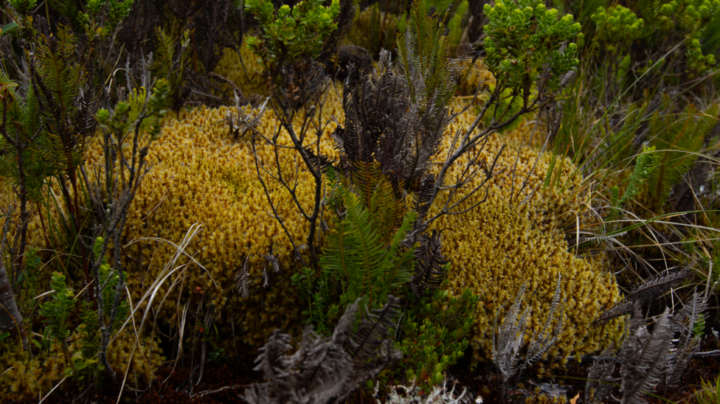
The peat bog (Moss sphagnum magellanicum) known as “pompon” in Chile absorbs and retains a great deal of water, releasing it drop by drop when there is no rain. In southern Chile there are about 3.1 million hectares of peatlands.
“We condemn the fact that the extraction of peat is permitted in Chiloé when there is no scientifically proven way for peat to be reproduced or planted…. there is no evidence of how it can regenerate.” ¨– Daniela Gumucio
Peat is a mixture of plant debris or dead organic matter, in varying degrees of decomposition, neither mineral nor fossilized, that has accumulated under waterlogged conditions.
The pompon is the main source of water for the short rivers in Chiloé, an archipelago of 9181 square kilometers and 168,000 inhabitants, located 1200 kilometers south of Santiago. The local population makes a living from agriculture, livestock, forestry, fishing and tourism, in that order.
“We don’t have glaciers, or thaws. Our water system is totally different from that of the entire continent and the rest of Chile. Since we don’t have glaciers or snow, our rivers function on the basis of rain and peat bogs that retain water and in times of scarcity release it,” Daniela Gumucio told IPS by telephone.
The 36-year-old history and geography teacher said that the Chiloé community is concerned about the supply of drinking water for consumption and for small family subsistence farming.
This long narrow South American country, which stretches between the Andes Mountains and the Pacific Ocean, has 19.5 million inhabitants and is facing one of the worst droughts in its history.
It’s strange to talk about water scarcity in Chiloé because it has a rainy climate. In 2011 more than 3000 millimeters of water fell there, but since 2015 rainfall began to decline.
In 2015 rainfall totaled 2483 millimeters, but by 2023 the amount had dropped to 1598 and so far this year only 316, according to data from the Quellón station reported to IPS by the Chilean Meteorological Directorate.
The forecast for April, May, and June 2024 is that below-normal rainfall will continue.
A water emergency was declared in the region in January and the residents of nine municipalities are supplied by water trucks.
To supply water to the inhabitants of the 10 municipalities of Chiloé, the State spent 1.12 million dollars to hire water trucks between 2019 and 2024. In Ancud alone, one of the municipalities, the expenditure was 345,000 dollars in that period.
A close-up shot of a peat bog in a watershed on the island of Chiloé, which has the ability to absorb water 10 times its weight. Because of this property, those who extract it today, without any oversight, dry it, crush it and pack it in sacks to sell it to traders who export it or sell it in local gardening shops. CREDIT: Courtesy of Gaspar Espinoza
Alert among social activists
The concern among the people of Chiloé over their water supply comes from the major boost for wind energy projects installed on the peat bogs and new legislation that prohibits the extraction of peat, but opens the doors to its use by those who present sustainable management plans.
Several energy projects are located in the Piuchén mountain range, in the west of Chiloé, where peat bogs are abundant.
“They want to extend a high voltage line from Castro to Chonchi. And there are two very large wind farm projects. But to install the turbines they have to dynamite the peat bog. This is a direct attack on our water resource and on our ways of obtaining water,” Gumucio said.
In 2020, the French company Engie bought three wind farms in Chiloé for 77 million dollars: San Pedro 1 and San Pedro 2, with a total of 31 wind turbines that will produce 101 megawatts (MW), and a third wind farm that will produce an additional 151 MW.
In addition, 18 kilometers of lines will be installed to carry energy to a substation in Gamboa Alto, in the municipality of Castro, and from there to the national power grid.
Another 92 turbines are included in the Tabla Ruca project, between the municipalities of Chonchi and Quellón.
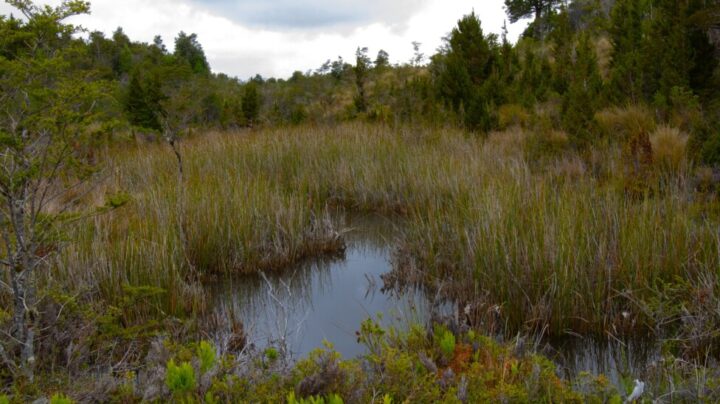
Peat bogs accumulate and retain rainwater in the wetlands of Chiloé and release it drop by drop to river beds in times of drought. CREDIT: Courtesy of Gaspar Espinoza
Engie describes its initiatives as part of the transition to a world with zero net greenhouse gas emissions, thanks to the production of clean or green energy.
Leaders of 14 social and community organizations expressed their concerns in meetings with regional authorities, but to no avail. Now they have informed their communities and called on the region’s authorities to protect their main water source.
Local residents marched in protest on Mar. 22 in Ancud and demonstrated on Apr. 22 in Puente Gamboa, in Castro, the main municipality of the archipelago.
Thanks to peatlands, the rivers of Chiloé do not dry up. The peat bogs accumulate rainwater on the surface, horizontally, and begin to release it slowly when rainfall is scarce.
For the same reason, peat is dup up and sold for gardening. In 2019 Chile exported 4600 tons of peat.
The wind energy projects are set up in areas of raised peat bogs, known as ombrotophic, located at the origin of the hydrographic basins.
“We have had a good response in the municipal council of Chonchi, where the mayor and councilors publicly expressed their opposition to approving these projects,” said Gumucio.
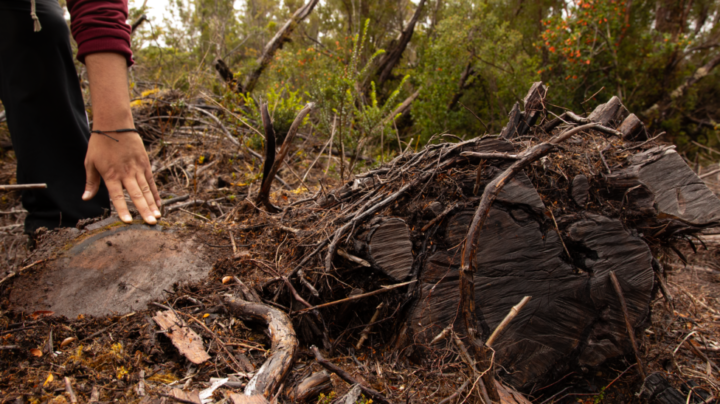
Dozens of trees have been felled in Chiloé to install wind turbines and make way for high-voltage towers that will transmit green energy to Chile’s national power grid, without benefiting the inhabitants of the Chiloé archipelago. CREDIT: Courtesy of Gaspar Espinoza
The other threat to peatlands
The second threat to the Chiloé peat bogs comes from Law 21.660 on environmental protection of peatlands, published in Chile’s Official Gazette on Apr. 10.
This law prohibits the extraction of peat in the entire territory, but also establishes rules to authorize its use if sustainable management plans are presented and approved by the Agricultural and Livestock Service, depending on a favorable report from the new Biodiversity and Protected Areas Service.
The peatland management plan aims to avoid the permanent alteration of its structure and functions.
Those requesting permits must prove that they have the necessary skills to monitor the regeneration process of the vegetation layer and comply with the harvesting methodology outlined for sustainable use.
But local residents doubt the government’s oversight and enforcement capacity
Dozens of trees have been felled in Chiloé to install wind turbines and make way for high-voltage towers that will transmit green energy to Chile’s national power grid, without benefiting the inhabitants of the Chiloé archipelago. CREDIT: Courtesy of Gaspar Espinoza
“We condemn the fact that the extraction of peat is permitted in Chiloé when there is no scientifically proven way for peat to be reproduced or planted…. there is no evidence of how it can regenerate,” said Gumucio.
The activist does not believe that sustainable management is viable and complained that the government did not accept a petition for the law to not be applied in Chiloé.
“We have a different water system and if this law is to be implemented, it should be on the mainland where there are other sources of water,” she said.
But according to Gumucio, everything seems to be aligned to deepen the water crisis in Chiloé.
“The logging of the forest, the extraction of peat, and the installation of energy projects all contribute to the drying up of our aquifers and basins. And in that sense, there is tremendous neglect by the State, which is not looking after our welfare and our right to have water,” she argued.
Peatland is part of the vegetation of the island of Chiloé, but is threatened by unsupervised exploitation, which the authorities hope to curb with a recently approved law, whose regulations are to be ready within the next two years. CREDIT: Courtesy of Gaspar Espinoza
Scientists express their view
Six scientists from various Chilean universities issued a public statement asserting that the new law is a step in the right direction to protect Chile’s peatlands.
In their statement, scientists Carolina León, Jorge Pérez Quezada, Roy Mackenzie, María Paz Martínez, Pablo Marquet and Verónica Delgado emphasize that the new law “will require the presentation of a sustainable management plan” to exploit peat that is currently extracted without any controls.
They add that management plans must now be approved by the competent authorities and that those who extract peat will be asked to “ensure that the structure and functions of the peatlands are not permanently modified.”
They also say that the regulations of the law, which are to be issued within two years, “must establish the form of peat harvesting and post-harvest monitoring of the peat bog to protect the regeneration of the plant, something that has not been taken into consideration until now.”
They point out that the new law will improve oversight because it allows monitoring of intermediaries and exporters who could be fined if they do not comply with the legislation.
“While it is true that there is concern among certain communities and environmental groups, we believe that these concerns can be taken into account during the discussion of the regulations,” they say.
The scientists reiterate, however, that “peatlands are key ecosystems for mitigating the national and planetary climate and biodiversity crisis” and admit that “significant challenges remain to protect them, although this is a big step in the right direction.”
(upbeat marching band music) ♪ Go – Welcome to the 18th season of WVIA “Scholastic Scrimmage.”
I’m your host, Paul Lazar.
“Scholastic Scrimmage” is a question and answer competition featuring high school students from across the WVIA viewing area.
In each program, two schools will compete in a single elimination tournament for a chance to win 1, 3, or $5,000.
Tonight’s match features Wyoming Valley West versus Lake Lehman.
Representing Wyoming Valley West are Tessa Kopetchny, Jalen Buchinski, Elvis Castanos, Evelyn Saltz.
And their alternate is Joey Souder.
Their advisor is Robert Bonczewski.
Representing Lake Lehman are Teagan Norconk, Brianna London, Francis Pinnacoli, and Seth Berry.
Their alternates are Evan Kaiser and Cassidy Gallagher.
And their advisor is Cecelia Jennings.
“Scholastic Scrimmage” is a game of rapid recall of factual information, so let’s take a moment and review the rules.
The first team to buzz in will have an opportunity to answer a toss-up question.
Correct answers to these questions are awarded 10 points and that team will then receive a 5 point bonus question.
If that toss-up answer is incorrect, no points will be deducted, but the question will then rebound to the other team.
If the other team answers correctly, they’ll be given the toss-up points, but will not receive a bonus question.
Well, let’s go ahead and get started with this toss-up question.
What country’s 1993 election was contested between Prince Ranariddh and Prime Minister Hun Sen, who restored the monarchy under Norodom Sihanouk?
(buzzer beeps) That was Cambodia.
Let’s go to another toss-up.
What British chemist, whose law equates the total pressure of a gas mixture to the sum of partial pressures, proposed an early atomic theory?
(button beeps) Teagan, Lake Lehman?
– Boyle?
– Is incorrect.
Rebound now to Valley West.
(buzzer beeps) That was John Dalton.
Let’s go to another toss-up.
What island whose western most tip is home to Negril Lighthouse also contains the city of Port Royal, which sits at the mouth of Kingston Harbor?
(button beeps) – Jalen, Valley West.
– Jamaica?
– Is correct.
(buzzer warbles) And here comes your bonus.
What Weaver of Raveloe is framed for stealing money from a religious community and adopts a daughter named Eppie in an 1861 novel by George Eliot.
(buzzer beeps) That was “Silas Marner”.
Here’s our next toss-up question.
What human reclines naked and reaches out with his left hand to touch God’s hand on a portion of a Sistine Chapel depicting his creation?
(button beeps) Jalen, Valley West.
– Adam.
– Is correct.
(buzzer warbles) And here comes your bonus.
Many migrants heading to the US have to cross what inhospitable gap along the Panama-Columbia border?
(button beeps) – The Panama Canal?
– No, it’s the Darien Gap, the Darien Gap.
Let’s go to another toss-up.
What leader who ordered a massacre at Drogheda, disbanded the Rump Parliament after Charles I’s execution, and ruled as Lord Protector of Britain?
(button beeps) Francis, Lake Lehman.
– Oliver Cromwell?
– Is correct, and here comes your bonus now.
(buzzer warbles) What general captured Mexico City in 1847, ran as the Whig nominee for president in 1852, and devised the Anaconda plan during the Civil War?
– Try it.
I don’t, try it.
(button beeps) – Daniel Boone?
– No, that’s Winfield Scott.
Let’s go to another toss-up.
What city hosted an NFL team that moved to Tennessee and was originally called the Oilers (button beeps) and now is home- Jalen, Valley West.
– Houston.
– Is correct, and here comes your bonus question.
(buzzer warbles) Article 71 of the United Nations charter introduced what term for large activist groups such as Oxfam that are independent of direct state funding?
(buzzer beeps) That is NGO, or non-governmental organization.
Here’s our next toss-up question.
What novel, which is partly said on the fictional island of San Lorenzo, depicts how the planet’s water is frozen by ice-nine and is by Kurt Vonnegut?
(buzzer beeps) That’s “Cat’s Cradle.”
Let’s move on to another toss-up question.
What long molecules, three of which are found in a triglyceride, are unsaturated when they have a double bond as in their healthy- (button beeps) Seth, Lake Lehman.
– Lipids?
– [Paul] Is, be more specific.
– Fatty acids?
– Is correct, and here (buzzer warbles) comes your bonus question.
(timer beeps) The Agulhas and Humbolt are examples of what large scale flows of surface ocean water?
– Glaciers?
– Try it.
(button beeps) – Glaciers?
– No, we’re were looking for ocean current, ocean current.
Well that sound that you heard signals the end of the first quarter and it’s now time for the lightning round.
(logo buzzes) In this segment, each team will have an opportunity to answer as many of the 10 rapid fire questions as they can in one minute.
Wyoming Valley West has won the coin toss and will pick first.
Your categories are, how monarchs died or African cities.
– Do how monarchs die?
– How monarchs die?
– How monarchs died it is, and your time begins after I finish reading the first question.
Given a ruler, state whether they died in battle, were assassinated, died of an infectious disease, or none of the above.
Russia’s Nicholas II.
(button beeps) – He was murdered.
– [Paul] Yes.
England’s Harold Godwinson?
(button beeps) – None of the above.
– [Paul] Died in battle.
Athens’ Pericles.
(button beeps) – Died in battle.
– Infectious disease.
Egypt’s Cleopatra.
(button beeps) – Infectious disease.
– [Paul] None of the above.
England’s Richard III.
(button beeps) – Died in battle.
– Yes.
Sweden’s Gustavus Adolphus.
(button beeps) – Infectious disease.
– Died in battle.
Rome’s Caligula.
(button beeps) – None of the above.
– Assassination.
France’s Henry IV.
(button beeps) – Died in battle.
– Assassination.
Sparta’s Leonidas I.
(button beeps) – Assassination.
– Died in battle.
(group chuckles) Russia’s Catherine the Great.
(button beeps) – None of the above.
– That’s correct, Valley West (Evelyn chuckles) and that’s going to do it for your portion of the lightning round.
(group speaks faintly) Lake Lehman, we’re coming over to you, and your remaining category will be African cities.
And once again, your time begins after I finish reading the first question.
In what country could one visit these African cities?
Cairo.
(button beeps) – Egypt?
– [Paul] Yes.
Casablanca.
(button beeps) – Pass.
– [Paul] Morocco.
Mogadishu.
– Don’t got it.
(button beeps) – Rwanda.
– [Paul] Somalia.
Dara Salaam.
(button beeps) – French Guiana.
– [Paul] Tanzania.
Lagos.
– Try- – Just say it, say it, say it.
(button beeps) – Equatorial Guinea?
– [Paul] Nigeria.
Bamako.
(button beeps) – Pass.
– Mali.
Accra.
– Accra, isn’t that Niger?
(button beeps) – Uganda.
– [Paul] Ghana.
Gaborone.
(button beeps) – Kenya.
– [Paul] Botswana.
Constantine and Oran.
– Constantine (indistinct).
– (button beeps) Tunisia?
– [Paul] Algeria.
Dakar.
(button beeps) – Kenya.
(timer beeps) – That was Senegal.
Some tough categories in that lightning round.
And that’s going to finish that particular lightning round.
And after that we have Wyoming Valley West in the lead over Lake Lehman 45 to 25.
And we’re now going to move into the second quarter with this toss-up question.
What civilization’s deities included groups called the Ogdoad and Ennead, the latter of which included the Sun god Atum and the afterlife god Osiris.
(button beeps) Francis, Lake Lehman.
– Egypt.
– Is correct, (buzzer warbles) and here comes your bonus.
What French author portrayed the social climber, Eugene de Rastignac, in his 1835 novel “Le Père Goriot,” part of his many volume series, “The Human Comedy.”
– Try Voltaire?
(button beeps) Voltaire?
– Nope, that’s Honore de Balzac.
Let’s go to another toss-up.
What man issued the Berlin and Milan decrees to enforce the Continental System against British trade on behalf of his French empire in 1807?
(button beeps) Jalen, Valley West.
– Napoleon?
– Is correct, and here comes your bonus.
(buzzer warbles) In 1993, what progressive conservative briefly succeeded Brian Mulroney as prime minister of Canada, becoming the first woman to hold the role?
(group speaks faintly) (buzzer beeps) That was Kim Campbell.
Let’s go to another toss-up.
In jazz, what instrument played by musicians like Art Blakey and Buddy Rich is usually found in a namesake kit, including its bass (button beeps) and stare types.
Francis, Lake Lehman.
– Drum, drummer.
– Is correct, and here comes your bonus.
(buzzer warbles) Toronto’s Robarts Library exemplifies what post-war architectural style that uses minimalist designs, often with large stretches of exposed concrete?
(button beeps) (Seth speaks faintly) – Brutalism?
– Is correct for your bonus points, Lake Lehman.
As we move on to another toss-up.
What quantity, which for a spring equals half the spring constant times extension squared, is an energy of position contrasted with kinetic energy?
(button beeps) Teagan, Lake Lehman.
– Potential energy.
– [Paul] Is correct, and your bonus.
(buzzer warbles) Taxonomic class Chilopoda consists of what predatory arthropods that have one pair of legs per body segment?
– Very close, we were looking for centipede, centipede.
Here comes our next toss-up.
What man prosecuted Lucky Luciano in the 1930s, served as New York’s governor from 1943 to 1954, and lost the 1948 (Francis speaking faintly) presidential race to Harry Truman?
(Francis speaking faintly) (button beeps) Jalen, Valley West.
– Dewey?
– Is correct, (buzzer warbles) and here comes your bonus.
In July, 2023, Meta launched what text-based app intended to rival Elon Musk’s Twitter.
(button beeps) – Threads.
– Threads is correct for your bonus points, Valley West.
As we move on to another toss-up.
What country, which like Hungary, was fined by the EU in 2023 for eroding the rule of law, is led by the Law and Justice Party of Jaroslaw Kaczynski?
(button beeps) Jalen, Valley West.
– Poland?
– Is correct, (buzzer warbles) and here comes your bonus.
What lawyer argued Brown v. Board before the Supreme Court before becoming its first African American justice in 1967?
(button beeps) – Thurgood Marshall.
– Is correct for your bonus points, Valley West.
Moving on to another toss-up.
What chemist, whose namesake equation relates rate constants to a temperature dependent exponential is a Swede who defined bases as hydroxide donors?
(buzzer beeps) That was Svante Arrhenius.
(timer beeps) And that sound that you heard signals the end of the first half, and we’re now going to give our contestants a little bit of a break, and the opportunity for those of you at home to get to know them a little better.
(light music) And we’ll start with the students from Valley West, and Tessa, I’ll come to you first.
Tell us what you like to do for fun when you’re not in class.
– I love to crochet and I play the violin for my school’s orchestra as well as the chamber orchestra.
– [Paul] Oh, that’s wonderful, thanks for being here Tessa.
Jaylen?
– I love watching movies, my favorite movies are the James Bond films from the sixties.
And I love learning about history.
(Evelyn chuckles) – Very cool, thanks Jalen.
Elvis.
– In my free time I like to play volleyball with other members of the Wyoming Valley West volleyball team.
– [Paul] Sounds like fun.
Evelyn.
– I like to spend time with my friends and I often watch “The Office,” it’s my favorite show.
(group chuckles) – It is a good show.
(chuckles) Thanks for being here Valley West and good luck to you the rest of the way.
Lake Lehman, we’re gonna come over to you and Teagan, if you wouldn’t mind telling us what you like to do for fun when you’re not in school.
– Well I enjoy playing video games, reading books, and I try to play the piano.
– [Paul] Okay, Brianna?
– I like to paint and draw and go to art lessons, and I play volleyball for the school.
– Okay, Francis?
– I like to read and watch movies and go to the movies.
– [Paul] Okay, and Seth.
– I like to be outside, go fishing, rock climbing.
– [Paul] You’re a risk taker.
– Yeah.
– All right, thank you Seth.
Good luck to you Lake Lehman going forward.
It was very nice to meet all of you.
And now we’ll go ahead and begin the third quarter with this toss-up question.
What explorer, whom the Spanish made the first governor of Puerto Rico, reached Florida in 1513 while supposedly looking for the Fountain of Youth?
(button beeps) Jalen, Valley West.
– Ponce de Leon.
– Is correct, and here comes your bonus.
(buzzer warbles) What organ in the chest, which undergoes involution as a person ages, is the site of T-cell maturation?
(group speaks faintly) (button beeps) – Lungs?
– Nope.
That is the thymus, the thymus.
Let’s go to another toss-up.
What English author called history, “The register of the crimes, follies, and misfortunes of mankind.”
in his “Decline and Fall of the Roman Empire.”
(button beeps) Teagan, Lake Lehman.
– Oscar Wilde?
– Is incorrect, rebound to Valley West.
(buzzer beeps) That is Edward Gibbon.
Let’s go to another toss-up.
What term refers to declining to bet in poker, a situation where the king can be captured next turn in chess, or a money transfer that can bounce?
(button beeps) Evelyn, Valley West.
– Check.
– Is correct, and here comes your bonus question.
Oscar Wilde wrote the letter “De Profundis” while in what prison, which is the namesake of a Wilde ballad that claims, “Each man kills the thing he loves”?
(both speaking faintly) (buzzer beeps) – That was “Reading Gaol.”
Let’s go to another toss-up question.
In what phenomenon, whose law incorporates Lenz’s law and is named after Michael Faraday, is current created due to a changing magnetic flux.
(button beeps) Teagan, Lake Lehman.
– Lightning?
– Is incorrect, rebound to Valley West.
(buzzer beeps) That was electromagnetic induction, shocking.
(group chuckles) Let’s go to our next toss-up question.
What labor union led by executive director Duncan Crabtree-Ireland and President Fran Drescher went on strike in 2023 to protect actors’ rights?
(button beeps) Seth, Lake Lehman.
– Hollywood?
– [Paul] Judges?
– No.
– Is incorrect, rebound to Valley West.
(Elvis speaking faintly) (button beeps) – SAG, S-A-G. – SAG is correct for your rebound points, (buzzer warbles) very good Wyoming Valley West.
And let’s move on to another toss-up.
What Monarch, who subdued Greece by winning the 338 BC Battle of Chaeronea, was an Argead king of Macedon and the father of Alexander the Great?
(buzzer beeps) That Monarch was Philip II.
Let’s go to another toss-up and get your pencils and papers ready.
– Uh-oh.
– Two answers are required here, if x is a one digit integer and x squared has a units digit of nine- (button beeps) Teagan, Lake Lehman.
– 3 and -3?
– Is incorrect, rebound now to Valley West.
(group speaking faintly) (buzzer beeps) Well you had one of them.
We were looking for 3 and 7, (timer beeps) 3 and 7.
Well that sound that you heard signals the end of the third quarter and another lightning round.
(logo buzzes) This time Lake Lehman will pick first.
Your categories are up and down or Sacramento.
(Francis chuckles) – Up and down?
– I, – What- – Any big up and down fans here?
– I guess do up and down.
I don’t- – Up and down.
– What?
– Do the up or down.
– Okay, up or down?
– Up and down it is.
– Sure.
– And your time begins after I finish reading the first question.
Give these answers that contain up or down.
Developmental disorder caused by an extra chromosome 21.
(button beeps) – Down syndrome.
– Okay, okay.
– Yes, part of Michigan whose residents are called- (button beeps) – Upper Peninsula.
– [Paul] Yes.
Title estate of the Crawley family in a British TV series.
(button beeps) – Pass – [Paul] Downton Abbey.
– Oh.
– Yoga pose in which the head and feet- (button beeps) – Downward dog.
– Yes.
Greek letter between tau and phi.
(button beeps) – Upsilon.
– [Paul] Yes.
Richard Adams novel about a rabbit warren.
– Rabbit warren.
(button beeps) – Pass.
– [Paul] “Watership Down.”
– Oh – Shel Silverstein poem that ends, “I got sick to my stomach and I threw down.”
(button beeps) – Get up.
(chuckles) – Falling up.
(Seth chuckles) Christmas song noting, “Reindeer pause, out jumps good old Santa Claus.”
– Up on the rooftop, chimney- – “Up on the Rooftop?”
(button beeps) – “Up on the Rooftop?”
– [Paul] “Up on the Housetop.”
William Faulkner’s story about lawyer Gavin Stevens.
(button beeps) Pass.
– [Paul] “Go Down, Moses.”
Common English name for the location of Christ’s last supper.
(button beeps) – Pass.
– That was the Upper Room, (timer beeps) the Upper Room.
Okay, Lake Lehman, that’s gonna wrap up your portion of the lightning round.
– (indistinct) question.
– Valley West, we’re coming your way.
Your remaining category will be Sacramento.
And again your time begins after I finish reading the first question.
Answer the following about Sacramento, California.
California’s current governor who resides in Sacramento.
(button beeps) – Gavin Newsom.
– Gavin Newsom?
– [Paul] Yes, Sacramento born actress who plays Captain Marvel.
(button beeps) – Bree Larson?
– [Paul] Yes.
Horse based service that delivered mail between Sacramento and Saint Joseph.
(Elvis speaks faintly) (button beeps) – Pass.
– [Paul] Pony Express.
Its NBA team.
(button beeps) – Sacramento Kings.
– [Paul] Yes.
Commodity discovered in 1848 at Sutter’s Mill in present day Sacramento (button beeps) – Gold?
– [Paul] Yes.
Mountain range to its East.
(Elvis speaking faintly) (button beeps) – Pass.
– [Paul] Sierra Nevada.
Creator of “Tom Sawyer” who wrote for the Sacramento Union.
(button beeps) – Huckleberry Finn?
– No (indistinct).
– Mark Twain.
– Oh.
– Language from which Sacramento derives.
(button beeps) – Latin?
– [Paul] Spanish.
River that joins the Sacramento River and downtown Sacramento.
(button beeps) – Pass.
– [Paul] American River.
2017 film set there starring Saoirse Ronan.
(button beeps) – Pass.
– That was “Lady Bird”.
And that’s going to do it for the lightning round.
And after that we currently have Wyoming Valley West in the lead over Lake Lehman, 135 to 80.
And we’re now going to go ahead and begin the last segment of the game with this toss-up question.
What poet who declared “That is no country for old men.”
in “Sailing to Byzantium” repeated the line, “A terrible beauty is born.”
in his poem “Easter, 1916.”
(group speaking faintly) (buzzer beeps) Okay, the answer we’re looking for was William Butler Yeats.
Here’s our next toss-up.
What kingdom, which in the 15 hundreds ruled the Netherlands under its branch of the Habsburg Dynasty, formed from the marriage of Ferdinand and Isabella.
(button beeps) Jalen, Valley West.
– Austria?
– Is incorrect, rebound to Lake Lehman.
(group speaking faintly) (button beeps) – France?
– Spain, Spain.
– Oh.
– Let’s go to another toss-up.
What expressions which can be raised to powers and expanded to give the coefficients found in Pascal’s Triangle are polynomials with two terms.
(button beeps) – Quadratic.
– Brianna, Lake Lehman.
– Quadratic.
– Is incorrect, Rebound to Valley West.
– We know this.
– Hm?
– It’s Pascal Triangle.
We know this.
(button beeps) – Binomial?
– Binomial is correct (buzzer warbles) for your rebound points, Valley West, as we move on to another toss-up.
What author depicted a cloud of doom in a 2020 book about the 30 story Wayside School and described a curse on the Yelnats family in his novel “Holes”.
– (indistinct) no.
(buzzer beeps) – Okay, that was Louis Sachar.
Let’s go to another toss-up.
What TV program whose masters tournament featured Sam Buttrey, Amy Schneider, and James Holzhauer.
– (button beeps) – Oh.
– Francis, Lake Lehman.
– Jeopardy?
– Is correct.
And your bonus question.
(buzzer warbles) Hundreds of species of Cichlids live in what African Lake also called Lake Nyasa, which shares its name with a country governed from Lilongwe.
(button beeps) – Chad?
– No Lake Malawi, Malawi.
– Oh.
– Here’s our next toss-up.
What adaptations, which include the counter shading used by penguins and orcas and the disruptive color of zebras, help animals avoid detection?
(button beeps) – Teagan, Lake Lehman.
– Camouflage?
– Is correct, and your bonus.
(buzzer warbles) What sport, whose 2023 World Championships took place in Belgrade on the Sava, include such disciplines as single sculls.
– What?
(chuckles) – Single skulls?
(button beeps) – Fencing?
– Rowing, we’re looking for rowing.
Here comes our next toss-up.
What Bible book, whose Catholic version tells of Susanna and the Elders, also features the writing on the wall and a prophet thrown to a den of lions.
(button beeps) Jalen, Valley West.
(group speaks faintly) – I need an answer.
– Kings.
– Is incorrect, rebound to Lake Lehman.
– Any book.
(button beeps) – Exodus?
– Nope, the book of Daniel.
the book of Daniel.
– Oh.
– Let’s go to another toss-up.
What waterway bordered the ancient gates of Alexander, receives the Ural River, is north of Iran, and is the world’s largest enclosed body of water.
(button beeps) Jalen, Valley West.
– The Caspian Sea?
– Is correct, and here comes your bonus (buzzer warbles) and gets your pencils and papers ready.
What is the y-intercept of a line that has a slope of 3 and that passes through the point -3, -2.
(buzzer beeps) (timer beeps) – Okay, ran out of time there, that was 7.
Well that’s the end of the game.
And our winter tonight is Wyoming Valley West over Lake Lehman 155 to 100.
Congratulations, Wyoming Valley West.
You are going to be moving on, and we’ll see you next time (upbeat marching band music) with another round of “Scholastic Scrimmage”.
I’m your host, Paul Lazar, and thanks for watching.
The community frequently targets transgender people. Now they are able to welcome new measures that mean they will be able to safely access health care. Credit: Yusufzai Ashfaq/IPS
PESHAWAR, Pakistan, Apr 30 2024 (IPS) – Transgender people and civil society organizations have welcomed the decision of the chief minister in Khyber Pakhtunkhwa, Pakistan, to allocate separate rooms in hospitals for the transgender community so they can avail themselves of uninterrupted healthcare.
“We demand that all provinces follow suit and announce facilities for more than 500,000 transgender people in the country,” Farzana Shah, president of the Khyber Pakhtunkhwa (KP) Transgender Association, told IPS.
On April 6, KP Chief Minister Ali Amin Khan Gandapur announced separate rooms for transgender persons in public hospitals after complaints that they aren’t getting admissions because they face violence in the facilities.
“In the last year, about 47 transgender people have died because of violence, and 90 have been injured. Many injured transgender people die due to delayed treatment. In most cases, we can’t get healthcare at hospitals,” Shah, 40, said.
The Chief Minister’s directives to reserve rooms have received a positive response.
Members of a delegation of transgender people who recently met him quoted Gandapur as saying, “Provision of better health facilities to transgender persons in the province is our priority. We will help the underprivileged community.”
Arzoo Khan, a social activist, is overwhelmed.
“In all 38 district-level hospitals, we now have a separate room. Previously, the hospitals denied admission to our colleagues,” Khan said.
“The problem we face is that most transgender people have been deserted by their families because of social repercussions. People look down on transgender people.”
“We don’t have anyone to help us; therefore, the government’s support is a highly welcome step,” Khan said.
In addition to the allocation of space, the government also provided land for a separate graveyard for transgender people.
Civil society activist Jamal Khan said that there are several instances when the local communities have denied the burial of eunuchs because they don’t consider them Muslims.
“They earn their livelihoods through dancing at marriage parties and on other festive occasions where they have social acceptability,” he said. “The allocation of separate hospitals’ rooms and land for graveyards are really commendable measures that will lead to the protection and respect of transpeople.”
Transgender people are often deprived of last rituals, like giving them baths and performing their funerals after deaths.
Sobia Khan, another leader, said they are deeply vulnerable and subject to abuse and violent attacks, despite being a cheap source of entertainment.
“Some transgender people also have HIV/AIDS and other potentially fatal diseases for which they need continuous medication,” Sobia said.
The attitude of the police towards the group was also bad, she added
“More often than not, police beat up our members; they pull them by their collars and drag them into the streets.”
Khan claimed that her parents have been excluding her for the past ten years.
“Peshawar, the capital of KP, is home to 9,000 transgender persons; most of them have lost connections with their families and they were regarded as sinners and hence ditched by near and dear ones,” Sobia said.
Where the group was targeted by violence, the perpetrators were seldom brought to justice, which emboldens others to mistreat transgender people.
“Sexual harassment of trans people is a common sight. Everyone thinks that we are sex workers, which is untrue because we only dance. Many are raped,” she said.
Police officer Rahim Shah told IPS that many transgender people were invited to marriage parties where they danced for money.
Shah claimed that upon their return from the performance at night, robbers targeted them and killed or injured those who attempted to resist.
“In cases of murder or transgender injuries, their family members don’t come to receive dead bodies for burial or look after the wounded in hospitals,” he said. Their problems are complex, as they neither enjoyed respect in the community nor in their families.
Sumaira Shah, 29, narrates her ordeal after running away from home.
“My family was staunchly opposed to dancing and my father and brothers used to beat me every day, forcing me to quit dancing as it was a source of dishonoring the family but it was my fashion,” she said.
“Sick of daily taunts and beatings, I ran away from my native Swat district to Peshawar when I was just 14,” she said. Since then, I haven’t seen any of my relatives. Shah said she welcomed the hospital room policy.
“A month ago, a hospital in Peshawar sent me back home with some medicines despite having a high fever,” she said.
She said, “People frequently threaten me when I decline their offer for sex relations, and I’m afraid because many of our seniors have died at the hands of gangsters when they didn’t comply with their demand for illicit relations.”
Social rights activist Pervez Ahmed appreciates the government’s new initiatives.
He claimed that this was the first time the government had made an effort to safeguard the health of those who had lost their parents’ support and faced harsh rejection from the community.
Ahmed said that the government has already included transgender people in a free health insurance program, under which they can avail themselves of USD 12,000 per year.
Delegates at the workshop on Harnessing Demographic Dividend through the Roadmap to 2030 for Lao PDR. Credit: APDA
VIENTIANE, Apr 29 2024 (IPS) – A recent workshop of lawmakers heard that targeted interventions would be necessary to meet the International Conference on Population and Development (ICPD), its Programme of Action (PoA), and Lao PDR’s national commitments to ICPD25 at the Nairobi Summit 2019.
The Workshop on Harnessing Demographic Dividend through the Roadmap to 2030 for Lao PDR aimed to equip parliamentarians with the knowledge and strategies necessary to address the critical population and development challenges confronting Lao PDR.
Thoummaly Vongphachanh, MP and Chair of Social and Cultural Affairs Committees, National Assembly, told the workshop in her opening address that collective action was important for tackling population and development challenges.
Edcel Lagman, MP Philippines and acting Chair of AFPPD, addressed the ICPD’s emphasis on individual rights, gender equality, and the correlation between development and women’s empowerment. With this in mind, he urged parliamentarians to enact rights-based policies that promote gender equality and social justice, incorporating population dynamics into development planning.
UNFPA Representative to Lao PDR, Dr Bakhtiyor Kadyrov, reiterated the organization’s commitment to supporting parliamentarians and government initiatives in addressing population and development challenges, emphasizing the importance of inclusive policies and partnerships to ensure no one is left behind.
A representative of DoP/MPI, Kaluna Nanthavongduangsy, provided an overall overview of the ICPD and its POA, along with Lao PDR’s national commitments to ICPD25, at the Nairobi Summit 2019. He said its commitment was based on five pillars.
Managing and using demographic benefits and investing in youth.
Addressing climate change and its impact on the public sector and social protection.
Promoting health and well-being, including rights to sexual and reproductive health.
Enhancing the availability and use of demographic information.
Strengthening partnerships and mobilizing resources.
Latdavanh Songvilay, Director General of the Macroeconomic Research Institute, Lao Academy of Social and Economic Sciences, outlined various challenges hindering the realization of the demographic dividend in Lao PDR. These challenges may include barriers to education and employment, inadequate healthcare infrastructure, and socio-cultural factors impacting women’s empowerment and reproductive health.
Her presentation offered valuable insights into the complex interplay between demographic changes, socio-economic development, and policy formulation in Lao PDR. By identifying opportunities and addressing challenges, her analysis was crucial for the parliamentarians to make informed decisions and identify targeted interventions that could maximize the benefits of the demographic transition.
The Lao’s Family Welfare Promotion Association’s Executive Director, Dr Souphon Sayavong, emphasized the importance of comprehensive approaches that combine legal frameworks, law enforcement, survivor support services, and community engagement to combat SGBV effectively.
He also noted that harmful practices, such as child marriage and other forms of gender-based violence, needed targeted interventions to raise awareness, provide support to survivors, and change social norms that perpetuate harmful practices.
Sayavong also said that there were socio-economic consequences of gender inequality and SGBV, emphasizing their detrimental effects on individual well-being, community development, and national progress.
Dr Mayfong Mayxay, Member of Parliament and Vice-Rector of the University of Health Sciences, Ministry of Health, Lao PDR, said it was crucial to identify and tackle the various problems encountered by young people, including drug addiction, school dropout, early marriage, adolescent pregnancy, and inadequate nutrition during pregnancy.
He said additional issues like substance abuse, smoking, and alcohol consumption needed targeted interventions, including prevention programmes and awareness campaigns. School dropout issues were often socioeconomic, so it was important to find strategies including scholarships, vocational training opportunities, and community-based support systems to ensure that young people can access education and pursue their aspirations.
During his presentation, he highlighted the risks associated with early marriage and adolescent pregnancies, which pose significant health risks for both mothers and children.
Mayxay emphasized the importance of comprehensive sexual education, access to reproductive health services, and legal reforms to address these issues and protect the rights of young girls.
He underscored the importance of promoting maternal and child health, including the need for nutritional education, prenatal care services, and support systems to address malnutrition and its adverse effects on maternal and child health outcomes.
Solutions he suggested involved holistic approaches encompassing education, healthcare, community support, and policy reforms, to empower young people and ensure their health and well-being.
Dr Usmonov Farrukh, interim Executive Director of AFPPD, reiterated AFPPD’s commitment to supporting parliamentarians’ advocacy on population and development in the Asia-Pacific in his closing speech, emphasizing collective action and partnership.
Vongphachanh’s closing remarks summed up the priorities agreed to in the meeting of the 14 National Commitments at the first National Conference on Population and Development, Demographic Change, held in 2023. She said opportunities, challenges, and policy levers to achieve demographic dividends, women’s empowerment and prevention and response to GBV and harmful practices, commitment to their programme of Family Planning 2030, and the health and future of the young population, particularly the resolutions for social issues they are facing such as drug use, school dropout, early marriage, and adolescent pregnancy, were crucial.
Note: This workshop was supported by AFPPD and APDA, the UNFPA, and the Japan Trust Fund.
BONN, Germany, Apr 26 2024 (IPS) – In December 2022, the fifteenth meeting of the Conference of the Parties to the Convention on Biological Diversity (CBD) saw governments worldwide unite behind a set of ambitious targets aimed at addressing biodiversity loss and restoring natural ecosystems, through the Global Biodiversity Framework – known now as the Biodiversity Plan.
As the world gears up to meet these critical commitments for people and nature, success depends very directly on the concrete choices and actions of people from every region, across all disciplines and at every level of decision-making. In this collaborative effort, non-governmental stakeholders of the Intergovernmental Platform on Biodiversity and Ecosystem Services (IPBES) are vital actors, in addition to the 146 Governments who are members of IPBES.
But who are IPBES stakeholders? Any individual or organization that can benefit from or contribute to the science-policy work of IPBES is an IPBES stakeholder. They include individual scientists, knowledge-holders, experts and practitioners, as well as institutions, organizations, and groups operating within and beyond the fields of biodiversity and nature’s contributions to people.
There are two main self-organized groups of IPBES stakeholders: ONet and IIFBES. ONet provides a broad space for individuals and organizations to exchange knowledge, align actions and deepen engagement with the work of IPBES—with subgroups from the social sciences, young career researchers and many more. IIFBES is a network to bring together the expertise, perspectives and interests of Indigenous Peoples and local communities interested in IPBES’s work. Both of these ‘umbrella’ groups are instrumental in amplifying diverse voices, knowledge systems, and experience, to strengthen science-policy for biodiversity and nature’s contributions to people. This is important not only in support of IPBES, but also to the success of the Biodiversity Plan.
IPBES stakeholders contribute to the achievement of the Biodiversity Plan in three distinct ways. Firstly, they fortify the scientific foundations underpinning policies to protect biodiversity and nature’s contributions to people. Their expertise, channeled into the IPBES assessments, was instrumental in shaping the targets and indicators of the Biodiversity Plan. IPBES stakeholders will also continue to play a central role in ensuring that the actions to meet these targets are grounded in robust scientific knowledge and evidence.
Secondly, IPBES stakeholders are equipped with the resources and tools provided by IPBES: including Assessment Reports and their summaries for policymakers, to advocate for and effect change. These resources offer invaluable insights into national, regional, and global thematic issues. When considered by decision-makers, they become catalysts for evidence-based policies. Effective dissemination and uptake of these resources are paramount in translating global targets into tangible, on-the-ground initiatives that address local challenges. Consequently, stakeholders can make a substantial contribution by widely disseminating IPBES products and providing information for their effective use.
Thirdly, IPBES stakeholders have a tremendous opportunity to engage in the international forums where policy decisions are explored and made. Their active involvement and participation in decision-making bodies within these forums, coupled with their own extensive networks, foster the exchange of knowledge and resources. Collaborations forged in these settings bridge the gap between science and policy. Many IPBES stakeholders are active participants in the CBD processes, for instance, facilitating the exchange of information between these two bodies and thereby driving the Biodiversity Plan’s effective implementation.
Only through collective action and close collaboration between international institutions, policy actors, scientists, local and Indigenous communities, and other relevant stakeholders can we seamlessly translate science into policy and practice, ultimately achieving the goals of the Biodiversity Plan. This is why more individuals and organizations should seize the opportunity to become active IPBES stakeholders. Joining the IPBES community is not only a commitment to a sustainable future for people and nature but is also a positive response to the pressing global biodiversity crisis.
Dr. Anne Larigauderie is the Executive Secretary of IPBES (www.ipbes.net) – the Intergovernmental Science-Policy Platform on Biodiversity and Ecosystem Services, which provides objective scientific assessments about the state of knowledge regarding the planet’s biodiversity, ecosystems and the contributions they make to people, as well as options and actions to protect and sustainably use these vital natural assets.
Aid agencies say that refugees caught on the Polish and Belarus borders are subject to brutal pushbacks. Graphic: IPS
BRATISLAVA, Apr 25 2024 (IPS) – As the refugee crisis on the Belarus/EU borders approaches its fourth year, a crackdown on activism in Belarus is worsening the situation for migrants stuck in a “death zone” as they attempt to leave the country.
Groups working with refugees say the repression of NGOs in Belarus has led to many organizations stopping their aid work for migrants, leaving them with limited or no humanitarian help.
And although international organizations are operating in the country providing some services to refugees, NGOs fear it is not enough.
“There have been elevated levels of violence [against refugees from border guards] since the start of this crisis. But what has got worse is that before there were more people willing to help these refugees in Belarus, but now there is pretty much no one there helping as activism can be punished criminally in the country,” Enira Bronitskaya, human rights activist at Belarussian NGO Human Constanta, which was forced to pull out of the country and now operates from Poland, told IPS.
Since the start of the refugee crisis on the Belarus/EU border in the summer of 2021, rights groups have spoken out over brutal refugee ‘pushbacks’ by guards on both sides of the border.
Some have accused Minsk of manufacturing the crisis as a response to EU sanctions. They say Belarusian authorities actively organize, encourage, and even force migrants to attempt crossings over the border, but at the same time sanction violent and degrading treatment of those same migrants by border guards.
But others have also raised issue with what they say are equally violent and inhumane methods used by EU border guards in Poland, Latvia and Lithuania against those same migrants, as well as systematic breaches of their rights to claim asylum.
“These people are subjected to numerous forms of violence, both by Belarusian and Polish border guards. We’ve seen bruises, black eyes, knocked-out teeth after blows, kicks or hits with the back of rifles, irritation of skin and eyes after being sprayed with pepper gas, and teeth marks after dog bites,” Bartek Rumienczyk of the Polish NGO We Are Monitoring (WAM), which helps migrants who arrive in Poland from Belarus, told IPS.
“We also tell people they are entitled to ask for international protection in Poland, but in practice, these pleas are often ignored by border guards. We have witnessed numerous situations when people were asking for asylum in our presence and still they were pushed back to Belarus,” he added
These practices leave people stranded between the two borders in terrible conditions. Some aid workers describe it as a “death zone”.
“Refugees who manage to make it over [into the EU] talk about the ‘death zone’ between fences on the EU border and razor wires on the Belarus side and border guards who will not let them back into Belarus. They are therefore stuck there,” Joanna Ladomirska, Medical Coordinator for Medecins sans Frontieres (MSF) in Poland, told IPS.
“This death zone runs all along the Belarus/EU border, and it is huge—maybe tens of thousands of square kilometers—and no one knows how many people might have died there, or might be there needing treatment. My worry is that no one has access to this zone—not NGOs, no one,” she added.
At least 94 people have been known to have died in the border area since the start of the crisis, according to Human Constanta’s research, although it is thought many more may have also lost their lives.
Those that do manage to cross the border are invariably injured, some seriously. Exhaustion, hypothermia, and gastrointestinal affections because migrants have been forced to drink water from swamps or rivers are common, while almost a third of them have trench foot, and many have suffered serious injuries from razor- and barbed-wire fences. Some have also had to have parts of their limbs amputated due to frostbite, according to aid groups providing medical care to them.
Although both international and local organizations continue to work to help migrants on the EU side of the border, this is much more limited on the Belarusian side, say those working directly with migrants.
Since mass protests following his re-election in 2020, autocratic Belarusian President Alexander Lukashenko has implemented a sweeping crackdown on dissent. This has seen, among others, widespread prosecutions of workers in civil society.
Many NGOs, including some that had previously helped migrants, have been forced to close, leaving only a handful of major international organizations to do what they can for migrants.
However, questions have been raised about how effective their operations are.
“There are international organizations like the ICRC that are working with the Red Cross, but the Belarus Red Cross is only handing out food parcels in certain areas; it’s not a regular, stable supply,” said Bronitskaya.
“Basically, there is no one there giving [the migrants] the help they need. It is very possible there will be even more deaths than before,” she added.
But it is not just those stuck between the borders who are struggling to get help.
Anyone who fails to get into the EU and finds themselves back in Belarus is classed as an irregular migrant, is unable to access healthcare or benefits, and cannot legally work.
Many quickly find themselves in poverty, living in constant fear of being discovered by immigration authorities, and vulnerable to exploitation. Some aid workers told IPS they had heard of migrants in Minsk and other Belarussian cities forced to turn to prostitution to pay to support themselves.
Facing such problems, many decide they have little choice but to attempt the crossing again despite the risks.
Aid organizations and global rights groups say governments in EU countries and in Minsk must adhere to their obligations to protect the rights of these migrants.
“It’s not the best approach to the situation if the EU makes it difficult or impossible to cross its border by building walls or putting up legal barriers, nor is it good if Belarus creates a situation where people are stranded,” Normal Sitali, Medical Operations Manager for Medecins sans Frontieres (MSF) in Belarus, told IPS.
“There must be unhindered access to the border area for independent humanitarian organizations and for international and civil society organizations to respond to the dire situation there. Governments need to look at ensuring access to healthcare for these people so that international organizations do not need to provide and pay for it; they also need to look at legal protections for them; and they need to examine how these people can be ensured the space and protection to claim their rights as individuals while in transit,” he added.
MSF, which helped thousands of migrants during the crisis, last year stopped providing services to them after deciding migrants’ medical needs were outweighed by their need for protection and legal support, which MSF says can only be provided by dedicated organisations with specific expertise.
But some doubt the situation will improve any time soon with political relations between Belarus and the EU badly strained.
“Governments need to do something but the political situation makes things complicated. EU governments will not negotiate with Lukashenko because of the repressions going on in Belarus. Unless there is some significant change, nothing is going to get better,” said Bronitskaya.
However, others are hopeful of change.
Officials in Poland’s new government, which came to power in December last year, have claimed the number of pushbacks has fallen under the new administration and said a new border and migration policy is being drawn up that would treat the protection of human rights as a priority. Plans are also being put in place for the border forces to set up special search and rescue groups to stop humanitarian crises at the country’s borders, they have said.
“As a European country, [Poland] should respect European human rights laws and provide people with access to safety. You don’t need to negotiate with the Belarus regime to do that,” Ladomirska told IPS.
“I hope that with the new Polish government, something might change. We’re talking to them; change is feasible, and with the new government, there is an opportunity for that change.”