Recipes with a Taste of Sustainable Development on the Coast of El Salvador

Biodiversity, Civil Society, Development & Aid, Economy & Trade, Editors’ Choice, Energy, Environment, Featured, Food & Agriculture, Global Governance, Green Economy, Headlines, Integration and Development Brazilian-style, IPS UN: Inside the Glasshouse, Latin America & the Caribbean, Poverty & SDGs, Projects, Regional Categories, Special Report, TerraViva United Nations
Environment

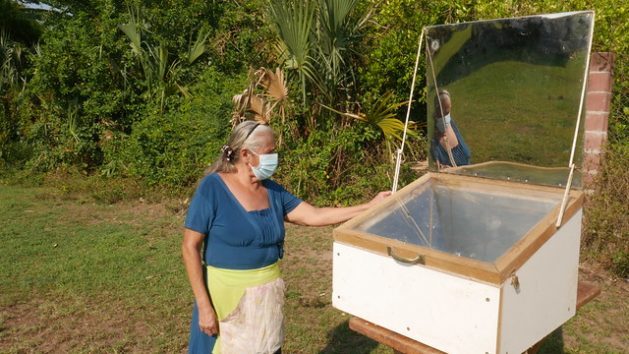
María Luz Rodríguez stands next to her solar oven where she cooked lasagna in the village of El Salamar in San Luis La Herradura municipality. In this region in southern El Salvador, an effort is being made to implement environmental actions to ensure the sustainable use of natural resources. CREDIT: Edgardo Ayala/ IPS

María Luz Rodríguez stands next to her solar oven where she cooked lasagna in the village of El Salamar in San Luis La Herradura municipality. In this region in southern El Salvador, an effort is being made to implement environmental actions to ensure the sustainable use of natural resources. CREDIT: Edgardo Ayala/ IPS

SAN LUIS LA HERRADURA, El Salvador, Mar 31 2021 (IPS) – Salvadoran villager Maria Luz Rodriguez placed the cheese on top of the lasagna she was cooking outdoors, put the pan in her solar oven and glanced at the midday sun to be sure there was enough energy for cooking.


“Hopefully it won’t get too cloudy later,” Maria Luz, 78, told IPS. She then checked the thermometer inside the oven to see if it had reached 150 degrees Celsius, the ideal temperature to start baking.

She lives in El Salamar, a coastal village of 95 families located in San Luis La Herradura, a municipality in the central department of La Paz which is home to some 30,000 people on the edge of an impressive ecosystem: the mangroves and bodies of water that make up the Estero de Jaltepeque, a natural reserve whose watershed covers 934 square kilometres.

After several minutes the cheese began to melt, a clear sign that things were going well inside the solar oven, which is simply a box with a lid that functions as a mirror, directing sunlight into the interior, which is covered with metal sheets.

“I like to cook lasagna on special occasions,” Maria Luz said with a smile.

After Tropical Storm Stan hit Central America in 2005, a small emergency fund reached El Salamar two years later, which eventually became the start of a much more ambitious sustainable development project that ended up including more than 600 families.

Solar ovens and energy-efficient cookstoves emerged as an important component of the programme.
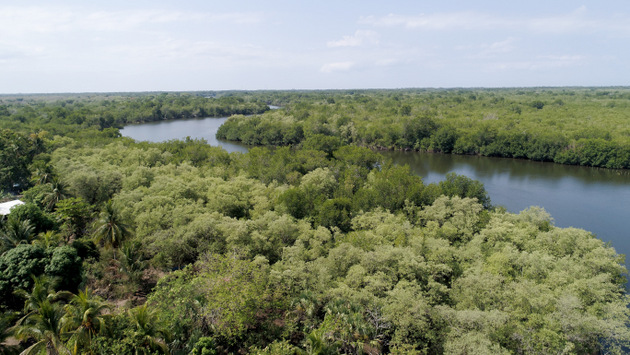
Aerial view of Estero de Jaltepeque, in San Luis La Herradura, a municipality on the Pacific coast in southern El Salvador where a sustainable development programme is being carried out in local communities, including the use of solar stoves and sustainable fishing and agriculture techniques. CREDIT: Edgardo Ayala /IPS

Aerial view of Estero de Jaltepeque, in San Luis La Herradura, a municipality on the Pacific coast in southern El Salvador where a sustainable development programme is being carried out in local communities, including the use of solar stoves and sustainable fishing and agriculture techniques. CREDIT: Edgardo Ayala /IPS

The project was financed by the Global Environment Facility‘s (GEF) Small Grants Programme, and El Salamar was later joined by other villages, bringing the total number to 18. The overall investment was more than 400,000 dollars.

In addition to solar ovens and high-energy rocket stoves, work was done on mangrove reforestation and sustainable management of fishing and agriculture, among other measures. Agriculture and fishing are the main activities in these villages, in addition to seasonal work during the sugarcane harvest.

While María Luz made the lasagna, her daughter, María del Carmen Rodríguez, 49, was cooking two other dishes: bean soup with vegetables and beef, and rice – not in a solar oven but on one of the rocket stoves.

This stove is a circular structure 25 centimetres high and about 30 centimetres in diameter, whose base has an opening in which a small metal grill is inserted to hold twigs no more than 15 centimetres long, which come from the gliridicia (Gliricidia sepium) tree. This promotes the use of living fences that provide firewood, to avoid damaging the mangroves.

The stove maintains a good flame with very little wood, due to its high energy efficiency, unlike traditional cookstoves, which require several logs to prepare each meal and produce smoke that is harmful to health.
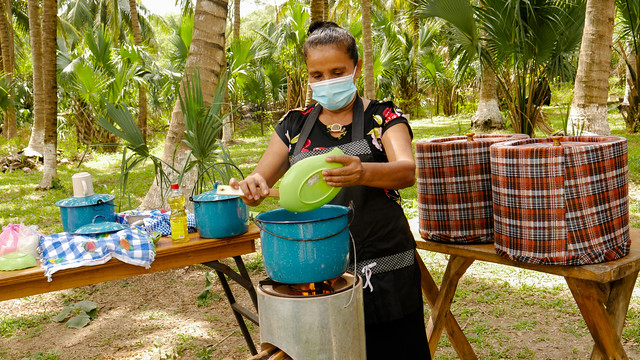
María del Carmen Rodríguez cooks rice on a rocket stove using a few twigs from a tree species that emits less CO2 than mangroves, whose sustainability is also preserved thanks to the use of the tree. Many families in the community of El Salamar have benefited from this energy-efficient technology, as well as other initiatives promoted along the Pacific coast in southern El Salvador. CREDIT: Edgardo Ayala /IPS

María del Carmen Rodríguez cooks rice on a rocket stove using a few twigs from a tree species that emits less CO2 than mangroves, whose sustainability is also preserved thanks to the use of the tree. Many families in the community of El Salamar have benefited from this energy-efficient technology, as well as other initiatives promoted along the Pacific coast in southern El Salvador. CREDIT: Edgardo Ayala /IPS

The rocket stove can cook anything, but it is designed to work with another complementary mechanism for maximum energy efficiency.

Once the stews or soups have reached boiling point, they are placed inside the “magic” stove: a circular box about 36 centimetres in diameter made of polystyrene or durapax, as it is known locally, a material that retains heat.

The food is left there, covered, to finish cooking with the steam from the hot pot, like a kind of steamer.

“The nice thing about this is that you can do other things while the soup is cooking by itself in the magic stove,” explained María del Carmen, a homemaker who has five children.

The technology for both stoves was brought to these coastal villages by a team of Chileans financed by the Chile Fund against Hunger and Poverty, established in 2006 by the government of that South American country and the United Nations Development Programme (UNDP) to promote South-South cooperation.

The Chileans taught a group of young people from several of these communities how to make the components of the rocket stoves, which are made from clay, cement and a commercial sealant or glue.
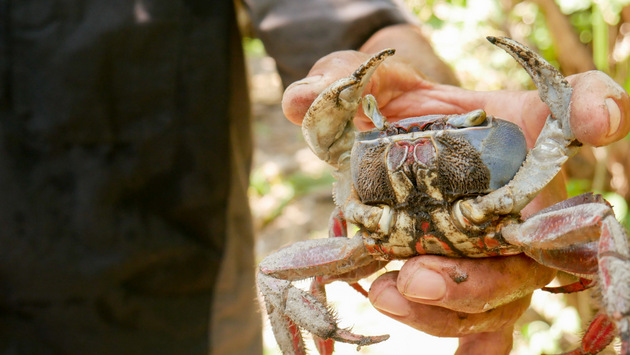
The blue crab is one of the species raised in nurseries by people in the Estero de Jaltepeque region in southern El Salvador, as part of an environmental sustainability project in the area financed by the Global Environment Facility’s Small Grants Programme. CREDIT: Edgardo Ayala/IPS

The blue crab is one of the species raised in nurseries by people in the Estero de Jaltepeque region in southern El Salvador, as part of an environmental sustainability project in the area financed by the Global Environment Facility’s Small Grants Programme. CREDIT: Edgardo Ayala/IPS

The use of these stoves “has reduced carbon dioxide (CO2) emissions by at least 50 percent compared to traditional stoves,” Juan René Guzmán, coordinator of the GEF’s Small Grants Programme in El Salvador, told IPS.

Some 150 families use rocket stoves and magic stoves in 10 of the villages that were part of the project, which ended in 2017.

“People were given their cooking kits, and in return they had to help plant mangroves, or collect plastic, not burn garbage, etc. But not everyone was willing to work for the environment,” Claudia Trinidad, 26, a native of El Salamar and a senior studying business administration – online due to the COVID pandemic – at the Lutheran University of El Salvador, told IPS.

Those who worked on the mangrove reforestation generated hours of labour, which were counted as more than 800,000 dollars in matching funds provided by the communities.

In the project area, 500 hectares of mangroves have been preserved or restored, and sustainable practices have been implemented on 300 hectares of marine and land ecosystems.
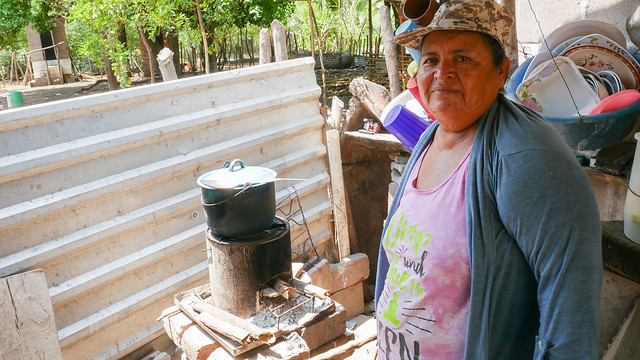
Petrona Cañénguez shows how she cooks bean soup on an energy-efficient rocket stove in an outside room of her home in the hamlet of San Sebastián El Chingo, one of the beneficiaries of a sustainable development programme in the municipality of San Luis La Herradura, on El Salvador's southern coast. CREDIT: Edgardo Ayala /IPS

Petrona Cañénguez shows how she cooks bean soup on an energy-efficient rocket stove in an outside room of her home in the hamlet of San Sebastián El Chingo, one of the beneficiaries of a sustainable development programme in the municipality of San Luis La Herradura, on El Salvador’s southern coast. CREDIT: Edgardo Ayala /IPS

Petrona Cañénguez, from the town of San Sebastián El Chingo, was among the people who participated in the work. She was also cooking bean soup for lunch on her rocket stove when IPS visited her home during a tour of the area.

“I like the stove because you feel less heat when you are preparing food, plus it’s very economical, just a few twigs and that’s it,” said Petrona, 59.

The bean soup, a staple dish in El Salvador, would be ready in an hour, she said. She used just under one kilo of beans, and the soup would feed her and her four children for about five days.

However, she used only the rocket stove, without the magic stove, more out of habit than anything else. “We always have gliridicia twigs on hand,” she said, which make it easy to use the stove.

Although the solar oven offers the cleanest solution, few people still have theirs, IPS found.

This is due to the fact that the wood they were built with was not of the best quality and the coastal weather conditions and moths soon took their toll.

Maria Luz is one of the few people who still uses hers, not only to cook lasagna, but for a wide variety of recipes, such as orange bread.

However, the project is not only about stoves and ovens.
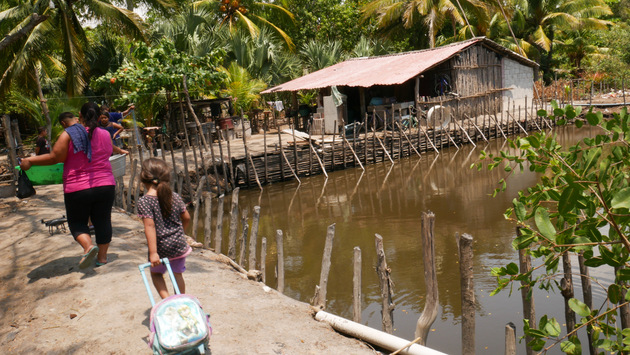
 Some families living in coastal villages in the municipality of San Luis La Herradura have dug ponds for sustainable fishing, which was of great help to the local population during the COVID-19 lockdown in this coastal area of southern El Salvador. CREDIT: Edgardo Ayala /IPS

Some families living in coastal villages in the municipality of San Luis La Herradura have dug ponds for sustainable fishing, which was of great help to the local population during the COVID-19 lockdown in this coastal area of southern El Salvador. CREDIT: Edgardo Ayala /IPS

The beneficiary families also received cayucos (flat-bottomed boats smaller than canoes) and fishing nets, plus support for setting up nurseries for blue crabs and mollusks native to the area, as part of the fishing component with a focus on sustainability in this region on the shores of the Pacific Ocean.

Several families have dug ponds that fill up with water from the estuary at high tide, where they raise fish that provide them with food in times of scarcity, such as during the lockdown declared in the country in March 2020 to curb the spread of coronavirus.

The project also promoted the planting of corn and beans with native seeds, as well as other crops – tomatoes, cucumbers, cushaw squash and radishes – using organic fertiliser and herbicides.

The president of the Local Development Committee of San Luis La Herradura, Daniel Mercado, told IPS that during the COVID-19 health emergency people in the area resorted to bartering to stock up on the food they needed.

“If one community had tomatoes and another had fish, we traded, we learned to survive, to coexist,” Daniel said. “It was like the communism of the early Christians.”
  Source

Debt Moratoria in the Next Pandemic: Be Prepared, and Be Fair

Aid, Civil Society, Featured, Global, Headlines, Human Rights, Humanitarian Emergencies, Poverty & SDGs, TerraViva United Nations

Opinion

Credit: Temilade Adelaja via Communication for Development Ltd/CGAP, Washington DC

WASHINGTON DC, Mar 25 2021 (IPS) – Imagine it is 2025 and that, unfortunately, another pandemic is sweeping the world. Much like in the 2020 crisis, borrowers have seen their livelihoods upended and are struggling to repay loans.


One of the questions before policy makers amid this new crisis is whether to extend moratoria to distressed borrowers. In search of answers, they reflect on the world’s experience with the COVID-19 pandemic and whether moratoria were part of the solution. These policy makers conclude that they did some things right in 2020.

Just days into COVID-19 lockdowns, bank regulators in more than 115 countries granted special permission for financial services providers (FSPs) to extend moratoria to millions of borrowers, especially those with small business and consumer loans. These moratoria were the next best thing to cash in the wallet for borrowers who had lost their jobs or seen their business revenue plummet.

For lower-income countries, whose governments could ill afford welfare payments, moratoria became an important form of economic relief. And by relaxing provisioning on paused loans, these special moratoria also shored up FSPs’ balance sheets and prevented panic in financial systems.

Through the moratoria, the world’s economies put the shock-absorbing capacity of financial systems to good use.

But these policy makers also see that moratoria could have worked better in some respects. So, in 2025, as the world once again turns to moratoria, they are determined to learn the lessons of the past and make moratoria work even better. What do they do differently?

Fair burden sharing

As public health authorities shutter the economy to stop the new pandemic, advocates for lower-income people are already calling on policy makers to spread the economic burden among those better able to bear it.

Policy makers know that moratoria on small loans (as well as evictions and mortgages) will shift some economic pain from lower-income families and small businesses onto banks and landlords — at least, temporarily.

But they recall that, in 2020, FSPs shifted the pain back to small borrowers by allowing interest to accrue and compound during moratoria. Ultimately, borrowers paid to pause their loans – often dearly.

Back in 2020, policy makers debated whether to shift some of the long-term burden of accrued and compounding interest away from borrowers, but it was difficult for them to find a workable solution.

In India, after much debate in the Supreme Court over who should pay this additional interest, the government found a remedy when it agreed to pay banks the compounding portion of borrowers’ interest incurred during moratoria. Implicitly, this decision made moratoria part of the government’s overall pandemic response while affirming the right of the banks to charge fully for delayed payments.

Fortunately, in 2025, several governments have included special provisions in their catastrophe protocols that pledge government funding for a portion of the interest that small loans accrue during moratoria.

This pledge helps to ensure policies intended to help low-income people don’t end up harming them. It has the added benefit of providing banks with a small amount of liquidity during the moratoria period.

Moratoria will also be fairer this time around because policy makers have universally agreed that borrowers should have the right to choose whether to accept or reject a moratorium offer. This was not always the case in 2020.

In some countries, regulators — anxious to prevent panic — and FSPs — wishing to avoid tedious case-by-case administration — promulgated blanket moratoria, even before obtaining agreement from borrowers.

However, some borrowers preferred to keep paying to avoid extra interest charges. In response to push back from borrowers on unilateral moratoria, authorities in Peru affirmed consumers’ right to unwind unwanted moratoria. Today, following this example, regulators the world over require FSPs to notify borrowers of moratoria offers and present them with the option to refuse.

Policy makers have also anticipated the challenge of maintaining borrowers’ standing with credit bureaus. When borrowers accept moratoria during a national emergency, it should not hurt their creditworthiness.

In 2020, there was confusion over how banks should report restructured loans to credit bureaus, how credit bureaus were to incorporate these loans into credit scores, and how new lenders were to use the information.

In India, FSPs simply didn’t report many loans for several months. Eventually, those problems were sorted out. Now, in 2025, credit bureaus follow well-understood protocols for handling loans in moratoria during emergencies.

Preparedness

The emergency protocols that the world’s banking authorities and FSPs put in place after the COVID-19 pandemic also address operational continuity and communications.

Back in 2020, economic lockdowns prevented in-person interactions between lenders and borrowers and often led to breakdowns in communication. In Uganda, loan officers could not meet with customers in the field, and transport restrictions prevented adequate staffing of branches and even call centers. FSPs transacting mainly in cash were caught especially flat-footed.

Thankfully, this problem is behind us now. The pandemic accelerated FSPs’ digitization plans across the world, and record numbers of borrowers started using mobile technology. FSPs serving lower-income customers now routinely communicate and transact digitally.

They have also upgraded their internal systems to handle the irregular schedules of loans in moratoria. And the expansion of digital infrastructure during and after COVID-19 now allows staff to work from home.

Consumer protection

As financial regulators and supervisors prepare for the new moratoria in 2025, they are better equipped to mitigate some of the consumer risks that appeared in 2020. They now use market monitoring tools, such as suptech, consumer phone surveys and mystery shopping, to assess consumer risks in real time. They can quickly spot issues such as abusive collections practices.

Nevertheless, both financial authorities and FSPs have learned from the previous crisis that ensuring good communication and transparency will be challenging. Moratoria are unfamiliar concepts, and the math is complicated.

Learning from 2020, when poor communication led to misunderstandings, mistakes and abuse, regulators have already issued consumer protection rules to ensure the public fully understands moratoria offers and their consequences.

Additionally, communications now flow not just to customers, but also from them. Policy makers are widely using tools that give consumers a collective voice and reveal what they are experiencing.

Several regulators have put consultative bodies in place to have a regular dialogue with consumers, and consumer associations regularly convey issues to them. Such tools proved useful in 2020.

In Peru, for example, the consumer protection agency INDECOPI listened systematically to customers and alerted regulators and FSPs to emerging abuses so that they could respond quickly.

Agility

The COVID-19 pandemic lasted much longer than anyone foresaw, and unanticipated implementation challenges arose. If policy makers learned one thing, was is that you can never anticipate all the ways an emergency will unfold.

Accordingly, the countries that were best prepared for the next pandemic were those that had established channels for authorities and FSPs to work together to respond to evolving conditions.

Source: Consultative Group to Assist the Poor (CGAP) is a global partnership of more than 30 leading development organizations that works to advance the lives of poor people through financial inclusion.

*Elisabeth is the former managing director of the Center for Financial Inclusion at Accion. She is a visiting fellow at the Financial Access Initiative and a consultant at CGAP.

*Eric Duflos, Senior Financial Sector Specialist, leads CGAP’s work on consumer protection, from policy, industry and customer perspectives, ensuring that financial services have positive outcomes for customers.

  Source

Women Will Not Reach Parity at the Pinnacle of Power for Another 130 Years, Predicts UN

Civil Society, Editors’ Choice, Featured, Gender, Global, Headlines, IPS UN: Inside the Glasshouse, TerraViva United Nations

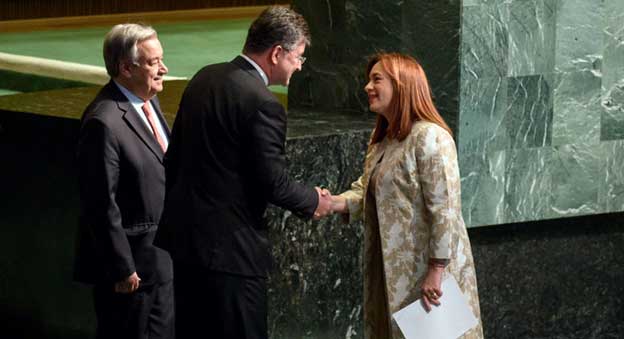
María Fernanda Espinosa Garcés was only the fourth woman in the 76-year history of the United Nations to be elected President of the General Assembly, the UN’s main deliberative and policy-making body. She was the Foreign Minister of Ecuador. She is being congratulated by the outgoing President Miroslav Lajčák, (centre) and the UN Secretary-General, Antonio Guterres. September 2018. Credit: UN / Loey Felipe

UNITED NATIONS, Mar 12 2021 (IPS) – The United Nations says the highest levels of political power remain the furthest from achieving gender parity in an increasingly male-dominated power structure worldwide.


Women serve as Heads of State or Government in only 23 countries (10 women Heads of State and 13 women Heads of Government out of 193 UN member states), while 119 countries have never had a woman leader.

At the current rate, says a new report by UN Secretary-General Antonio Guterres, parity at the pinnacle of power will not be reached for another 130 years. (based on calculations of UN-Women data, as of 1 November 2020).

But this triggers the question: Does this also apply to the United Nations, which has never had a woman as Secretary-General, while only four women have been elected to lead the General Assembly– over a period of 76 years.?

Available research demonstrates that women’s and men’s education, political experience and ages upon entering executive office are similar.

Gendered perceptions that executive offices should be filled by men, and not on the basis of credentials, account for women’s severe underrepresentation at this level., according to the report which will go before the annual sessions of the Commission on the Status of Women (CSW), March 15-26.
https://undocs.org/E/CN.6/2021/3

The CSW, described as the principal global intergovernmental body, exclusively dedicated to the promotion of gender equality and the empowerment of women, is a functional Commission of the UN Economic and Social Council (ECOSOC).

Speaking on International Women’s Day March 8, Guterres singled out the progress made on gender parity under his administration.

“Overall, we in the United Nations are on a positive trajectory towards gender parity. Two decades after the General Assembly’s first deadline, we are finally making progress across the entire United Nations system. We achieved the goal of 50-50 gender parity amongst my Senior leadership, two years ahead of my commitment,” he said.

In the Secretariat, the proportion of women in the professional categories and above has increased to over 41 per cent from 37 per cent in 2017 – a steady annual increase. “This shows that our strategy works”.

In the Secretariat’s field operations, the gender balance is 31 percent women and 69 percent men.

Guterres also said: “We are taking steps to identify qualified women candidates to replace many of the 3,000 international staff who are retiring in the next eight years, the majority of whom are men. This includes measures to develop staff and build internal talent pipelines.”

In 1953, India’s Vijaya Lakshmi Pandit, pictured at UN Headquarters alongside the then Secretary-General Dag Hammarskjöld, was elected as the 8th and first woman President. Credit: UN / Albert Fox

Gender equality is a question of power. “We live in a male-dominated world with a male-dominated culture and male-dominated power structures. This has inevitably affected the institutional culture of the United Nations, and of diplomacy as a whole”, he declared.

But does that male-dominated power structure reach out to the office of the UN Secretary-General?

Ian Richards, a former president of the UN staff coordinating committee, told IPS there have been varied reactions from UN staff to the Secretary-General’s gender parity policy, particularly when it comes to downsizing in peacekeeping operations.

“However, this year many staff have been asking us if the Secretary-General plans to apply the gender parity policy to his own position, which up to now has only been filled by men. We don’t know how to answer them on this as it is outside our mandate,” said Richards.

“The Secretary-General may wish to address this question directly,” he added.

Barbara Adams, chair of the board of Global Policy Forum, told IPS: “It’s a relief to see that the Secretary-General is no longer equating gender parity with gender equality. As we know overcoming structural or institutional discrimination of any and all kinds extends to measures beyond individual appointments.”

The recognition of importance and impact of power dynamics is welcome, but “taking” power in the present setup is a bit of a contradiction in terms, she argued.

Perhaps the quote of Simone de Beauvoir would be of interest, said Adams, a former Associate Director of the Quaker United Nations Office in New York (1981–1988).

Considered one of the most pre-eminent French existentialist philosophers and writers, Simone de Beauvoir, once famously remarked: “The point is not for women simply to take power out of men’s hands, since that wouldn’t change anything about the world. It’s a question precisely of destroying that notion of power”.


  Source

International Women’s Day, 2021The World Not Only Needs Women Leaders – It Needs Feminist Leaders

Civil Society, Crime & Justice, Economy & Trade, Education, Featured, Gender, Gender Violence, Global, Headlines, Health, Human Rights, Humanitarian Emergencies, Inequity, Labour, TerraViva United Nations, Women & Economy, Women in Politics

Opinion

The following opinion piece is part of series to mark the upcoming International Women’s Day, March 8.

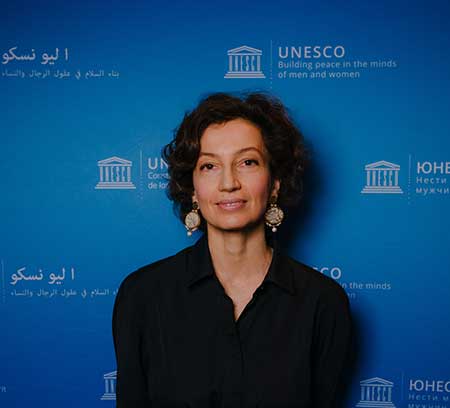
Audrey Azoulay, Director-General of UNESCO

PARIS and REYKJAVIK, Mar 5 2021 (IPS) – International Women’s Day pays tribute to the achievements of women worldwide and reminds us what still needs to be done for full gender equality. In 2021, we are taking stock of the many ways in which COVID-19 has disproportionately affected women and girls around the world.


The pandemic has created a new landscape. Although women have played a key role in responding to the crisis, gender inequalities have widened across the board. In education, 767 million women and girls were impacted by school closures. Eleven million may never return to class, joining the 132 million already out of school before the crisis struck. From the economic perspective, the recession is pushing 47 million more women and girls into poverty, destroying their economic independence and making them more vulnerable to gender-based discrimination and violence.

As we look at this landscape, we have to ask ourselves: if gender equality is our goal, what kind of leadership will the world need moving forward?

It is not enough to just count the number of women in the highest positions of power. No single person at the top of the pyramid can repair the damage being done to the progress that has been made in gender equality since the world adopted the Beijing Declaration on women’s rights 25 years ago.

What we need are leaders for gender equality – and we need them everywhere in our societal structures. Leaders of all ages, all gender identities and from all backgrounds. These leaders are not just agents of change, but designers of change. They lead through their example and engagement. They expose injustices and unequal opportunities. They know that gender inequalities stem from discrimination and exclusion and that it is only by lifting these barriers that real change can happen. This is feminist leadership.

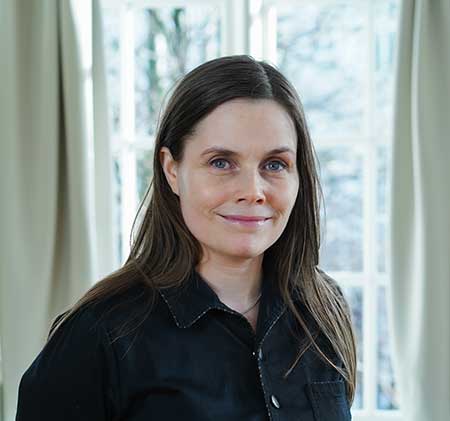
Katrín Jakobsdóttir, Prime Minister of Iceland

Feminist leaders tackle power structures. They name and deconstruct all forms of exclusion and marginalization. They empathize with the vulnerable and voiceless, and champion their causes. They open new doors and take risks, courageously blowing the whistle on hidden injustice, and unmasking structural barriers perpetuating inequalities. They are all around us. Be it the activist defending an indigenous community, the schoolgirl mobilizing her generation to save the climate, or the poet raising her voice to promote social justice.

Feminist leaders have the courage to create, report, educate, experiment. Think about Azata Soro, actress, film director and producer who broke her silence on sexual harassment and violence in the African film industry. Think about Maria Ressa, risking jail for her brave investigative journalism. Think about Yande Banda, a tireless advocate for girls’ education in Zambia and beyond. Think about Katalin Karikó, who overcame the many challenges faced by women in science and was instrumental in developing the Pfizer-BioNTech coronavirus vaccine. As stories like these become known, they challenge people’s intimate convictions of what is achievable and by whom. These women are, in all their diversity, feminist leaders.

However, feminist leadership is not the prerogative of women alone. Gender equality isn’t just a women’s fight, it’s a fight for social justice. Men also need to be involved in the construction of a fairer society. Many of them are showing the way. The Congolese gynecologist, Dr Denis Mukwege, won a Nobel Peace Prize for his advocacy to stop rape from being used as a ‘strategy of war’. And there are many others like him, all over the world.

On this International Women’s Day, we stand committed to building future generations of feminist leaders through education. We support women who dare to create and do what is necessary to prevent them from censorship and attacks. We call on the international community to ensure the safety of women journalists who address gender inequalities through their reporting. We also stand side by side with men who dare to care and reject toxic masculinities and behaviours and open up spaces for women to influence decision-making or participate in scientific discovery and innovation.

Let us support these feminist leaders, from all walks of life. Let us take action so that women can affirm their leadership and be powerful role models for generations to come. Because gender equality not only serves to advance the cause of women – a fairer society benefits us all.

Audrey Azoulay is Director-General of UNESCO and Katrín Jakobsdóttir is Prime Minister of Iceland.

  Source

International Women’s Day, 2021Gender Equality is The Roadmap We Need to Overcome Our Most Pressing Global Challenges

Civil Society, Climate Change, Development & Aid, Economy & Trade, Featured, Gender, Gender Violence, Global, Headlines, Health, Human Rights, Humanitarian Emergencies, Poverty & SDGs, Sustainability, TerraViva United Nations, Women & Climate Change

Opinion

The following opinion piece is part of series to mark the upcoming International Women’s Day March 8.

NEW YORK, Mar 4 2021 (IPS) – In 2020, progress on gender equality stalled or regressed in many countries in large part because of the far-reaching impacts of the COVID-19 pandemic. According to a recent analysis, by 2021, around 435 million girls and women will be living on less than $1.90 a day, including 47 million pushed into poverty as a result of the pandemic. Global lockdowns contributed to a surge of gender-based violence worldwide, and estimates show that sexual and reproductive health and rights (SRHR), the bedrock of gender equality, have been severely disrupted, resulting in an additional 49 million women at risk of experiencing an unmet need for modern contraception. Our most pressing global issues have seldom been so daunting, and fault lines in existing social, political, and economic systems have never been so deep.


Kathleen Sherwin

Fortunately, the evidence-based solutions we need to lay the groundwork for a future that delivers for all, including for girls, women, and underrepresented populations1 , are in plain sight. As a global community, by using gender equality as our shared North Star, we can set in motion actions that help us not only recover, but come out on the other side of our most pressing global challenges stronger. Achieving gender equality, with a focus on girls’ and women’s health and rights, must be central to the actions we take in response to COVID-19, and other deeply entrenched barriers to progress, such as climate change.

On this International Women’s Day, we’re calling on governments, the private sector, and civil society leaders to firmly position gender equality as our collective roadmap for coordinated action on COVID-19 and sustainable development. As essential first steps, together, we must prioritize collecting and using disaggregated data, securing the full and effective participation of girls and women in all aspects of decision-making, and investing more in gender equality. Sustainable progress toward a world that works for everyone depends on it.

Decision-makers must collect and use disaggregated data to set equitable action in motion.

Girls and women are too often invisible to decision-makers because data and knowledge about them is either incomplete or missing. To create policies that advance gender equality by addressing the disproportionate impacts of global challenges on girls, women, and underrepresented populations, we first need to invest in disaggregated data to get a full, intersectional picture of the uneven impacts of global issues.

In August 2020, in partnership with Focus 2030, we set out to do just that, conducting a first-of-its-kind multi-national survey — in 17 countries, representing half of the world’s population — to better understand the impacts of COVID-19 on girls and women, and global public opinion and expectations for policymaking on gender equality. We learned that girls and women are shouldering the worst of the pandemic’s impact: across 13 of 17 countries surveyed, women report experiencing greater emotional stress and mental health challenges than men, and taking on an even greater share of household tasks.

Girls and women must be fully and effectively engaged in charting our shared path forward.

Building a sustainable future for all requires the full participation — and potential — of girls and women in all aspects of our international and domestic response to global issues, and the realization of that potential depends on their health and rights. In fact, we now know that 82% of citizens globally believe women must be involved in all aspects of COVID-19 global health response and recovery efforts.

Crucially, we must engage today’s youth, who will ultimately bear the consequences of our action — or inaction — and who have the highest expectations for more government funding for gender equality. 75% of female respondents aged 18-24 expect their government to spend more on gender equality, and over 94% of young men and women are ready to take personal action to make sure that they do.

Gender equality is what citizens want, and it’s what the world needs to build a healthier future for all.

The resounding call for action on gender equality, matched by robust funding and accountability mechanisms, holds across countries surveyed for men and women, young and old alike. Over 80% of citizens globally want their government to invest more to promote gender equality, and are ready to act — from the way they vote, to the products they buy — to make sure that this happens. The resounding majority of citizens also believe that increasing access to SRHR is a top priority for immediate government action.

As governments, the private sector, and civil society leaders come together on International Women’s Day, and during upcoming global fora including the 65th session of the Commission on the Status of Women and the Generation Equality Forum to discuss how to transform words into action that improves the health of all people and the planet, ensuring that gender equality is our shared roadmap for responding to global challenges is crucial to sustainable progress now and in years to come. It’s what citizens want, and it’s what the world needs to build a healthier, more gender-equal future.

1 People of underrepresented sexual orientation, gender identity, and/or expressions, and sex characteristics (SOGIESC), and those who experience multiple and intersecting forms of discrimination and oppression.

The author is Interim President & CEO, Women Deliver

  Source

International Women’s Day, 2021To Lead is to Serve — A Pacific Woman’s Perspective

Asia-Pacific, Civil Society, Development & Aid, Featured, Gender, Headlines, Health, Humanitarian Emergencies, Inequity, Poverty & SDGs, TerraViva United Nations, Women & Climate Change, Women & Economy, Women in Politics, Women’s Health

Opinion

The following opinion piece is part of series to mark International Women’s Day March 8.

SUVA, Fiji, Mar 1 2021 (IPS) – An often quoted indigenous reference in the Samoan language is, O le ala i le pule o le tautua, literally translated, “the pathway to leadership is through service” because to be able to lead is to be willing to serve.


Since world leaders endorsed the blueprint for gender equality in Beijing 1995, women in leadership has dominated in numerous conversations and forums in terms of the need to increase women in leadership as a critical factor to achieve gender equality. Many of the perspectives shared, are about facilitating opportunities for women, advancing women in fields dominated by men, particularly in the sciences, and achieving equality in decision-making. Women in leadership has become a popular discourse from development, to academia, to politics, to science and innovation; and organisations across all sectors are recognizing the importance of inclusivity and equity for achieving sustainable development.

The 2020 Pacific review of the Beijing Platform for Action, 25 years after Beijing, highlighted that Pacific states still have a long way to go in achieving balanced representation of women in national parliaments. With the exception of the French Territories where equitable representation of women in their legislative assemblies is ensured by the French ‘parity law’, women’s representation in national parliaments across the region is shockingly low and temporary special measures (TSMs) are only used in a few states. At all levels, and across all nations, gender power dynamics disadvantage women as decision makers; and socio-cultural norms in the Pacific see men as the ‘natural’ spokespeople for families, communities and governments. That said, the report also noted an increase in women’s participation in all levels of decision-making at community levels, in public service and in civil society organisations. This raises a number of challenging questions.

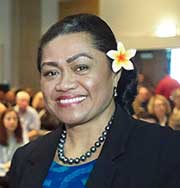
Leituala Kuiniselani Toelupe Tago-Elisara

Where does this lead us in a pandemic environment? COVID-19 has exacerbated existing and ongoing inequalities in the Pacific, hindering what is already very slow progress for achieving gender equality. The evidence is quite clear as to where these inequalities are found and policy dialogues and talanoa sessions held within the region over the last two and a half decades, have generated a multitude of recommendations on what can be done by governments and as a region. What then is the problem, we ask ourselves? It’s the resourcing, the response, the lack of political will and commitment, and the list goes on, that women leaders and women engaging in the gender space, know all too well.

So, what can we do and what does this mean for Women in Leadership? The answer lies in our ongoing concerted efforts to have women at the table with an equal voice to speak for the 50% of our population. We will keep pushing to have women leaders at the table who understand women’s lived experiences and needs, and that these are translated into decision-making on resource allocation and prioritisation. We need women who lead, knowing that they have families and communities to attend to after work, and appreciate the value of unpaid care work. More importantly, we need the same women leaders at the table to share those perspectives with their men counterparts, to affect change that will transform societies and enable positive and inclusive change for gender equality at all levels in society and across all locations – urban, rural and remote.

Our unprecedented experience with COVID-19 has changed the way we live, the way we work and certainly the way we exercise leadership and deliver service. It has reminded us that with border closures and travel restrictions, we need to be searching within our own borders and within our own societies for solutions. One of these solutions is for us to utilize and capitalize on the often-untapped skills, knowledge and expertise of women, to generate solutions for our development challenges. The role of women, as we are seeing in recovery efforts across the Pacific, is a testament to the service they continue to provide for our families and our communities. It is evidenced in women’s resilience and their significant capabilities in managing our communities and societies through multiple disasters and climatic events over the years, and through the multitude of cultural and customary obligations that we have all lived through, and will continue to live through. It is a reflection of women’s knowledge of our Pacific ways of knowing and ways of being, gathered and passed down from generation to generation.

The impacts of COVID-19 are huge and as a region and as a people, it will take some time to navigate our way through these impacts towards full recovery. However, if there is one learning that I take away from this crisis, it is our ability to remain resilient and to continue to serve each other and our people, with our women holding the fort in all our societies and communities across the Pacific Ocean, through their ongoing service. It is a manifestation and a living example of leadership through service, because to be able to lead is to be willing to serve, and being able to serve is being able to lead, and such is the spirit of Pacific women in leadership.

Leituala Kuiniselani Toelupe Tago-Elisara is Acting Regional Director, Polynesia Regional Office Pacific Community (SPC)

  Source