Funding, Policy Changes Could Result in Countries Reaping Benefit of Migration

Active Citizens, Africa, Civil Society, Development & Aid, Editors’ Choice, Featured, Global, Headlines, Human Rights, Humanitarian Emergencies, Inequality, Migration & Refugees, TerraViva United Nations

Migration & Refugees

The African Unions Migration Policy Framework for Africa (2018-2030) provides guidelines to manage migration and reap the benefits of well managed migration which contribute to global prosperity and progress. Credit: UNHCR

The African Unions Migration Policy Framework for Africa (2018-2030) provides guidelines to manage migration and reap the benefits of well managed migration which contribute to global prosperity and progress. Credit: UNHCR

BULAWAYO, Zimbabwe, Feb 23 2024 (IPS) – Amid an escalation of global conflict and climate change-induced displacements, the International Organization for Migration (IOM) is escalating its donor campaign.


For the first time since the organization’s formation in 1951, the IOM says it is “proactively approaching all partners to fund this vital appeal,” at a time when the number of migrants making perilous intercontinental journeys has increased.

“Irregular and forced migration have reached unprecedented levels and the challenges we face are increasingly complex,” said IOM Director General Amy Pope at the launch of the Global Appeal in Geneva in January.

It added to its appeal this week, asking for USD 112 million to provide urgent humanitarian and development assistance to over 1.4 million migrants and host communities in the Horn of Africa, Yemen, and Southern Africa. Routes from the Horn of Africa to Yemen and the Gulf States, and the Southern route from the Horn of Africa through Kenya and Tanzania to Southern Africa, are among the most dangerous, complex, and under-reported migratory routes in the world. In 2023, nearly 400,000 movements were recorded across the Eastern route, while an additional 80,000 movements were recorded on the Southern route, particularly to South Africa, the statement read.

“The evidence is overwhelming that migration, when well managed, is a major contributor to global prosperity and progress. We are at a critical moment in time, and we have designed this appeal  to help deliver on that promise. We can and must do better,”  Pope said at the launch.

The IOM has broken down the appeal as follows:

  • USD 3.4 billion for work on saving lives and protecting people on the move.
  • USD 2.7 billion for work on solutions to displacement, including reducing the risks and impacts of climate change.
  • USD 1.6 billion for work on facilitating regular pathways for migration.
  • USD 163 million for work on transforming IOM to deliver services in a better, more effective way.

“Full funding would allow IOM to serve almost 140 million people, including internally displaced people and the local communities that host them. Crucially, it would also allow for an expansion of the IOM’s development work, which helps prevent further displacement,” the IOM said in a media briefing.

However, experts and researchers say the global migration that has peaked in recent years has deeper, more complex roots that will require more than just responding to after the fact.

“What we’re seeing is a willingness from officials and citizens to thoroughly dehumanise migrants,” said Loren Landau, professor and chair at the University of Witwatersrand African Centre for Migration and Society.

“Not only can they be left to suffer, but they should be made to suffer. Only by doing this can ‘we’ send a message that others are unwelcome. The policies of the EU, Australia, and even South Africa are all designed to broadcast this sentiment,” Landau told IPS.

The IOM estimates that there are more than 140 million displaced people, and it’s global appeal for donor support will “save lives and protect people on the move, drive solutions to displacement, and facilitate safe pathways for regular migration.”

Thousands continue to make efforts to illegally enter Europe and the USA with assistance from traffickers,.

According to the IOM’s Missing Migrants Project, 60,000 people have died or disappeared on perilous journeys to seek economic opportunities over the last nine years.

Migration has in recent years become a political hot button, with right-wing political parties in Europe accused of whipping up public sentiment against migrants.

However, Landau says global inequality has worsened the displacement of millions of people.

“Migration has long been a crisis, although it has often been framed differently. There have always been displaced people. There has long been violence and corruption on the border. However, it has now moved from the edge of public debate to the centre,” Loren said.

“Global inequality, labour demand, conflict, and environmental factors are encouraging people to move, but movement is natural,” he told IPS.

Claims that migrants steal jobs from locals and force governments to divert social spending to accommodate migrants have fueled anti-immigrant sentiment.

Researchers, however, have always questioned those claims as the IOM ups its efforts to assist migrants in their new domiciles.

“Migrants are generally not why fewer people have secure employment, social protection, or feel their cultures and values are under threat.  But in light of those anxieties, migrants have become the fetish on which politicians and the public fixate,” Landau added.

In its appeal for donor funding, the IOM says well-managed migration “has the potential to advance development outcomes, contribute to climate change adaptation, and promote a safer and more peaceful, sustainable, prosperous, and equitable future.”

“The consequences of underfunded, piecemeal assistance come at a greater cost, not just in terms of money but in greater danger to migrants through irregular migration, trafficking, and smuggling,” said Pope.

“Getting the job done requires greater investment from governments, the private sector, individual donors, and other partners,” said Pope.

The African Union, which has seen the bulk of global migration, says the continent has witnessed changing patterns of migration, “a phenomenon that has become both dynamic and extremely complex.”

As part of efforts to address this and in what is expected to aid the work being done by the IOM, the AU set up the Migration Policy Framework for Africa (2018–2030).

The Framework provides “guidelines to manage migration in a coherent manner and therefore reap the benefits of migration.”

Those benefits are captured in IOM findings that “281 million international migrants generate 9.4% of global GDP.”

Despite the dangers that have come to define migrant experiences, especially on the high seas, the factors that drive millions to leave their homelands remain unresolved.

“There are immediate practical concerns about ensuring people can migrate safely,” said Landau.

“Beyond this, there is a broader need to recalibrate how we speak about these issues. Migration is not going anywhere so there’s a need to shift the framing from one of crisis to one of ‘the new normal’, Landau told IPS.
IPS UN Bureau Report

  Source

Children’s Futures at a Crossroads

Armed Conflicts, Civil Society, COVID-19, Featured, Global, Global Governance, Headlines, Human Rights, TerraViva United Nations

Opinion

Credit: UNICEF/Abdulazeem Mohamed

 
War in Sudan is putting the future of its 24 million youngest citizens at risk, the Representative of the UN Children’s Fund (UNICEF) warned. January 2024

 
Meanwhile geopolitical and geoeconomic fragmentation threaten the development and survival of children across the globe. But a more hopeful path exists.

UNITED NATIONS, Feb 23 2024 (IPS) – At the start of 2024, we stand at a critical juncture: Geopolitical tensions are escalating, economic integration is unravelling, and multilateral cooperation is faltering. This global fragmentation threatens to undermine decades of progress made for children worldwide.


The choices we make today – whether to continue on this path or whether we should bolster global cooperation – will have a profound impact on generations to come.

Children are always the most vulnerable in times of crisis – a reality highlighted by the COVID-19 pandemic, when school closures, economic hardship and disrupted health services jeopardized children’s rights and wellbeing.

Almost four years since that pandemic was declared, our new report, Prospects for Children in 2024: Cooperation in a Fragmented World, paints a concerning picture for children’s future development and welfare.

Tensions among major powers are rising and the threat of new conflicts emerging is high. Beyond the immediate physical dangers, children can experience lasting psychological trauma and violations of their basic rights.

If military spending continues increasing at the expense of investments in healthcare, education and social protections, children’s development will be further compromised.

Meanwhile, economic fragmentation is widening disparities between countries. Restrictive trade policies and supply chain disruptions are leading to rising energy and food prices, reducing access to essential goods and negatively impacting child nutrition and household incomes.

Competition for critical minerals essential for the green economy is increasing the risks of trade fragmentation while threatening the pace of the green energy transition. At the same time, the drive to expand mining for minerals puts mining communities and children at risk of exploitative practices.

Despite continued global economic growth, the lukewarm and uneven recovery is diminishing prospects for reducing child poverty. From now until 2030, 15 million more children a year will be living in poverty than would have otherwise, due to the unequal post-COVID recovery.

This gloomy picture is compounded by the weakening of multilateral institutions, which is further undermining the potential for progress for children. Why?

Because a fragmented multilateral system that is hamstrung by competing interests will struggle to deliver on conflict prevention, climate change, effective digital governance, debt relief and enforcing child rights standards, fuelling dissatisfaction in the Global South with rising inequalities.

Children in the poorest nations also face continued barriers to financing for basic services. Crippling debt, high remittance fees and lack of voice in global economic governance restrict investments in healthcare, education and social protections – investments vital to children’s survival and development.

But amid all these concerning trends, we see still signs of hope. Alternative alliances are emerging in the developing world to advance cooperation, bringing novel policy solutions, more nimble policymaking and effective results.

Despite expressing discontent with current democratic political structures, young people remain optimistic that opportunities exist to reform and resolve deficiencies in the political system, whether at the national or international level. They are engaging as change-makers, breathing new life into civic participation and democratic renewal.

In addition, technological innovations are unlocking new opportunities to empower children and enhance their rights. Green transition, if carried out in a just and sustainable way – one that prioritizes young people’s needs, skills and access to jobs in emerging sectors (such as the digital and green economy) – can benefit younger generations.

Reforms and modernization of global governance and financing arrangements could still deliver greater justice for developing countries. This more hopeful path will not unfold on its own. It requires global leaders to make an active choice – to double down on solidarity, inclusion and cooperation despite tensions and instability.

Prioritizing children and their rights must be at the centre of this choice.

Jasmina Byrne is Chief, Foresight & Policy, UNICEF Innocenti – Global Office of Research and Foresight.

IPS UN Bureau

  Source

Pakistan’s Election Outcomes Leave Many Unhappy

Asia-Pacific, Civil Society, Crime & Justice, Economy & Trade, Featured, Headlines, Human Rights, Press Freedom, TerraViva United Nations

Opinion

Credit: Rebecca Conway/Getty Images

LONDON, Feb 22 2024 (IPS) – Pakistan’s 8 February election has resulted in an uneasy compromise that few wanted or expected. There’s little indication the outcome is going to reverse recent regression in civic freedoms.


Army calls the shots

Around 128 million people can vote in Pakistan, but it’s the army, the sixth-biggest in the world, that’s always had the upper hand. In recent decades, it’s preferred to exert its power by strongly influencing the civilian government rather than outright military rule. Prime ministers have allied with the military to win power and been forced out when disagreements set in. No prime minister has ever served a full term.

In April 2022, Prime Minister Imran Khan was ousted through a parliamentary vote of no-confidence. But it was common knowledge this was the military’s will. Khan, having cosied up to the generals to come to power in 2018, had publicly and vocally fallen out with them over economic and foreign policy. He had to go.

Khan’s fall from grace was swift. He survived an assassination attempt in November 2022. In December 2023, he was barred from running in the election. Just ahead of voting he was found guilty in three separate trials, with the longest sentence being 14 years. Bushara Bibi, Khan’s wife, was jailed too.

The army turned to a former foe, Nawaz Sharif, three times previously prime minister. After he last fell out of favour in 2017, he was forced out and found guilty of corruption. Yet for this election he’d evidently patched things up enough to become the army’s favoured anti-Khan candidate.

A catalogue of restrictions

But voters didn’t go along with the army’s choice. Candidates running as independents but affiliated with Khan’s Pakistan Tehreek-e-Insaf (PTI) party won the most seats, albeit short of an outright majority. Sharif’s Pakistan Muslim League-Nawaz (PML-N) came second, with the Pakistan People’s Party (PPP), its partner in the 2022 coalition of convenience that replaced Khan, third.

This was a shock result, given the obstacles placed in the PTI’s way. The government postponed the election from November to February so, it said, it could hold a census. The suspicion was that the move was to allow more time to prosecute Khan and lean on his party’s politicians to swap allegiances.

Sure enough, some PTI representatives were banned from standing and others faced harassment and violence seeking to persuade them to distance themselves from Khan. In the biggest blow, PTI candidates were banned from using Khan’s cricket bat symbol on ballot papers. Symbols are crucial for mobilising party support, since over 40 per cent of people are unable to read. PTI candidates were forced to run as independents.

There was never any prospect of equal space for campaigning. Last year, the media regulator applied a de facto ban on mentioning Khan’s name on TV. In August 2023, it directed TV channels not to give airtime to 11 people, among them Khan and journalists considered sympathetic towards him. As the election neared, the military interfered in the media on a daily basis, telling them which stories to run.

Given these constraints, and the near impossibility of holding physical rallies, PTI used online opportunities. Khan kept up a virtual presence through AI-generated videos. WhatsApp was used to inform PTI supporters which independent candidates to vote for.

But constraints came here too. When the PTI organised an online rally in December, authorities blocked access to major social media platforms and slowed the internet down. On election day, they imposed a full internet and mobile data shutdown for the first time in Pakistan’s electoral history. The authorities claimed they’d done so on security grounds – the Islamic State terrorist group carried out two deadly bombings the day before – but it made independent oversight of voting and counting much harder. Further restrictions on Twitter followed after the results were out.

This pressure on the PTI and its supporters came on top of the ongoing repression of civic freedoms by successive governments. Pakistani authorities have continued to criminalise, threaten and harass human rights activists, restrict online freedoms, intimidate journalists, censor media and violently repress peaceful protests, particularly by women’s rights activists and people from the Baloch and Pashtun ethnic groups.

Uncertainty ahead

Despite the highly unlevel playing field, results show that many took the opportunity the election offered to communicate discontent with military influence, a political establishment dominated by two families and the dire economic conditions. A youthful population has found something appealing in Khan’s fiery populist rhetoric.

But what’s resulted is something few voters likely wanted. The PML-N and PPP quickly announced a resumption of their coalition. The PML-N’s Shehbaz Sharif, Nawaz Sharif’s brother, is set to return as prime minister. It would appear to be a coalition united by little more than a determination to keep the PTI out of power, suggesting a weak and fractious government will result.

Strong opposition can be expected. PTI supporters aren’t accepting this quietly. The party claims rigged votes denied it more seats. Thousands have protested and numerous legal cases have been filed. Their claims were given credence when an official in Rawalpindi stepped forward to say he’d been involved in election rigging. One politician from a minor party also announced he was renouncing his seat because the vote had been rigged to exclude the PTI-backed candidate.

Khan is no democratic hero. When he was in power and enjoyed the military’s favour, he used the same tools of repression now being applied to him and his party. Civic space conditions worsened under Khan and there’s been no let-up since.

The bigger problem is a system where the military calls the shots, sets the parameters that elected governments must stay within and actively works to suppress dissent. With many young voters angry and wanting change, problems can only be building up for the future. It’s vital that civic space be opened up so people have peaceful means to express dissent, seek change and hold power to account.

Andrew Firmin is CIVICUS Editor-in-Chief, co-director and writer for CIVICUS Lens and co-author of the State of Civil Society Report.

  Source

Snowless Winter and a Climate Crisis: Kashmir’s ‘Unprecedented’ Weather

Asia-Pacific, Civil Society, Climate Change, Climate Change Justice, Editors’ Choice, Environment, Featured, Food and Agriculture, Food Security and Nutrition, Headlines, Natural Resources, Sustainable Development Goals, TerraViva United Nations

Climate Change

Local Muslims held special prayer ceremonies in January for snowfall. Credit: Umar Manzoor Shah/IPS

Local Muslims held special prayer ceremonies in January for snowfall. Credit: Umar Manzoor Shah/IPS

SRINAGAR, India, Feb 20 2024 (IPS) – Abdul Gani Malik, a 75-year-old goldsmith living in Kashmir’s capital, Srinagar, has witnessed eras of tranquility and turbulence in the Himalayan region. What he has not seen, however, is a snowless Kashmir during the winter.


Malik still works at his shop, located in one of the jam-packed markets of the old city area of Kashmir’s capital, intricately lacing colorful emeralds on dazzling gold necklaces. While conversing with IPS, he mentions that the winter in Kashmir has never been so terrible and terrifying as it has been this year.

He recalls how, during the 40-day harshest winter period from December 21 to January 30, snow would accumulate to about six or seven feet, freezing and making pathways treacherous even for city dwellers. In the mountainous region, according to Malik, the snow would last for several months, regulating temperatures during the summer and providing water and food.

“Now is a different tale. The mountains appear dry and dead. The rivers are carrying no water, and our woods are bereft of life. This is an absolute apocalypse,” Malik said.

The region of Kashmir is located in the north-western complex of the Himalayan ranges, with marked relief variation, snow-capped summits, antecedent drainage, complex geological structure, and rich temperate vegetation and fauna.

Kashmir’s winter is traditionally divided into three parts: Chilay Kalan (old man winter), Chilay Khuarud (young winter), and Chilay Bacha (kiddy winter). The coldest part, called Chilay Kalan, starts on December 21 and ends at the end of January. It is during this period that snowfall is expected.

“The temperatures during this period plummet to even minus 8 to 10 degrees Celsius, and when it snows, it accumulates in glaciers. The snowfall in the later period is of no use,” says Abdul Ghani Malik.

He was part of the congregational prayers held across Kashmir for snowfall. Local Muslims, who constitute more than 90 percent of the local population, decided in January to hold special prayers for snowfall in all major mosques. “We prayed, and we hope God listens to our plight.”

According to Abid Ali, a student of environmental sciences from Kashmir, Kashmir’s livelihood depends on snowfall, and if it doesn’t snow, things are going to take a terrible shape.

“The region’s electricity system, agriculture, and tourism are all dependent on snowfall. The dry winter will prove catastrophic for the local populace,” Abid said.

Kashmir, as per estimates, reported a 79 percent precipitation deficit through December of last year. Indian meteorologists claim that unusual weather is linked to global warming and El Niño, the sporadic climate phenomenon that can create warm, dry conditions in the Indian subcontinent and other parts of Asia.

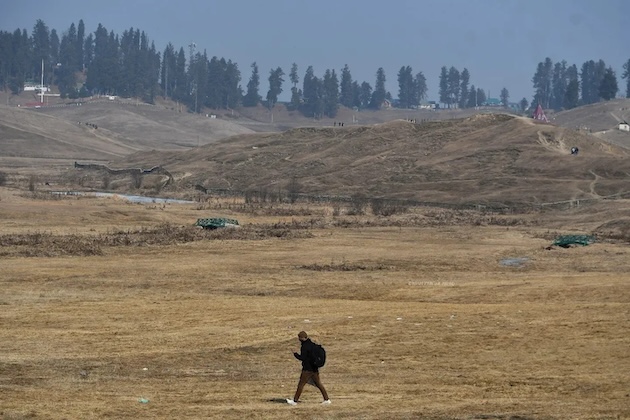
A man walks through an area in Kashmir where low snowfall is causing concern as the region’s economy is highly dependent on it. Credit: Umar Manzoor Shah/IPS

A man walks through an area in Kashmir where low snowfall is causing concern as the region’s economy is highly dependent on it. Credit: Umar Manzoor Shah/IPS

Threat to Agriculture

In Kashmir, 60 percent of the state’s revenue comes from agriculture and horticulture, and about 80 percent of the population lives in rural areas.

However, over the years, the valley has experienced irregular patterns of precipitation. In the first five months of 2022, Kashmir saw a 38 percent rain shortage, according to data provided by the Meteorological Department (MeT) in Srinagar.

The data reveals that the Kashmir Valley has experienced a significant lack of pre-monsoon precipitation over the years. From March 1 to May 31, 2022, the region got 99.5 mm of rain, 70 percent lower than average.

Comparatively, between March and May of each of the following years—2017, 2018, 2019, 2020, and 2021—there was a deficit of 16, 28, 35, and 26 percent, respectively. The dry winter this year is already throwing life out of gear for the farmers.

Abdul Karim Ganaie, a farmer hailing from south Kashmir’s Pulwama, says the threats are menacingly looming large, and people cannot do anything other than watch helplessly as the crisis unfolds.

When IPS contacted Choudhary Mohammad Iqbal, the director of agriculture in Kashmir, he stated that the department was closely monitoring the situation and would be issuing a warning to the farmers in the coming months.

“We accept that the situation is going to prove worrisome for Kashmir’s farming community, but we have to adopt a strategy to ensure minimal losses. We are working on that front,” Choudhary said.

Tourism under Cloud

The famous tourist destinations in Kashmir are also witnessing a dip in tourist arrivals, putting the people associated with this business in dire straits. In January, the famous tourist resorts recorded the lowest arrival of foreign and domestic tourists, with only 30 percent occupancy in hotels.

It snows at last but too little, too late!

Finally, in the first week of February, when the harshest 40-day-long spell was already over, it snowed in most of the areas of Kashmir. However, according to experts, the snow would yield the fewest results as it is not possible to accumulate for an extended period.

What is important, says Mehraj Ahmad, a research scholar working on climate change in Kashmir, is that the snow must accumulate in the higher reaches for as long as possible until the arrival of summers.

“The snowfall of February or March carries the least significance when compared with the snowfall of January. Therefore, we really are keeping our fingers crossed and praying for the safeguard of our lives against the dark, dreadful effects of climate change,” Ahmad said.

IPS UN Bureau Report

IPS UN Bureau, IPS UN Bureau Report, India, Kashmir

  Source

Last Chance Saloon? Myanmar Junta Imposes Military Conscription

Armed Conflicts, Asia-Pacific, Civil Society, Editors’ Choice, Featured, Headlines, Human Rights, Humanitarian Emergencies, Migration & Refugees, TerraViva United Nations

Armed Conflicts

A Buddhist pagoda towers above a teeming thoroughfare in Mae Sot, a Thai town dense with tens of thousands of people fleeing conflict in nearby Myanmar. Credit: William Webb/IPS

A Buddhist pagoda towers above a teeming thoroughfare in Mae Sot, a Thai town dense with tens of thousands of people fleeing conflict in nearby Myanmar. Credit: William Webb/IPS

MAE SOT, Thailand, Feb 15 2024 (IPS) – The news travelled like wildfire. In the teashops, bars, and market stalls that make Thailand’s border town of Mae Sot feel far more Burmese than Thai, the feared rumours circulating at the weekend were suddenly confirmed.

Military conscription would be imposed on young men and women for two to five years, regime-controlled broadcasters in Myanmar announced on the Saturday night airwaves. Details were sparse.


Panic scrolling through social media suddenly replaced conversation in one popular Mae Sot hangout run by a Burmese activist-entrepreneur for his clientele of exiles, fugitives, and migrants. Pool players stopped mid-break. “What the ***!” exclaimed the member of a rock band. 

Myanmar’s junta has been at war with much of the country since staging a coup three years ago, but still, it has come as a serious shock that for the first time in modern history, the military will impose on young people the choice of two uniforms—army or prison.

Analysts—Burmese and foreign—interpreted the developments in various ways. For some, it was a clear sign that the military was losing this patchwork civil war and could not sustain itself. For decades, it had thrived on recruiting youngsters from poor areas of the Bamar-majority heartlands of Sagaing and Magwe. But now those same arid regions are hotbeds of resistance against the regime, its forces stretched across the length and breadth of almost the entire country, depending mostly on air power to bomb civilian areas into submission.

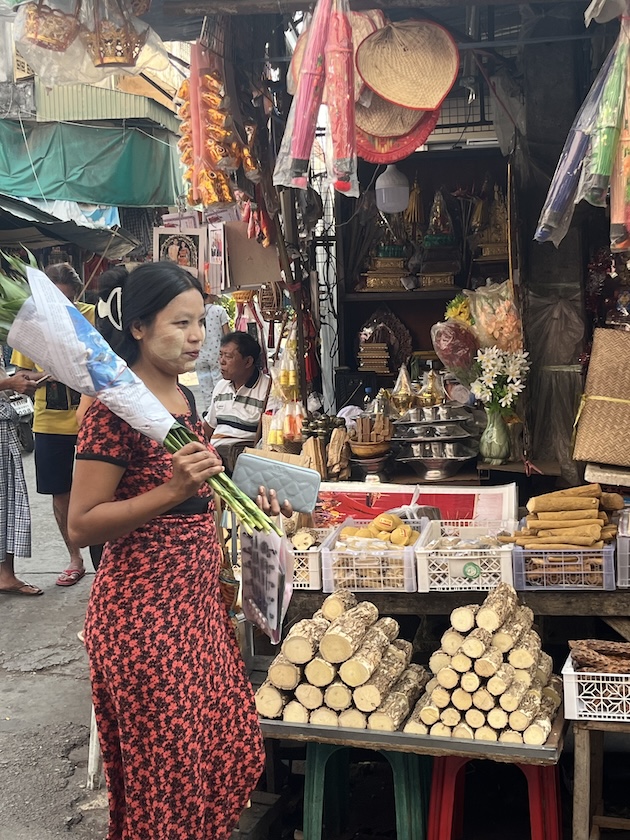
A Burmese woman wearing thanaka to protect her face from the sun walks through a market in the Thai border town of Mae Sot. The stall is selling the wood bark that is ground into the cosmetic paste so popular in Myanmar. Credit: William Webb/IPS

A Burmese woman wearing thanaka to protect her face from the sun walks through a market in the Thai border town of Mae Sot. The stall is selling the wood bark that is ground into the cosmetic paste so popular in Myanmar. Credit: William Webb/IPS

“An act of desperation,” Igor Blazevic said of the junta’s move, which follows sizeable territorial losses and a meltdown of its forces in northern Shan State late last year. Blazevic, a Myanmar expert at the Prague Civil Society Centre, predicted on Facebook that the measure would backfire because the regime was too “weakened and broken” to be able to administer recruitment on a large scale.

But on Monday night, more news was breaking that indicated the junta had got its ducks in a row—airports were suddenly requiring military authorisation stamped on tickets for even internal domestic flights. According to unconfirmed reports, some junta-controlled border posts were closing or imposing similar restrictions, and young men had been picked up on the streets of the commercial capital Yangon.

“It’s another way of terrorising the population,” was the view of one young Burmese who did not want to be named for obvious reasons.

In the Myanmar capital, Nay Pyi Taw, junta spokesperson Zaw Min Tun simply said conscription was essential because of the “situation”.

“The duty to safeguard and defend the nation extends beyond just the soldiers but to all citizens. So I want to tell everyone to proudly follow this people’s military service law,” he intoned.

No way, retorted May, a young refugee whose dream of becoming a doctor was shattered by the 2021 coup and the arrest of her father.

She said compulsory military service would simply drive more young people to join the People’s Defence Forces of the resistance— despite the heavy losses they are incurring and the military’s barbaric treatment of prisoners subjected to torture, summary executions, and, most recently, strung up and torched.

May slipped across the nearby border into Mae Sot with her family after spending two years as a refugee in a camp run by a section of the Karen National Liberation Army fighting what is known as the world’s longest-running civil war dating back to 1949.

“I cannot go back to Myanmar,” she said. At 19 years old, she fits the age range of 18 to 27 for single women to be conscripted. For men, it is 18 to 35 years, rising to 45 for specialists like doctors and IT workers who quit their state sector posts in droves after the coup, joining the Civil Disobedience Movement (CDM) of non-violent resistance.

On Sunday night in Mae Sot, large crowds of this latest wave of the Myanmar diaspora gathered for an outdoor CDM fund-raising concert, featuring dancing and music performed by several of the country’s ethnic minorities, including Karen and Chin. The concert was sponsored by an online bank set up by the resistance. Stalls sold knick-knacks and garments, and beer and hot food were swiftly ferried about by teams of neatly dressed waiters.

May and her entrepreneurial family had their properties and businesses seized and sealed by the military near Mandalay and are now rebuilding their lives, running a small restaurant among the estimated 100,000 to 200,000 Burmese living in and around Mae Sot, setting up businesses, social services, and accommodation safe from predatory Thai officials and regime spies.

May remains determined to study medicine somewhere somehow, representative of a young, capable, and innovative generation of Burmese plugged into a digital world while moving in and out of the shadows of war.

Bo Kyi, a veteran activist and former prisoner who co-founded the Assistance Association of Political Prisoners in Mae Sot 24 years ago, saw the military’s conscription order as a “huge challenge” for young people, especially those who had tried to keep out of politics and war. It would become very hard to leave the country legally now, he said.

“Millions will suffer and Burma will lose its human resources,” he said.

[embedded content]

William Webb is a travel writer who started out in Asia nearly 50 years ago

IPS UN Bureau Report

  Source

Moimuna Nursing Institute Ushers Hope for Vulnerable Rural Girls in Bangladesh

Aid, Asia-Pacific, Civil Society, Development & Aid, Editors’ Choice, Featured, Gender, Headlines, Health, Human Rights, Inequality, Sustainable Development Goals, TerraViva United Nations, Youth

Active Citizens

Dr MA Sayed conducts a practical with his students at the Moimuna Nursing Institute. Credit: Rafiqul Islam/IPS

Dr MA Sayed conducts a practical class with his students at the
Moimuna Nursing Institute. Credit: Rafiqul Islam/IPS

THAKURGAON, Bangladesh, Feb 6 2024 (IPS) – After passing her secondary school certificate (SCC) in 2019, Sweety Akter went door-to-door to collect money to enroll in a college, but she wasn’t successful.

Born to an extremely poor family in Fultala village under Baliadangi upazila in Thakurgaon district, Akter saw her dream of studying fading as she was unable to enroll in a college because of a lack of funding, despite her good results at school.


“I went to many places but did not get the opportunity for admission. I did not have the financial support to study at a private college or an educational institute.”

Then Sweety’s fortune changed.

“I luckily got a chance to study for a nursing diploma free of charge at Moimuna Nursing Institute (MNI),” she told IPS.

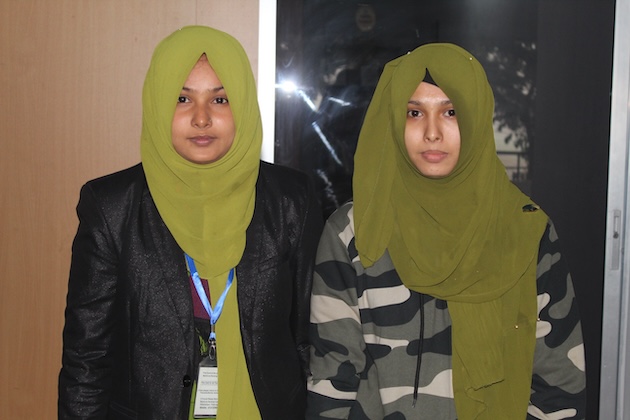
Two sisters, Sweety Akter (left) and Shikha Akter (right) enrolled in Moimuna Nursing Institute, Sweety has already completed a nursing diploma with financial support from the institute and Shikha is now a second-year student. Credit: Rafiqul Islam/IPS

Two sisters, Sweety Akter (left) and Shikha Akter (right), are enrolled in Moimuna Nursing Institute. Sweety has already completed a nursing diploma with financial support from the institute, and Shikha is now a second-year student. Credit: Rafiqul Islam/IPS

Explaining her financial hardships, the 22-year-old Akter said her father is a gambler who had sold all the family’s assets to gamble, and he had even sold their lone homestead, where they are currently living.

“My father does not give me and my younger sister any money for education. My mother works as domestic help at the houses of people and is bearing the costs for our four-member family,” she said.

Sweety said that if she had not had the opportunity to enroll at MNI, it would have been impossible for her to pursue tertiary education, and she would have been forced to marry.

Overcoming all the odds and passing the nursing diploma, she is now pursuing an internship at Rangpur Medical College and Hospital (RMCH) with financial support from the institute, which paves the way for former students to get jobs at hospitals.

Shikha Akhter (19) enrolled in Moimuna Nursing Institute in Thakurgaon, northwest Bangladesh, to pursue a diploma in nursing science and midwifery with the encouragement of her sister, Sweety.

Shikha said she enrolled in the institute at a minimum fee, and now she is enjoying more facilities than other students as her elder sister also studied there.

“I am studying the nursing diploma and staying at the MNI’s hostel, which makes my life easy. I want to be a good nurse and serve people,” she added.

Joya Rani, a 20-year-old girl from poverty-stricken Kaliganj village under Deviganj upazila, also studied the nursing diploma with financial support from the institute.

“My father is physically challenged, so he cannot work. My mother is the only breadwinner for our family, and she supports the family by rearing cattle. That’s why she cannot give me any money (for study),” she told IPS.

Joya, who is currently doing an internship at RMCH, said she received a stipend of Taka 2,000 (USD 19) from the institute over the past two years, and if she had not received the stipend, it would not have been possible for her to continue studying.

Moimuna Nursing Institute, located 460 kilometers away from the capital Dhaka, is a non-profit approved by the Bangladesh Council of Nursing and Midwifery and offers a three-year diploma in nursing for about USD 1,500, which includes tuition fees, accommodation, uniforms, and books.

Thakurgaon is a poor district in Bangladesh, with a poverty rate of 36.7 percent against 18.7 percent at the national level. Of them, about 19.7 percent of people in the district live in extreme poverty, which prevents many from continuing their education, particularly the girls.

Since the start of its journey in 2019–20, the MNI has been providing financial support, including stipends and need-based scholarships, for students coming from underprivileged families.

MNI’s managing director, Dr. MA Sayed, said the institute authorities are providing a handful of scholarships, with three poor students receiving stipends in each batch so that they can continue their nursing education.

In distributing scholarships and stipends, a committee of the institute inspects the houses of their students. If the committee finds evidence of acute financial hardship, the MNI provides support.

Even after completing the nursing diploma, the institute’s support continues, and it facilitates sending the former students to public hospitals to do internships.

“During their internship, we are providing financial support for some selected poor students so that they can accomplish their goals,” Sayed said.

He said the MNI provides a residential facility for its students to ensure a smooth environment for education, resulting in a 100 percent pass rate, which makes it the first in Thakurgaon district.

“We also carry out career counseling for students to encourage them to consider a higher education in nursing,” he added.

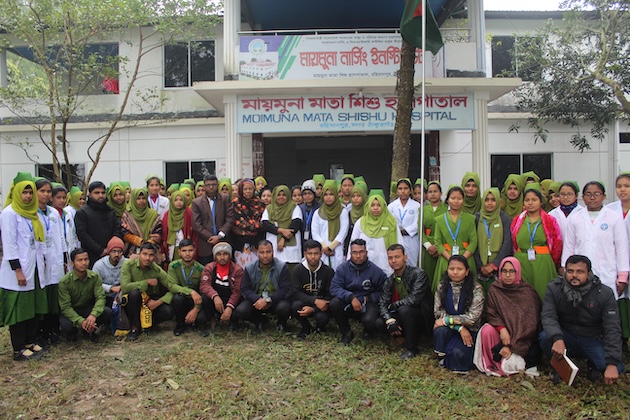
Teachers, students and staff of Moimuna Nursing Institute pose for a photo in front of its main building on the campus. Credit: Rafiqul Islam/IPS

Teachers, students, and staff of Moimuna Nursing Institute pose for a photo in front of its main building on the campus. Credit: Rafiqul Islam/IPS

Nirmola Toppa, mother of Nila Kispotta, who recently completed a nursing diploma from the MNI, said after her daughter passed the SSC examination, she tried to marry her off because she could not afford to pay for her daughter’s educational expenses.

But a scholarship meant Nila could complete her diploma, and she is now getting a stipend of Taka 2,000 (USD19) per month from MNI to complete her six-month internship at RMCH.

Nirmala said Nila received Taka 6,000 (USD 57) to enroll in the internship too.

Founder of Moimuna Nursing Institute, Dr. Saifullah Syed, said in Thakurgaon, many rural underprivileged girls and those coming from minority and ethnic communities pass the entrance exam (SSC) to enroll in nursing institutes but do not enroll due to financial constraints.

Also, there are many who could qualify but do not take the entrance exam, thinking that they may not be able to afford the educational expenses to become nurses and midwives, he said.

“That’s why I founded Moimuna Nursing Institute to ensure that qualified poor rural girls, particularly those coming from minority and ethnic communities, get the opportunity to become nurses and midwives,” Syed told IPS.

He asserted that his institute has established an endowment fund under the control of a Board of Trustees, provides need-based scholarships, and arranges sponsors.

The MNI welcomes donations as it means more students may be assisted.

IPS UN Bureau Report

  Source