Kanak Ambition for Independence Is Defiant Following Political Turmoil in New Caledonia

Asia-Pacific, Civil Society, Democracy, Editors’ Choice, Global Governance, Headlines, Human Rights, Indigenous Rights, Sustainable Development Goals, TerraViva United Nations

Indigenous Rights

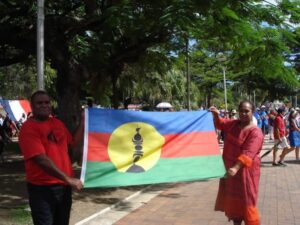
Kanak Pro-Independence supporters display the Kanak flag during a rally in the streets of Noumea prior to New Caledonia's first referendum on Independence in 2018. Credit: Catherine Wilson/IPS

Kanak Pro-Independence supporters display the Kanak flag during a rally in the streets of Noumea prior to New Caledonia’s first referendum on Independence in 2018. Credit: Catherine Wilson/IPS

NOUMEA, New Caledonia , Jul 17 2024 (IPS) – It’s been 26 years since a peace agreement, the Noumea Accord, was signed following an outbreak of conflict in the 1980s between Kanak islanders and French armed forces in the French overseas territory of New Caledonia.


But the eruption of turbulent protests and unrest again two months ago has shown that the cleavage of indigenous political grievances with the French state remains deep in this group of islands located east of Australia in the southwest Pacific.

The centre of New Caledonia’s capital, Noumea, a popular holiday destination in the Pacific Islands, is usually abuzz with tourists patronizing sidewalk cafes. But many of the streets, now patrolled by French police, are deserted and eerily quiet.

The protests, which began in mid-May, escalated to armed clashes between activists and French security forces, resulting in ten deaths. And the destruction of homes, public buildings and looting of shops and businesses has had a devastating impact on the small island society. The cost of the damage is estimated to be more than USD 1 billion; at least 7,000 people have lost jobs and incomes, and the territory’s economy has suffered a major downturn.

Barricades were erected in the streets of Noumea when confrontations escalated between Pro-Independence activists and French police in May following the French Parliament's adoption of electoral reforms in New Caledonia. Credit: Catherine Wilson/IPS

Barricades were erected in the streets of Noumea when confrontations escalated between Pro-Independence activists and French police in May following the French Parliament’s adoption of electoral reforms in New Caledonia. Credit: Catherine Wilson/IPS

The unrest has revealed the gaping fracture between France’s determination to retain control of the territory and the indigenous Kanak islanders, who are riled at lack of progress toward their call for self-determination.

“We protested in the streets. We wanted to say to the French state, you must respect the Kanaks because France voted for the reforms without consent from us,” Jacques (his name has been changed), a Kanak activist in Noumea, told IPS.

He was speaking of the adoption of electoral changes in New Caledonia by the French Parliament, which would have opened the electoral roll to tens of thousands of recent migrant settlers, the majority from Europe.

About 41 percent of New Caledonia’s population is indigenous and many believe it would have led to the declining influence of their vote against rising numbers of Loyalists in future elections and referendums. The changing demographic balance between Kanaks and non-Kanaks is a longstanding grievance.

The uprising in the 1980s was driven by grievances about land dispossession, poverty, inequality, the absence of civil and political rights, and France’s policy of promoting migration from France to New Caledonia.

While French President Emmanuel Macron suspended the electoral reforms in mid-June, many Pro-Independence supporters are unappeased.

Jacques is among a group of Kanak activists who have set up a campaign site next to a main road on the outskirts of the capital. They are sitting around a table under a marquee, surrounded by flags and banners.

“We want our country to be decolonized, as it is written in the Noumea agreement. The French state is only interested in dominating the population here. If the French state stays here, we will have more violence,” Jacques claims.

The French government agreed in the 1998 Noumea Accord to grant New Caledonia more governing powers, recognition of Kanak culture and right to consultation, restrictions on the local electoral roll allowing only Kanaks and long-term residents to vote and the holding of referendums on its future political status.

But by 2021, three referendums had been held, all with majority outcomes, to remain part of France. There was a 43.33 percent vote for Independence in the first referendum in 2018, which increased to 46.74 percent in the second in 2020. But Kanaks, severely affected by the COVID-19 pandemic, boycotted the third referendum in 2021. The overwhelming Loyalist vote of 96.5 percent has never been accepted by Pro-Independence political parties, such as the Kanak and Socialist National Liberation Front (FLNKS).

“We firmly support the call by FLNKS for the UN to declare the result of the third referendum null and void due to the non-participation of the people of Kanaky. Voter turnout was below 50 percent of registered voters; hence, it cannot be taken as the legitimate wish of the silent majority,” the sub-regional inter-governmental organization, the Melanesian Spearhead Group, stated in 2021.

Kanak separatists’ determination to keep their aspirations alive, even though options for changing the political status quo through referendums have been exhausted, has led to an increasingly polarized political landscape. Some entrenched Loyalists believe that the French state should “take over the New Caledonian government because of all the political problems that we have,” Catherine Ris, President of the University of New Caledonia in Noumea, told IPS. And, “on the Pro-Independence side, we do not hear the moderate people anymore.”

The recent mobilization of the Field Action Coordinating Cell (CCAT) by the Pro-Independence Caledonian Union party was a sign of some Kanaks’ belief that their demands are not being met through the political process. The core group of activists were a major force behind the recent protests and the Cell’s leader, Christian Tein, is currently being held in a jail in France on charges related to the unrest. Similarly, the major presence of youths on the streets in May is evidence that a new generation has lost faith in the pace of social and political change.

“The younger people want the change now because in their lives they have experienced and seen a lot of hardship—the persecution of the Kanak people, the difficulties of getting a job,” Jacques emphasized. An estimated 45 percent of people in New Caledonia who don’t have a high school certificate are indigenous, and the Kanak unemployment rate is reported to be as high as 38 percent.

Yet the representation of Kanaks in the territory’s government and politics has steadily increased over the past two decades. The number of seats held by Pro-Independence politicians in New Caledonia’s 54 seat Congress rose from 18 to 25 between 2004 and 2014, while Loyalists witnessed a decrease from 36 to 29 seats, reports Australia’s Lowy Institute for International Policy.

In 2021, Louis Mapou, the first Kanak Pro-Independence President of the government, was elected. And, following the French national election this month, Emmanuel Tjibaou, a Kanak leader from the rural North Province, was voted in as one of New Caledonia’s two members of the National Assembly in Paris.

In the wider region, New Caledonia’s self-determination movement has the international support of other Pacific Island countries, especially those that have indigenous Melanesian populations, such as Papua New Guinea and Fiji, as well as Azerbaijan and Russia. And the French overseas territory has been on the United Nations’ Decolonization List since 1986.

Yet there are New Caledonians who are concerned about the viability of a New Caledonian state. The territory relies heavily on France’s fiscal support, which amounts to 20 percent of the local gross domestic product (GDP) and pays for public services, local economic development programs and civil service salaries.

“We have a good economy here,” Marcieux, a Frenchman who has lived in New Caledonia for 30 years, told IPS in Noumea. “It is easy to speak of independence, but, in reality, it is very difficult. You need a way to make independence.”

But, until the yawning political divisions laid bare by the events of May are addressed, it will be difficult for New Caledonia’s leaders to present a united will to President Macron and the French Parliament located more than 16,000 kilometres away.

However, Tjibaou, the new member of the French National Assembly, is the focus of hope that meaningful dialogue can emerge from the recent conflict. He told local media soon after his election this month that “we all have to offer a framework for discussions to resume between the three partners, which are France, the FLNKS and the Loyalists… we have to capitalize on this.”

IPS UN Bureau Report

  Source

How Climate-Smart Strategies Revitalized Tanzania’s Livestock Sector

Africa, Africa Climate Wire, Armed Conflicts, Civil Society, Climate Change, Climate Change Justice, Development & Aid, Editors’ Choice, Environment, Featured, Food and Agriculture, Food Security and Nutrition, Headlines, Human Rights, Indigenous Rights, Sustainable Development Goals, TerraViva United Nations

Climate Change Justice

In a quest for survival, farmers and pastoralists living in Oldonyo Sambu, Tanzania’s northern Maasai Steppe, used to fight over every drop of water. However, 12 villages have now adopted climate-smart bylaws after months of negotiations, putting an end to hostilities.

A pastoralist gazes into the horizon while taking a break from grazing cattle in Ikolongo Village. Credit: Kizito Makoye/IPS

A pastoralist gazes into the horizon while taking a break from grazing cattle in Ikolongo Village. Credit: Kizito Makoye/IPS

IRINGA, Tanzania , Jul 16 2024 (IPS) – As the sun sets, its golden hues piece through the dusty haze, creating a dazzling display when a herd of livestock lazily roams on the arid landscape as they return home from grazing.


Dressed in shiny red robes, the youthful Maasai pastoralists routinely whistle as they steer cattle, goats and sheep to maintain a unified path.

The quest for survival has forced these herders in Oldonyo Sambu, Tanzania’s northern Maasai Steppe, jostling for dwindling water and pastures as they try to sustain their herds.

Surprisingly, 670 kilometres (416 miles) away in Ikolongo village, south of Tanzania, the plight of water consumers has improved, thanks to a community-led initiative that brought farmers and pastoralists together  to resolve their water woes.

Sitting under a baobab tree, 47-year-old Leinot Leboo watches his cattle drink from a pond. This tranquil moment contrasts sharply with the situation in Oldonyo Sambu, where farmers often clash with herders as they jostle for water.

“I don’t recall any fight between pastoralists and farmers here.We get enough pastures and water for our livestock,” says Leboo.

Unlike in Oldonyo Sambu, local villagers here have created specific grazing lands and water points for livestock to prevent clashes with farmers. “We often bring our cattle here and let them graze and drink without causing any disturbances,” says Leboo.

According to Ignas Mashaka, Ikolongo village chairman, the residents have created a system where pastoralists pay a small fee to feed their herds on rice husks produced by farmers, especially in the dry season.

“This arrangement provides a steady source of feed, but it also give farmers extra income,” says Mashaka

Cows drink from a pond used exclusively by pastoralists in Ikolongo village, Tanzania. Credit: Kizito Makoye/IPS

Cows drink from a pond used exclusively by pastoralists in Ikolongo village, Tanzania. Credit: Kizito Makoye/IPS

Strict Rules

After months of negotiation between local residents and local district authorities, the villagers enacted strict by-laws, which have now been adopted and ratified by 12 surrounding villages.

“These rules have helped to ease tensions over water use,” says Mashaka.

Under the initiative, local residents joined forces to construct dams and reservoirs which have reduced water scarcity, providing a reliable supply for farmers and pastoralists.

“We used to fight over every drop of water,” says Musa Chacha, a farmer at Ikolongo village. “But now, there’s enough for everyone and there’s no reason to fight,”

By working together and managing resources sustainably, Ikolongo villagers have built a strong and resilient community.

Female farmers in Ikolongo village learn horticulture to grow vegetables as part of their strategy to cope with drought. Credit: Kizito Makoye/IPS

Female farmers in Ikolongo village learn horticulture to grow vegetables as part of their strategy to cope with drought. Credit: Kizito Makoye/IPS

The Bigger Picture

Despite having vast grazing lands, the east African country faces frequent conflicts over water and other resources due to climate change and weak land governance. Prolonged droughts often lead to clashes between farmers and pastoralists as they jostle for water and grazing space.

Tanzania’s livestock sector, a vital source of livelihood for millions, holds potential for growth in production and trade. With a cattle population of 36.6 million, the country ranks second in Africa, after Ethiopia. This accounts for 1.4% of the global cattle population and 11% of Africa’s. Beyond cattle, Tanzania also boasts large numbers of sheep, goats, chickens, and pigs, placing it among the continent’s top ten in overall livestock numbers.

However, the sector is plagued by many challenges due to climate risks and low investment, World Bank analysts say.

Transformative Initiative

As part of its broader efforts to improve the livestock sector, Tanzania has launched a new USD 546 million initiative to bolster productivity, increase resilience to climate change and improve the livestock industry. The initiative entails innovative strategies to curb extreme weather by constructing water reservoirs, introducing drought-resistant forage crops, and improving livestock breeds.

Challenges and Solutions

According to a recent World Bank report, “Harnessing the Opportunity for a Climate-Smart and Competitive Livestock Sector in Tanzania,” the pasture-based livestock sector in Tanzania faces serious challenges due to climate change and endemic livestock diseases, impacting animal health, productivity, and market access.

A herd of cattle grazes in a designated pastoralist area in Ikolongo village. Credit: Kizito Makoye/IPS

A herd of cattle grazes in a designated pastoralist area in Ikolongo village. Credit: Kizito Makoye/IPS

Pastoralist’s Perspective

Saidi Juma, a 55-year-old pastoralist from Kilolo village, has witnessed changes in weather patterns over the years. “When I was young, the rains were predictable, and the grass was plenty,” he says. “But in recent years, we have struggled to find pasture for our animals, and the rivers dry up too soon.”

One aspect of the scheme is adopting climate-smart innovations, such as better animal husbandry practices, drought-resistant fodder, and efficient water management systems.

The introduction of drought-resilient Brachiaria grass at Ikolongo village has maintained better livestock health during dry spells. “We planted these grass because they are resilient to drought and provide enough food for our livestock,” says Mashaka.

According to him, drought-resistant forage crops has ensured a steady supply of nutritious feed for livestock in  dry seasons.

Expert Insights

In an interview with IPS, Malongo Mlozi, Professor of Agricultural studies and extension at Sokoine University of Agriculture, hailed the government initiative to revamp the ailing livestock sector by improving water management techniques.

“Water is life; by ensuring a reliable water supply, we can significantly improve the resilience of our livestock farmers against climate change,” he says

According to Mlozi, pastoralists must be trained to acquire the necessary skills and knowledge to cope with the vagaries of the weather.

“When pastoralists understand the benefits of climate-smart practices, they are more likely to adopt them and see positive results,”

Mlozi says the government scheme is likely to improve food security.

“By increasing the productivity of our livestock sector, we can ensure a stable supply of meat, milk, and other livestock products,” says Mlozi

Leinot Leboo grazes his cattle in a bushy enclave in Ikolongo village. Credit: Kizito Makoye/IPS

Leinot Leboo grazes his cattle in a bushy enclave in Ikolongo village. Credit: Kizito Makoye/IPS

“This will help in addressing the nutritional needs of our population and reduce dependency on imports.”

Under the initiative, the government will construct water harvesting structures and introduce solar-powered boreholes to provide an eco-friendly solution.

“Access to water has always been a problem for farmers and pastoralists.The solar-powered boreholes will provide enough water.”

The scheme is also aiming to improve market access for livestock products by improving value chains so pastoralists can fetch better prices in livestock markets closer to their communities.

Tanzania’s livestock sector is changing with climate-smart practices and community-led efforts, setting an example for other regions. By focusing on sustainability and innovation, Tanzania is improving the lives of pastoralists and promoting peace and cooperation.

“We have come a long way from those tough times. Now, we look forward to a future where our children can grow up without the fear of conflict and scarcity.”

This feature is published with the support of Open Society Foundations.

IPS UN Bureau Report

  Source

How Vote Reflects Farmers’ View on India’s BJP’s Agrarian Policy Amid Climate Change

Active Citizens, Asia-Pacific, Civil Society, Climate Change, Climate Change Justice, Food and Agriculture, Headlines, Humanitarian Emergencies, Sustainable Development Goals, TerraViva United Nations | Analysis

Democracy

Political parties often play lip service to climate change, but farmers in India, faced with unpopular policies and uncertainty in their livelihoods due to climate change, ensured their views were heard during the recent general elections.

Farmers in Kashmir sow rice crops. Farmers voted against the ruling BJP because of its unpopular policies and lack of support, as uncertain weather conditions impact their livelihoods. Credit: Umer Asif/IPS

Farmers in Kashmir sow rice crops. Farmers voted against the ruling BJP because of its unpopular policies and lack of support, as uncertain weather conditions impact their livelihoods. Credit: Umer Asif/IPS

SRINAGAR, Jul 15 2024 (IPS) – On June 4, Ram Das, a 65-year-old farmer from India’s northern state of Haryana, was anxiously waiting for the results of the country’s general elections. It was early morning when he left his home and, along with his fellow villagers, congregated near a tea stall that had a transistor set playing the election results.


By 11 in the morning, Das had already sipped three cups of tea and smoked a few cigarettes. His anxiety was plummeting as the results hinted at a decreasing number of seats for India’s ruling Bharatiya Janata Party (BJP). He, along with the entire hamlet, had voted against the Narendra Modi government. “The farmers are not happy at all. We wanted to teach this government a lesson, and that is what we did,” Das told Inter Press Service. 

Despite securing a third term in government, the BJP’s overall election performance was described as a “shock” to Prime Minister Narendra Modi by several media sources. The party fell short of its goal of winning 400 out of 543 seats, managing to secure only 240 seats compared to 303 in the last elections that were held in the year 2019. Opposition parties saw significant success in states with large farming populations, such as Uttar Pradesh, Haryana, Maharashtra, Punjab, and West Bengal. Consequently, the BJP had to rely on the 28 cumulative seats from its allies to form the government.

An infographic of the number of seats won by India's ruling Bharatiya Janata Party (BJP) in the 2019 and 2024 elections for Rajasthan, Uttar Pradesh, Haryana, and Punjab have the largest farming populations. The blue bars represent the 2019 elections, and the red bars represent the 2024 elections. The numbers on top of the bars indicate the number of seats won by the BJP out of the total seats available in each state. Credit: Umar Manzoor Shah/IPS

An infographic of the number of seats won by India’s ruling Bharatiya Janata Party (BJP) in the 2019 and 2024 elections for Rajasthan, Uttar Pradesh, Haryana, and Punjab have the largest farming populations. The blue bars represent the 2019 elections, and the red bars represent the 2024 elections. The numbers on top of the bars indicate the number of seats won by the BJP out of the total seats available in each state. Credit: Umar Manzoor Shah/IPS

What went wrong and where?

When Narendra Modi first took office in 2014, he promised to reform the agriculture sector and double farmers’ incomes. However, government data from 2022 shows that farmers still live in squalid conditions, earning just Rs 28 ($0.34) per day.

Government data reveals that between 2018 and 2022, a staggering 53,478 farmers took their own lives, overwhelmed by mounting debt, inadequate compensation for their produce, and unpredictable weather conditions. This means 36 farmers were killing themselves every day during this period. “The numbers could be much higher than what is being projected in the government data. This could be the tip of an ice-berg. Many farmer suicides go unreported and never find place in government files,” says Abinav Sinha, a civil society activist based in Indian state of Uttar Pradesh.

In 2020, Modi’s government enacted three controversial agricultural laws without consulting farmers’ groups. This move sparked a massive year-long protest, as farmers feared the laws would lead to increased corporatization of agriculture and the elimination of state-backed protections, such as the minimum support price and the procurement of farm produce by state agencies.

The government ultimately repealed the controversial agricultural laws, but not before enforcing a severe crackdown on the protests. Authorities arrested farmers, barricaded highways to prevent them from reaching New Delhi, and deployed shotguns, pellets, and drones to disperse tear gas on unarmed protesters. As per the various farmers’ associations, over 570 farmers were killed during the protest.

In February of this year, farmers once again took to the streets, this time demanding legal guarantees for a minimum support price (MSP) for crops, among other issues. However, negotiations with government officials failed to yield any conclusive results.

This was the reason that the farmers associations across the country galvanized their efforts into political action and unanimously resolved to vote against the ruling Bharatiya Janata Party (BJP).

June 4: The D-Day

Farmers like Das from Haryana were one amongst the thousands of other farmers who didn’t allow the BJP candidates to even enter their villages for the campaigning. “They were ruthless for us when we sought the rollback of the draconian farm laws. How on earth should we vote for them? We will not even allow them to campaign here,” Das said.

On June 4, this year, election results were announced, and the country was shocked to find the states with a considerable amount of agrarian population voting against the BJP.

In Rajasthan, where the BJP had secured a victory in the state government last December, it won 14 out of 25 seats in the recent elections, a significant drop from winning all 25 seats in 2019.

In Uttar Pradesh, a state where 65 percent of the population relies on agriculture, the BJP managed to win just 33 out of 80 seats, a sharp decline from the 62 seats it secured in 2019 and 71 in 2014.

In Haryana, known as India’s breadbasket, the BJP’s count dropped to five seats out of the 10 available, compared to winning all 10 seats in 2019. The opposition Congress claimed the remaining five seats.

In Punjab, a leading producer of rice and wheat, the BJP failed to win any seats, drawing a blank in the state.

Government Cannot Ignore Climate Change Now

Pranav Shankar, a climate change activist based in New Delhi, told IPS that the general elections in India this year have shown a considerable trend that cannot be ignored, downplayed or undermined. “The farmers have spoken out.  This is the reality. To date, the government has ignored the importance of the farming community. From now on, the government has to remain assiduous towards the farmers’ needs and take measures to tackle climate change that is wreaking havoc in the country and putting the farmers in distress,” Shankar said.

He added that more than 33 electoral officers were killed due to heat stroke during the national elections in India this year. “No one talked about them. Even the government itself seems to have forgotten about those poor souls. This is all very unprecedented,” Shankar said.

Note: This feature is published with the support of Open Society Foundations.

IPS UN Bureau Report

  Source

Overwhelmed Healthcare Systems in Gaza Struggle Through Evacuation Orders

Aid, Armed Conflicts, Civil Society, Development & Aid, Editors’ Choice, Featured, Headlines, Health, Human Rights, Humanitarian Emergencies, Middle East & North Africa, Migration & Refugees, Sustainable Development Goals, TerraViva United Nations

Humanitarian Emergencies

Displaced families in Gaza are on the move after the latest Israeli evacuation orders. Around nine in 10 Gazans have been displaced at least once since the war began. Photo: UNRWA

Displaced families in Gaza are on the move after the latest Israeli evacuation orders. Around nine in 10 Gazans have been displaced at least once since the war began. Photo: UNRWA

UNITED NATIONS, Jul 12 2024 (IPS) – For nine months, over 2 million people in the Gaza Strip have been forcibly displaced in the wake of the armed conflict between Israel and Hamas. The ongoing fighting and displacement have put significant strain on humanitarian organizations on the ground to address even basic health needs.

The United Nations and other humanitarian organizations have stressed that the healthcare system in Gaza has collapsed or has suffered undue pressure as a result of the fighting. Out of 36 hospitals in the area, 13 remain open, operating with partial functionality.


This includes Nasser Hospital, which now stands as the last hospital providing comprehensive healthcare services. It has been overwhelmed with patients in the wake of evacuation orders issued on July 1 by Israeli authorities for the east and south of Khan Younis. Patients and medical personnel working in the Gaza European Hospital, located in Khan Younis, evacuated ahead of time.

Although an official from the Israeli defense force stated that patients and medical personnel were exempt from the evacuation order, this was not conveyed to the humanitarian groups on the ground. 

Andrea de Domenico, UN-OCHA’s Head of Office in the Occupied Palestinian Territory, told reporters in a virtual press briefing on July 3 that OCHA was not informed. He stated that it was likely that those who evacuated acted based on past experiences where hospitals were specifically targeted for raids or military bombardment, and so they took preemptive measures to evacuate before the Israeli military moved in on Khan Younis.

Evacuation orders have devastating implications for the fragile health infrastructure by disrupting the functionality of health facilities within and adjacent to evacuation zones, as one spokesperson from the World Health Organization (WHO) told IPS. They impede access for both healthcare providers and patients, and they compromise the efficacy and security of humanitarian operations. In addition, this only increases the burden on other hospitals that are now charged with receiving patients from evacuated areas.

As one of the remaining hospitals providing comprehensive care, Nasser Hospital has been operating beyond capacity with limited supplies, amidst destruction in the surrounding area, which WHO staff on the ground have said is ‘indescribable’. The area surrounding the hospital is laden with heavy layers of debris, destroyed buildings, and no stretch of an intact road. Its pediatric ward has now hosted more than 120 patients since July 5, despite its 56-bed capacity.

OCHA and the World Health at Nasser Medical Complex in Gaza earlier this year. UN and other humanitarian agencies have been struggling to ensure health care continues. Credit: OCHA

OCHA and the World Health at Nasser Medical Complex in Gaza earlier this year. UN and other humanitarian agencies have been struggling to ensure health care continues. Credit: OCHA

It is also operating with dwindling medical supplies and holds responsibility for sterilizing equipment for the surrounding field hospitals, according to Doctors Without Borders (DWB). Despite the critical need for supplies, DWB trucks and convoys carrying these supplies have been unable to enter Gaza since April. As recently as July 3, trucks were denied entry due to ongoing fighting in the South.

“Overall, it’s a comprehensive issue—from shortages of beds and supplies to the lack of surgeons. With yet another hospital closed, patients’ lives are even more at risk,” said medical team leader Javid Abdelmoneim, working in Nasser Hospital.

The issue of life-saving aid being restricted from entering Gaza has continued to persist and impact operations for humanitarian organizations on the ground, including the UN. As the WHO spokesperson told IPS, their trucks were unable to pass through last week as the Karem Shalom crossing remains closed.

Fuel has been identified as critical to the functionality of health facilities and aid operations, and yet shortages are rampant. A WHO spokesperson stated that hospitals have been forced to work with limited supplies of fuel, electricity and solar systems, and this has only hindered groups from properly functioning.

Power blackouts in newborn/ICU and kidney dialysis units place their patients at critical risk. The lack of fuel also impacts the water and sanitation sectors, which require at least seventy-thousand liters of fuel a day, and yet in the last few weeks, they have only received less than ten percent of what is needed.

Only 500,000 liters of fuel have been brought in during the first week of July, and 2 million liters were brought in in the month of June, which humanitarian organizations note is a fraction of the fuel needed to sustain humanitarian, medical, and WASH operations—at least 400,000 liters per day.

Trash and sewage buildup and a lack of clean water, among other factors, have all led to the spread of water-borne diseases and upper respiratory infections. According to the WHO, since mid-October 2023, they have reported cases of diarrhea, lice and scabies, skin rashes, impetigo and chicken pox.

“While a healthy body can more easily fight off diseases, a wasted and weakened body will struggle and become more susceptible,” one WHO spokesperson told IPS.

Meanwhile, acute food insecurity has ravaged Gaza. Since the start of the war, food insecurity has been a major concern for humanitarian actors in the region and globally.

The Integrated Phase Classification (IPC)’s special brief acute food insecurity projected that 96 percent of Gaza’s population, or 2.15 million people, would be experiencing extreme levels of food insecurity between June 16 and September 30, which includes over 495,000 people who face catastrophic food insecurity. More than half of the households reported that often, they did not have any food in the household, and more than 20 percent go full days and nights without eating. The violence and repeated displacement have challenged people’s ability to cope or to access humanitarian assistance.

This is further exacerbated when humanitarian workers are also forced to relocate for their own safety and move their operations. Domenico stated that the constant movement also means that warehouses containing fuel and supplies are abandoned as a result. In the case of UN agencies such as OCHA and its partners, humanitarian operations may be considered a parameter of activity that is (or should be) protected from military activity. Their presence is likely to signal to people that it may be safe to be there or that their basic needs will be met.

So far, 34 people have died from malnutrition and dehydration, according to the Ministry of Health. Of those deaths, WHO notes that 28 of them are children. A group of independent experts has warned that famine has spread throughout the Gaza Strip, noting recent cases of children who have died due to hunger and malnutrition, one of whom was as young as six months old.

“With the death of these children from starvation despite medical treatment in central Gaza, there is no doubt that famine has spread from northern Gaza into central and southern Gaza,” the experts said in a shared statement.

The IPC special brief notes that only a cessation of the armed conflict and sustained, uninterrupted humanitarian intervention could reduce the risk of famine. Humanitarian organizations have struggled to maintain their operations while hostilities have persisted in the Gaza Strip, endangering and displacing more than a million civilians multiple times over, along with humanitarian workers who have risked their lives to continue providing what little life-saving aid can cross the border. Military violence has continued despite international condemnation and repeated demands for a ceasefire.

Organizations such as WHO and Doctors Without Borders have coordinated with health partners and agencies on the ground, namely UNRWA, to provide primary care, support vaccination campaigns, and deploy emergency medical teams. As the WHO notes, however, these efforts can only support the health system; they cannot replace it.

IPS UN Bureau Report

Note: This feature was published with the support of the Riana Group.

  Source

US Arms Suppliers in Gaza Killings Should be “Named, Shamed & Boycotted”

Armed Conflicts, Civil Society, Featured, Global Governance, Headlines, Human Rights, Middle East & North Africa, TerraViva United Nations

A child watches as bodies are recovered from under the rubble of a house in the Al-Nasr neighborhood, east of the city of Rafah, in the southern Gaza Strip. Credit: UN News/Ziad Taleb

UNITED NATIONS, Jul 3 2024 (IPS) – The US gun lobby justifies the unfettered American gun ownership in the US on a misguided premise: Guns don’t kill people, it’s bullets that kill people.

The accusations of genocide and war crimes in Gaza have been directed firstly, at Israel, for the killings of more than 37,700, mostly civilians, and over 86,000 injured, in retaliation for the 1,200 killed by Hamas last October, according to estimates from Gaza health officials, as cited by Cable News Network (CNN) last week.


And secondly, the blame is also squarely on the United States, the unrestrained supplier of arms, including the devastating 2,000-pound unguided bombs, to the Netanyahu government.

But a group of UN human rights experts is now blaming a third force: US arms manufacturers who are accused of implicitly killing people, along with financial institutions that fund most of these weapons suppliers.

“The transfer of weapons and ammunition to Israel may constitute serious violations of human rights and international humanitarian laws and risk State complicity in international crimes, possibly including genocide, the UN experts said last week, reiterating their demand to stop transfers immediately.”

In line with recent calls from the Human Rights Council, the UN experts are calling for halt to the sale, transfer and diversion of arms, munitions and other military equipment to Israel by US arms manufacturers – including BAE Systems, Boeing, Caterpillar, General Dynamics, Lockheed Martin, Northrop Grumman, Oshkosh, Rheinmetall AG, Rolls-Royce Power Systems, RTX, and ThyssenKrupp.

The experts say these defense contractors should also end transfers, even if they are executed under existing export licenses.

“These companies, by sending weapons, parts, components, and ammunition to Israeli forces, risk being complicit in serious violations of international human rights and international humanitarian laws,” the experts said.

This risk is heightened by the recent decision from the International Court of Justice (ICJ) ordering Israel to immediately halt its military offensive in Rafah, having recognised genocide as a plausible risk, as well as the request filed by the Prosecutor of the International Criminal Court (ICC) seeking arrest warrants for Israeli leaders on allegations of war crimes and crimes against humanity.

“In this context, continuing arms transfers to Israel may be seen as knowingly providing assistance for operations that contravene international human rights and international humanitarian laws and may result in profit from such assistance.”

Dr Ramzy Baroud, a journalist and Editor of The Palestine Chronicle, told IPS the UN experts’ statement is important, as it highlights the complex role of the US in supporting, sustaining, and benefiting from the Israeli genocide in Gaza.

“Quite often we call on, demand and implore the US to end its support of Israel, so that the genocide may come to an end. The experts, however, are reminding us that the US involvement is not confined to that of the White House, and direct or indirect US military and logistical support to Israel”, he pointed out.

Indeed, he said, US support is channeled through multiple players, those who manufacture, transport, assemble and maintain the weapons and munition — a multi-billion-dollar military machine that has harvested the lives of tens of thousands of Palestinians.

These companies must be named, shamed, boycotted and held accountable in every possible way. They must understand that there are legal repercussions to their action, as they are complicit in the Israeli crimes against the Palestinians, said Dr Baroud, a Non-resident Senior Research Fellow at the Center for Islam and Global Affairs (CIGA).

These companies are, as the experts said, ‘knowingly’ providing direct assistance to Israel in its genocidal war. They are fully aware of the extent of these crimes as articulated in the South African case against Israel at the ICJ, and the call for arrest warrants by the chief prosecutor of the ICC.

The next rational step is for these companies to be taken to task. They seem to have no moral threshold. Their quest for profits by far exceeds their concern that their weapons are killing thousands of children, women and civilians in Gaza, and throughout occupied Palestine. They must face justice as participants in the Israeli genocide in Gaza, declared Dr Baroud.

Norman Solomon, executive director, Institute for Public Accuracy, told IPS it’s difficult to draw any clear distinction between the U.S. government and the arms makers that sell to it.

“The two are so intertwined that differentiating between them is often a distinction without a difference. The revolving door for individuals, in both directions, places weapons executives in pivotal government positions and vice versa”.

The magnitude of the military profits, he pointed out, is overwhelming in the nation’s political economy and culture. The multibillion-dollar corporations that depend on selling weaponry to the government are directly participating in a routine process of literally making a killing on behalf of massive profit-taking.

To call these firms “defense contractors” is a misnomer, since what they sell has little to do with defense in any meaningful sense, he argued.

“The stepped-up weapons sales and gifts to Israel are continuations of a partnership between the U.S. government and arms suppliers with the purpose of aiding an ally and reaping still more massive profits. In tandem, the U.S. government and the companies are providing Israel with the means to continue mass murder of Palestinian civilians in Gaza. The core of the problem is lack of democracy and vastly excessive corporate power”.

In moral terms, the culpability is far-reaching. Yet, in a sinister way, he said, the military contractors are doing what capitalism provides for them to do — seek to maximize profits regardless of the consequences for human beings and the natural environment.

In contrast, within a democratic system, government is supposed to be responsive to the informed consent of the governed — conditions that certainly do not exist in the United States.

Meanwhile, in terms of international law and human decency, the U.S. government and its arms suppliers are guilty of horrendous crimes, which assist and compound those of Israel, declared Solomon, who is also national director, RootsAction.org and author of, “War Made Invisible: How America Hides the Human Toll of Its Military Machine”

A report from the Human Rights Council in mid-June details six emblematic attacks involving the suspected use of GBU-31 (2,0000 lbs), GBU-32 (1,000 lbs) and GBU-39 (250 lbs) bombs from 9 October to 2 December 2023 on residential buildings, a school, refugee camps and a market.

The UN Human Rights Office verified 218 deaths from these six attacks, and said information received indicated the number of fatalities could be much higher.

“The requirement to select means and methods of warfare that avoid or at the very least minimise to every extent civilian harm appears to have been consistently violated in Israel’s bombing campaign,” said High Commissioner for Human Rights Volker Türk.

The report says the series of Israeli strikes, exemplified by the six incidents, indicates that the IDF may have repeatedly violated fundamental principles of the laws of war. In this connection, it notes that unlawful targeting when committed as part of a widespread or systematic attack against a civilian population, in line with a State or organisational policy, may also implicate the commission of crimes against humanity.

Financial institutions investing in these arms companies are also called to account. Investors such as Alfried Krupp von Bohlen und Halbach-Stiftung, Amundi Asset Management, Bank of America, BlackRock, Capital Group, Causeway Capital Management, Citigroup, Fidelity Management & Research, INVESCO Ltd, JP Morgan Chase, Harris Associates, Morgan Stanley, Norges Bank Investment Management, Newport Group, Raven’swing Asset Management, State Farm Mutual Automobile Insurance, State Street Corporation, Union Investment Privatfonds, The Vanguard Group, Wellington and Wells Fargo & Company, are urged to take action.

Failure to prevent or mitigate their business relationships with these arms manufacturers transferring arms to Israel could move from being directly linked to human rights abuses to contributing to them, with repercussions for complicity in potential atrocity crimes, the experts said.

“Arms initiate, sustain, exacerbate, and prolong armed conflicts, as well as other forms of oppression, hence the availability of arms is an essential precondition for the commission of war crimes and violations of human rights, including by private armament companies,” said the experts.

The experts paid tribute to the sustained work of journalists who have been documenting and reporting on the devastating impact of these weapons systems on civilians in Gaza, and human rights defenders and lawyers, among other stakeholders, who are dedicated to holding States and companies accountable for the transfer of weapons to Israel.

IPS UN Bureau Report

  Source

Special Report: Exposing Afghanistan’s Pervasive, Methodical System of Gender Oppression

Civil Society, Development & Aid, Editors’ Choice, Education, Featured, Gender, Headlines, Human Rights, Humanitarian Emergencies, Middle East & North Africa, Sustainable Development Goals, TerraViva United Nations

Education Cannot Wait. Future of Education is here

Richard Bennett during his oral statement at the Human Rights Council on June 18, 2024. Credit: Anne-Marie Colombet/Human Rights Council

Richard Bennett during his oral statement at the Human Rights Council on June 18, 2024. Credit: Anne-Marie Colombet/Human Rights Council

NAIROBI , Jul 1 2024 (IPS) – The UN Special Rapporteur’s annual report on human rights in Afghanistan lays bare the alarming phenomenon of an institutionalized system of discrimination, segregation, disrespect for human dignity and exclusion of women and girls.

In the new report, Richard Bennett, the UN’s Special Rapporteur, provides an intersectional analysis of the establishment and enforcement of this institutionalized system of unparalleled gender oppression. It paints a picture of a worsening situation for women and girls.


“The situation is that the de facto authorities, who control the country but are not yet recognized as a government, are not just failing to implement their obligations to human rights under the human rights treaties that they’ve signed. They are deliberately implementing policies and practices that flout those policies to create a society where women are permanently inferior to men,” says Bennett in an exclusive interview with IPS.

Education Cannot Wait’s #AfghanGirlsVoices global campaign highlights real-life testimonies of hope, courage and resilience by Afghan girls denied their right to education. Credit: ECW

Education Cannot Wait’s #AfghanGirlsVoices global campaign highlights real-life testimonies of hope, courage and resilience by Afghan girls denied their right to education. Credit: ECW

“Of course, there is sexism in every country, some worse than others, but this is very different from any other country.”

Bennett is referring to the distressing pattern of large-scale systematic violations and subjugation of women’s and girls’ fundamental rights that is unfolding, abetted by the Taliban’s discriminatory and misogynist policies and harsh enforcement methods such as gender apartheid and persecution.

“Only in Afghanistan has a government shut schools for girls above the age of 13, above the sixth grade, and does not allow women to go to universities. And this, combined with segregation, means that women are really suffering. For example, women can only get treatment from doctors who are women and the same applies to teaching. It is a very segregated society as a whole. Just today, a businesswoman told me that she could only do business with female customers. This is affecting not just the current situation and the current generation, but the future as well.”

The Special Rapporteur finds that the Taliban’s institutionalized system of discrimination is most visible through its relentless issuance and enforcement of edicts, decrees, declarations and orders that in and of themselves constitute severe deprivations of human rights and violations of international law.

Between June 2023 and March 2024, they issued an estimated 52 edicts. These include banning foreign non-governmental organizations from providing educational programmes, including community-based education. The Taliban banned women from participating in radio and television shows alongside male presenters.

In July 2023, female beauty salons were forced to close. In August 2023, women were prohibited from entering Band-e Amir National Park. In October 2023, women were excluded from holding directorships within non-governmental organizations. In February 2024, women on television were required to wear a black hijab, with their faces covered, leaving only their eyes visible.

“We are concerned about intergenerational issues, but also intersectional issues. There is discrimination against women and girls who are of an ethnic or religious or linguistic marginalized groups,  or persons with disabilities, or a woman heading a household. Travel requires accompaniment by a close male relative and some women do not have such a person available. All of this is extremely restrictive and will also affect future generations as it will lead to a lack of education and professions,” Bennett says.

The report finds that “women and girls are being maneuvered into increasingly narrow roles where the deep-rooted patriarchy, bolstered and legitimized by Taliban ideology, deems them to belong: as bearers and rearers of children, and as objects available for exploitation, including debt bondage, domestic servitude, sexual exploitation and other forms of unremunerated or poorly remunerated labor.”

The UN Special Rapporteur stresses that there was progress in Afghanistan before the return of the Taliban.

“It was not perfect, but for 20 years there was notable progress. As a result, there are very many professional women in Afghanistan, and women who head households as the main income earners—the main breadwinners for their families. The restrictions are having very serious negative effects.”

Richard Bennett, UN Special Rapporteur Afghanistan, advocates for the rights of every girl to education in Afghanistan. Credit: ECW

Richard Bennett, UN Special Rapporteur for Afghanistan, advocates for the rights of every girl to education in Afghanistan. Credit: ECW

Bennett is among the prominent supporters of the global #AfghanGirlsVoices campaign launched by Education Cannot Wait (ECW), the global fund for education in emergencies and protracted crises within the United Nations. Now in its second phase, the campaign aims to ensure unrestricted access to education for Afghan girls and young women.

After seizing power in 2021, the Taliban swiftly imposed a ban on secondary education for girls, subsequently expanding this restriction to encompass universities and, more recently, private learning centers. Young women have also been prevented from leaving Afghanistan to pursue tertiary education.

“There has never been universal education in Afghanistan, even in the 20 years preceding the return of the Taliban. However, the education system gradually improved, although not as much in remote or rural areas. Part of this was due to a lack of resources, as well as an ongoing internal conflict. So, it was insecure and difficult to maintain schools. But once the Taliban came back into power after August 2021, an education system built over two decades was quickly unraveling,” he says.

In addition to the school closures, he speaks of concerns about the quality of education from two perspectives. One is the alarm over an ongoing brain drain in Afghanistan since the Taliban took over. Many teachers and university lecturers have left the country.

The other concerns are changes to the curriculum and especially a notable increase in madrasa education. Madrasa education has always been a feature of life in Afghanistan. “But now there seems to be at least anecdotal information that the teaching is much more religious-based than a broad education. Girls can go to madrasas,” he says. 

On recommendations and urgent solutions moving forward, Bennett stresses that “no country should ban schools. We therefore continue to call for the reversal of this policy and the reopening of schools with a good quality education. My recommendations are what I call an all-tools approach, as only one approach or any one tool will not work.”

Overall, he says the report calls for justice and accountability, incorporating human rights and women’s voices in political processes and diplomatic engagement. Emphasizing that bolstering documentation of human rights abuses and violations is critical, as is reinforcing protection and solidarity for Afghan women, girls and human rights defenders.

Bennett has a direct message to the current rulers in Afghanistan, the Taliban, to reverse their policies and to comply with human rights. The second message is to the international community, urging them not to normalize or recognize Afghanistan’s unacceptable and worsening human rights situation.

Further stressing that the global community should strongly resist normalizing diplomatic relations or accepting the Taliban into the UN unless and until they meet concrete, measurable, verifiable benchmarks on human rights and the rights of women and girls.

IPS UN Bureau Report

  Source