What Is the Cost of Phasing Out Fossil Fuels in Latin America?

Civil Society, Climate Action, Climate Change, Climate Change Finance, Conferences, COP28, Development & Aid, Editors’ Choice, Energy, Environment, Featured, Global, Global Governance, Headlines, Integration and Development Brazilian-style, IPS UN: Inside the Glasshouse, Latin America & the Caribbean, Projects, Regional Categories, Sustainable Development Goals, TerraViva United Nations

Climate Change

Colombian President Gustavo Petro presented his environmental plans at COP28 in Dubai and added his country to the small group of nations that support the negotiation of a binding treaty to prevent the proliferation of fossil fuels, despite his country being an oil producer. CREDIT: Emilio Godoy / IPS

Colombian President Gustavo Petro presented his environmental plans at COP28 in Dubai and added his country to the small group of nations that support the negotiation of a binding treaty to prevent the proliferation of fossil fuels, despite his country being an oil producer. CREDIT: Emilio Godoy / IPS

DUBAI, Dec 12 2023 (IPS) – One of the most heated debates at the annual climate summit coming to a conclusion in this United Arab Emirates city revolved around the phrasing of the final declaration, regarding the “phase-out” or “phase-down” of fossil fuels within a given time frame.


This is an essential calculation on the decommissioning of refineries, pipelines, power plants and other infrastructure that, in some cases, have been in operation for years, as discussed at the 28th Conference of the Parties (COP28) to the United Nations Framework Convention on Climate Change (UNFCCC).

Experts who talked to IPS at the summit agreed on the magnitude of the bill, which for some Latin American nations could be unaffordable.

“Financial support will be needed. There must be a differentiated approach, differentiated timing, and developed countries must come up with the resources.” — Fernanda Carvalho

Fernanda Carvalho of Brazil, global leader for Energy and Climate Policy at the non-governmental World Wildlife Fund (WWF), referred to the amount without specifying a figure.

“Financial support will be needed. There must be a differentiated approach, differentiated timing, and developed countries must come up with the resources,” the expert, who was present at COP28, held at Expo City on the outskirts of Dubai, told IPS.

COP28 engaged in an acrimonious debate between phase-out and phase-down, with a definite date, of oil, gas and coal, which has already anticipated a disappointing end in Dubai, that in line with the tradition at these summits extended its negotiations one more day, to conclude on Wednesday, Dec. 13.

The “phase-down” concept has been in the climate-energy jargon for years, but it really took off at the 2021 COP26 in the Scottish city of Glasgow, whose Climate Pact alludes to the reduction of coal still being produced and the elimination of inefficient fossil fuel subsidies.

Throughout the climate summits since 1995, developing countries have insisted on differentiated measures for them, in accordance with their own situation, the need for financing from developed nations and the transfer of technology, especially energy alternatives.

Enrique Maurtúa of Argentina, senior diplomacy advisor to the Independent Global Stocktake (iGST) – an umbrella data and advocacy initiative – said they hoped for a political signal to determine regulations or market measures regarding a phase-down or phase-out.

“If a target date is not set, there is no signal. If you set a phase-out for 2050, that is a pathway for the transition. With a deadline, the market can react. And then each country must evaluate its specific context,” the expert told IPS in the COP28 Green Zone, which hosted civil society organizations at the summit.

Available scientific knowledge indicates that the majority of proven hydrocarbon reserves must remain unextracted by 2030 to keep the planetary temperature rise below 2 degrees Celsius, the threshold agreed in the 2015 Paris Climate Change Agreement to avoid massive disasters.

On Sunday, Dec. 10 the non-governmental Climate Action Network (CAN) delivered at COP28 a dishonorable mention to the United States for its role in Israel's carnage in Gaza, in the traditional Fossil of the Day award for “doing the most to achieve the least” in terms of progress on climate change at the summits. CREDIT: Emilio Godoy / IPS

On Sunday, Dec. 10 the non-governmental Climate Action Network (CAN) delivered at COP28 a dishonorable mention to the United States for its role in Israel’s carnage in Gaza, in the traditional Fossil of the Day award for “doing the most to achieve the least” in terms of progress on climate change at the summits. CREDIT: Emilio Godoy / IPS

Failed attempts

In the Latin American region there are unsuccessful precedents of fossil fuel phase-outs.

In 2007, the then president of Ecuador, Rafael Correa (2007-2017), launched the Yasuní-Ishpingo Tambococha Tiputini initiative, which sought the care of the Yasuní National Park in the Ecuadorian Amazon rainforest, in exchange for funds from governments, foundations, companies and individuals of about 3.6 billion dollars by 2024 to leave the oil in the ground.

The aim was to leave 846 million barrels of oil untouched underground. But a special fund created by Ecuador and the United Nations Environment Fund only raised 13 million dollars, according to the Ecuadorian government. So Correa decided to cancel the initiative in 2013, at a time when renewable energies had not yet really taken off.

In a referendum held in August, Ecuadorians decided to halt oil extraction in a block in Yasuní that would provide 57,000 barrels per day in 2022 – the same result sought by Correa, but without foreign funds.

The result of the referendum is to be implemented within a year, although the position of the government of the current president, banana tycoon Daniel Noboa, who took office on Nov. 23, is still unclear.

Meanwhile, in Colombia, President Gustavo Petro has put the brakes on new oil and coal exploration contracts, a promise from his 2022 election campaign.

In addition, the president announced on Dec. 2 in Dubai that his country was joining nine other nations that are promoting the formal initiation of the negotiation of a Fossil Fuel Non-Proliferation Treaty.

Colombia will thus become the first Latin American nation and the largest oil and coal producer to join the initiative that first emerged in 2015 when several Pacific Island leaders and NGOs raised the urgent need for an international mechanism to phase out fossil fuels.

For the undertaking of a just energy transition to cleaner fuels, Petro estimates an initial bill of 14 billion dollars, to come from governments of the developed North, multilateral organizations and international funds.

The latest summit of hope for the climate kicked off on Nov. 30 in this Arab city under the slogan “Unite. Act. Deliver” – the least successful in the history of COPs since the first one, held in Berlin in 1995.

The hopes included commitments and voluntary declarations on renewable energy and energy efficiency; agriculture, food and climate; health and climate; climate finance; refrigeration; and just transitions with a gender focus.

In addition, there were financial pledges of some 86 billion dollars, without specifying whether it is all new money, to be allocated to these issues.

Like many countries, the host of COP28, the United Arab Emirates, has had a pavilion in the so-called Green Zone, which hosts non-governmental organizations, companies and other institutions. The Emirati government bet a lot on the climate summit to deliver results, but without directly targeting the fossil fuels on which its economy depends. CREDIT: Emilio Godoy / IPS

Like many countries, the host of COP28, the United Arab Emirates, has had a pavilion in the so-called Green Zone, which hosts non-governmental organizations, companies and other institutions. The Emirati government bet a lot on the climate summit to deliver results, but without directly targeting the fossil fuels on which its economy depends. CREDIT: Emilio Godoy / IPS

Billions

Given the production and exploration plans of the main hydrocarbon producing countries in the region, the magnitude of the challenge in the medium and long term is enormous.

In October, Brazil, the largest economy in the region and the 11th largest in the world, extracted 3.543 billion barrels of oil and 152 million cubic meters (m3) of gas per day.

This represented approximately two percent of the domestic economy that month.

Mexico, the region’s second largest economy, extracted 1.64 million barrels and 4.971 billion m3 of gas per day in October, equivalent to 52 million dollars in revenues.

Meanwhile, Colombia produced 780,487 barrels of oil in the first eight months of 2023 and 1,568 cubic feet per day of gas, equivalent to 12 percent of public revenues.

“We have to think about decarbonization measures. We want Latin America to be a clean energy powerhouse,” said Carvalho.

As of September, Brazil’s state-owned oil giant Petrobras was working on obtaining 9.571 billion barrels of oil equivalent, according to the Global Oil & Gas Exit List produced by the German non-governmental organization Urgewald.

This represents an excess of 94 percent above the limit set by the 2015 Paris Agreement to keep global warming below two degrees Celsius.

Meanwhile, Mexico’s state-owned oil company Pemex is producing 1.444 billion barrels of oil equivalent, 56 percent above the threshold set by the Paris Agreement.

Finally, the public company Ecopetrol, mostly owned by the Colombian state, is working to obtain 447 million barrels, 98 percent above the Paris Agreement limit, according to Urgewald.

In addition, the cost of action against the climate crisis is far from affordable for any Latin American nation.

For example, Mexico estimated that the implementation of 35 measures, including in the power, gas and oil generation sector, would cost 137 billion dollars in 2030, but the benefits would total 295 billion dollars.

But Maurtúa says the budget question is only relative. “There is a lot of public money with which many things can be done,” complemented by international resources, he argued.


Argentina: Unpalatable Choices in Election Plagued with Uncertainty

Civil Society, Economy & Trade, Featured, Financial Crisis, Gender, Gender Identity, Headlines, Latin America & the Caribbean, TerraViva United Nations

Opinion

Credit: Tomás Cuesta/Getty Images

MONTEVIDEO, Uruguay, Nov 3 2023 (IPS) – For many of Argentina’s voters the choice in the 19 November presidential runoff is between the lesser of two evils: Sergio Massa, economy minister of a government that’s presiding over a once-in-a-generation economic meltdown with a whopping 140-per cent inflation rate, or Javier Milei, a far-right libertarian who admires Donald Trump, wants to shut down the Central Bank and wields a chainsaw in public as a symbol of his willingness to slash the state. Many will rue that it ever came to this.


A peculiar outsider

A post-modern media celebrity, Milei’s performance style is a perfect fit for social media. He’s easily angered, reacts violently and insults copiously. He’s unapologetically sexist and mocks identity politics.

Milei bangs the drum for ‘anarcho-capitalism’, an ultra-individualistic ideology in which the market has absolute pre-eminence: earlier this year, he described the sale of human organs as ‘just another market’.

To expand his appeal beyond this extreme economic niche he forged an alliance with the culturally conservative right. His running mate, Victoria Villarruel, represents the backlash against abortion – legalised after decades of civil society campaigning in 2020 – and sexual diversity and gender equality policies, along with reappraisal of the murderous military dictatorship that ruled Argentina between 1976 and 1983.

In the run-up to primary elections in August, the two mainstream coalitions – the centre-left incumbent Union for the Homeland (UP) and the centre-right opposition Together for Change (JxC) – displayed a notable lack of leadership and indulged in internal squabbles that showed very little empathy for people’s daily struggles. All they had to offer in the face of widespread concerns about inflation and insecurity were the candidacies of the current minister of the economy and a former minister of security. They made it easy for Milei to hold them responsible for decades of corruption, ineffectiveness and failure.

In Milei’s discourse, the hardworking, productive majority is being bled dry by taxation to maintain the privileges of a parasitic and corrupt political ‘caste’. His proposal is deceptively simple: shrink the state to a minimum to destroy the caste that lives off it, clearing their way for individual progress.

Milei gained traction among young voters, particularly young men, via TikTok. He found fertile ground among a generation that no longer expect to be better off than their parents. While many of his followers concede that his ideas may be a little crazy, they appear to be willing to take the risk of embracing the unknown on the basis that the really crazy plan would be to allow those long in control to retain their power and expect things to turn out differently. Milei has capitalised on the despair, hopelessness and accumulated anger so many rightfully feel.

Surprise after surprise

The first surprise came on 13 August, when Milei won the most votes of any candidate in the primaries.

Milei only entered politics in 2021, when the 17 per cent vote he amassed in the capital, Buenos Aires, sent him and two other libertarians to the National Congress. In the 2023 primaries he went much further, winning 30 per cent of the vote. He placed ahead of JxC, whose two candidates received a joint 28 per cent, and UP, the current incarnation of the Peronist Party, which took 27 per cent. The bulk of the UP vote, 21 per cent, went to Massa. That Peronism, once the dominant force, came third was a historic first.

The second surprise came on 22 October. Following the primaries, all talk was of Milei winning the presidency. He trumpeted his intent to win the first round outright. Measured against these expectations, his second place looks like an underperformance. But the fact that a candidate who wasn’t on the radar before the primaries has made the runoff shows how quickly the political landscape can shift.

In the October vote Milei took almost the exact share he’d received in the primaries. Massa finished above him with almost 37 per cent, displacing JxC, which lost four points on its second-place performance in the primaries.

The fact that the economy minister was able to distance himself from the government he’s part of – one often described as the worst in 40 years – to come first was viewed as a notable victory, even though his share was just about the lowest Peronism has ever received.

One explanation for Massa’s improved performance was turnout, which increased by eight points to almost 78 per cent – still low for a country with compulsory voting, but enough to make a difference. Much of the increase could be credited to the political machinery that mobilised voters on election day, aided by the minister-candidate pulling as many levers as he could to improve his chances. This included putting lots of instant cash into voters’ pockets, including through tax breaks benefiting targeted groups of workers and consumers.

An unpalatable decision

There’s still much uncertainty ahead. Economic failure is Milei’s best propaganda, so much will depend on how the economy behaves over the next couple of weeks. Milei and the destruction he represents can’t be written off.

Neither those currently in power nor those in the mainstream opposition recognise the obvious: Milei is their fault. They’ve held power for the best part of the past 40 years without effectively tackling any of the issues that concern people the most.

Many voters now feel they face an unpalatable choice between a corrupt and failing government and a dangerous disruptor. They fear that if they choose to keep Milei out, their votes may be misinterpreted as a show of active support for a continuity they also reject. What’s at stake here is more than one election. If Milei is kept at bay, the political dynamics leading to the current economic dysfunction will still need to be addressed – or the far-right threat to democracy won’t end with Milei.

Inés M. Pousadela is CIVICUS Senior Research Specialist, co-director and writer for CIVICUS Lens and co-author of the State of Civil Society Report.

  Source

Hurricane Otis and the Indifference Toward the Children of Acapulco

Civil Society, Crime & Justice, Gender, Gender Violence, Headlines, Human Rights, Inequality, Labour, Latin America & the Caribbean, Poverty & SDGs, TerraViva United Nations

Opinion

ACAPULCO, Mexico, Nov 2 2023 (IPS) – Acapulco is a paradise. A port of golden sunsets, toasted sand, and deep blue sea. Its dream beaches captivated the hearts of Elvis Presley and Elizabeth Taylor. US President John F. Kennedy chose its shores to spend his honeymoon with Jackie Kennedy. Its luxury hotels and the untamed sea made it the most famous tourist destination in Mexico.


Rosi Orozco

Today, Acapulco is devastated. A Category 5 hurricane—the deadliest possible rating—called “Otis” hit the beach on October 25 with incomparable force. No one anticipated it. Hours before it made landfall, it was just an inconvenient storm. Suddenly it became a deadly cyclone. Most of the hotels are destroyed, the sea swallowed people, houses were blown away, and dozens of people are dead.

In the last century, its beauty attracted the world’s most influential celebrities. Its tranquil mornings and lively nightlife attracted actresses, singers, politicians, aristocratic musicians, and families who wanted to spend their summers by the sea. I myself spent my youth at the family timeshare apartment in Acapulco, and it was there that I met my husband Alejandro, with whom I’ve been married for 40 years. My life is permanently connected to Acapulco.

Luxury businessmen, millionaire athletes, and Michelin-starred chefs arrived. Also drug dealers, money launderers, and men looking for girls and boys to rape in exchange for food or a few dollars for their parents who lived in the city’s poor areas.

Because there are two Acapulcos. They both share an airport and roads, so all roads lead to that pair of versions of the same city. There is a “diamond Acapulco” where the rich vacation with all the amenities at their disposal. And there is a “traditional Acapulco,” where the poor live who work for wealthy tourists.

The people who inhabit “diamond Acapulco” and “traditional Acapulco” do not usually cross paths. They live in the same city, but they are separated by golf courses and exclusive shopping malls. Only rich foreigners and wealthy nationals cross to the poor side when they feel a repugnant urge: to make their plans for child sex tourism a reality with girls and boys as young as 3 years old.

Acapulco is one of the most unequal tourist destinations in the world. In Mexico, it is the most unequal municipality of all: more than 60% of its 900,000 inhabitants live in extreme poverty, which means they do not know what they will eat today or tomorrow. They are the workers who serve plates of fresh seafood, who sweep marble floors, who fill the wine glasses of tourists.

For years, journalists and human rights organizations have told horrific stories that combine poverty, inequality, and sex tourism: a 6-year-old boy rented out to be photographed naked in exchange for milk and eggs; a 9-year-old girl sold to a Canadian tourist to be his wife for a month; homeless teenagers invited to sex parties on lavish yachts in exchange for food; parents and mothers waiting outside hotels for their children to be raped for a price paid in dollars per hour.

Those pedophiles and child molesters turned Acapulco into the country’s primary destination for child sexual tourism. They also led Mexico to the disgraceful second position in the production of child pornography, only surpassed by Thailand, according to data from the Mexican Chamber of Deputies and the United Nations Children’s Fund.

Today, Acapulco is a different place. Little remains of the port that enchanted singers Agustín Lara and Luis Miguel. There are thousands of poor families without homes, hundreds of workers who lost their jobs, and dozens of fishermen without boats to go out to sea to find sustenance. The destruction is so extensive that complete economic recovery is estimated to take decades, not years.

Under these conditions, childhood is at very high risk. Many families have lost so much that their bodies are the only currency they have left. And in the dirty business of forced prostitution, child bodies are the most sought after.

Amid this unprecedented crisis in Mexico, the Chamber of Deputies approved amendments to the general law against human trafficking. These changes aim to broaden the scope of the law enacted in 2012 and update it to address new technologies that traffickers and organized crime engaged in sexual exploitation can use. The wording has some issues that we are still analyzing, but it also includes positive aspects.

For example, it introduces new protections for individuals with injuries, intellectual disabilities, and Afro-Mexican towns and communities. The latter represent 6.5% of the total population in Guerrero and 4% of the residents in Acapulco, according to the National Population Council.

Civil society organizations are monitoring these changes and hope that the deputies will honor their commitment to protecting the victims.

Meanwhile, it is the responsibility of all, not just in Mexico, to help Acapulco back on its feet, a place that has given so much to both nationals and foreigners. It won’t be easy or quick, but every day we delay puts the vulnerable children at risk due to the magnitude of sexual tourism in that beautiful port.

After Hurricane Otis, Acapulco will be different. Its reconstruction is an opportunity to build a new city on the ruins of depravity, one with values and respect for human dignity. I long for the day to see it standing and for its coastline, beach, and air to remain a paradise, especially for children like me who grew up happily by the sea.

IPS UN Bureau

  Source

How to Defend the Environment and Survive in the Attempt, as a Woman in Mexico

Active Citizens, Biodiversity, Civil Society, Climate Action, Conservation, Crime & Justice, Editors’ Choice, Environment, Featured, Gender, Headlines, Human Rights, Latin America & the Caribbean, Regional Categories, TerraViva United Nations, Water & Sanitation, Women & Climate Change

Human Rights

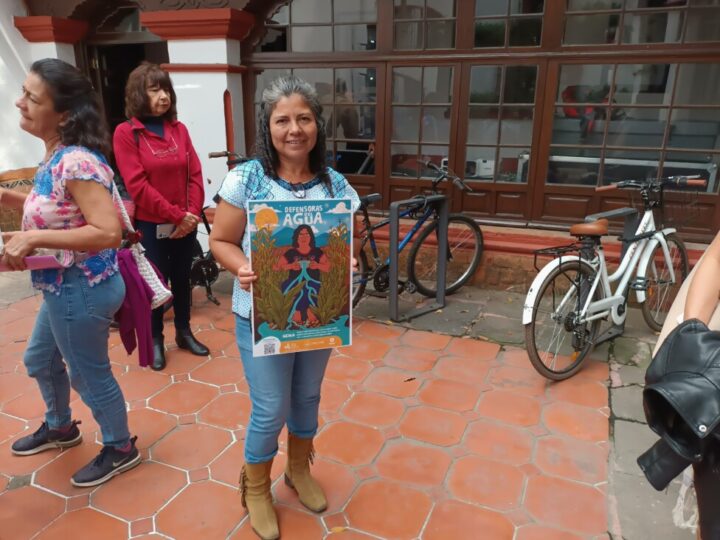
Dozens of women environmentalists participated in Mexico City in the launch of the Voices of Life campaign by eight non-governmental organizations on Oct. 12, 2023, which brings together hundreds of activists in five of the country's 32 states. CREDIT: Emilio Godoy / IPS

Dozens of women environmentalists participated in Mexico City in the launch of the Voices of Life campaign by eight non-governmental organizations on Oct. 12, 2023, which brings together hundreds of activists in five of the country’s 32 states. CREDIT: Emilio Godoy / IPS

MEXICO CITY, Oct 24 2023 (IPS) – The defense of the right to water led Gema Pacheco to become involved in environmental struggles in the southern Mexican state of Oaxaca, an area threatened by drought, land degradation, megaprojects, mining and deforestation.


Care “means first and foremost to value the place where we live, that the environment in which we grow up is part of our life and on which our existence depends,” said Pacheco, deputy municipal agent of San Matías Chilazoa, in the municipality of Ejutla de Crespo, some 355 kilometers south of Mexico City.

“We are in the phase of seeing how the Escazú Agreement will be applied. The most important thing is effective implementation. It is something new and it will not be ready overnight.” — Gisselle García

A biologist by profession, the activist is a member of the Local Committee for the Care and Defense of Water in San Matías Chilazoa, which belongs to the Coordinating Committee of Peoples United for the Care and Defense of Water (Copuda).

The local population is dedicated to growing corn, beans and chickpeas, an activity hampered by the scarcity of water in a country that has been suffering from a severe drought over the past year.

To deal with the phenomenon, the community created three water reservoirs and infiltration wells to feed the water table.

“Women’s participation has been restricted, there are few women in leadership positions. The main challenge is acceptance. There is little participation, because they see it as a waste of time and it is very demanding,” lamented Pacheco.

In November 2021, the 16 communities of Copuda obtained the right to manage the water resources in their territories, thus receiving water concessions.

But women activists like Pacheco face multiple threats for protecting their livelihoods and culture in a country where such activities can pose a lethal risk.

For this reason, eight organizations from five Mexican states launched the Voices of Life campaign on Oct. 12, involving hundreds of habitat protectors, some of whom came to the Mexican capital for the event, where IPS interviewed several of them.

Involvement in the defense of water led Gema Pacheco to become an environmental activist, participating in the Voices of Life campaign in Mexico, which seeks to bring visibility and respect to this high-risk activity in Mexico. CREDIT: Emilio Godoy / IPS

Involvement in the defense of water led Gema Pacheco to become an environmental activist, participating in the Voices of Life campaign in Mexico, which seeks to bring visibility and respect to this high-risk activity in Mexico. CREDIT: Emilio Godoy / IPS

The initiative seeks to promote the right to a healthy environment, facilitate environmental information, protect and recognize people and organizations that defend the environment, as well as learn how to use information and communication technologies.

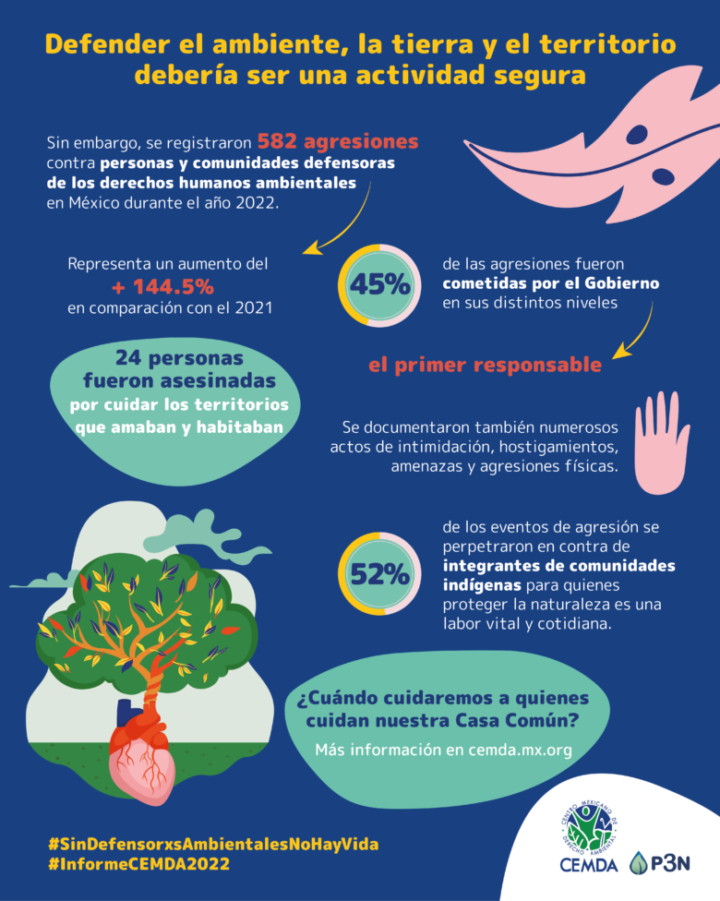
In 2022, Mexico ranked number three in Latin America in terms of murders of environmental activists, with 31 killed (four women and 16 indigenous people), behind Colombia (60) and Brazil (34), out of a global total of 177, according to the London-based non-governmental organization Global Witness.

A year earlier, this Latin American country of almost 129 million inhabitants ranked first on the planet, with 54 killings, so 2022 reflected an improvement.

“The situation in Mexico remains dire for defenders, and non-fatal attacks, including intimidation, threats, forced displacement, harassment and criminalization, continued to greatly complicate their work,” the report says.

The outlook remains serious for activists, as the non-governmental Mexican Center for Environmental Law (Cemda) documented 582 attacks in 2022, more than double the number in 2021. Oaxaca, Mexico City and the northern state of Chihuahua reported the highest number of attacks.

Urban problems

The south of Mexico City is home to the largest area of conservation land, but faces growing threats, such as deforestation, urbanization and irregular settlements.

Protected land defines the areas preserved by the public administration to ensure the survival of the land and its biodiversity.

Social anthropologist Tania Lopez said another risk has now emerged, in the form of the new General Land Use Planning Program 2020-2035 for the Mexican capital, which has a population of more than eight million people, although Greater Mexico City is home to more than 20 million.

“There was no public consultation of the plan based on a vision of development from the perspective of native peoples. In addition, it encourages real estate speculation, changes in land use and invasions,” said López, a member of the non-governmental organization Sembradoras Xochimilpas, part of the Voices of Life campaign.

Mexico is one of the most dangerous countries in the world for environmental defenders. In 2022, 31 activists were murdered, the third highest number in the region behind Colombia and Brazil. CREDIT: Cemda

Mexico is one of the most dangerous countries in the world for environmental defenders. In 2022, 31 activists were murdered, the third highest number in the region behind Colombia and Brazil. CREDIT: Cemda

Apart from the failure to carry out mandatory consultation processes, activists point out irregularities in the governmental Planning Institute and its technical and citizen advisory councils, because they are not included as members.

The conservation land, which provides clean air, water, agricultural production and protection of flora and fauna, totals some 87,000 hectares, more than half of Mexico City.

The plan stipulates conservation of rural and urban land. But critics of the program point out that the former would lose some 30,000 hectares, destined for rural housing.

The capital’s legislature is debating the program, which should have been ready by 2020.

Gisselle García, a lawyer with the non-governmental Interamerican Association for Environmental Defense, said attacks on women activists occur within a patriarchal culture that limits the existence of safe spaces for women’s participation in the defense of rights.

“It’s an entire system, which reflects the legal structure. If a woman files a civil or criminal complaint, she is not heard,” she told IPS, describing the special gender-based handicaps faced by women environmental defenders.

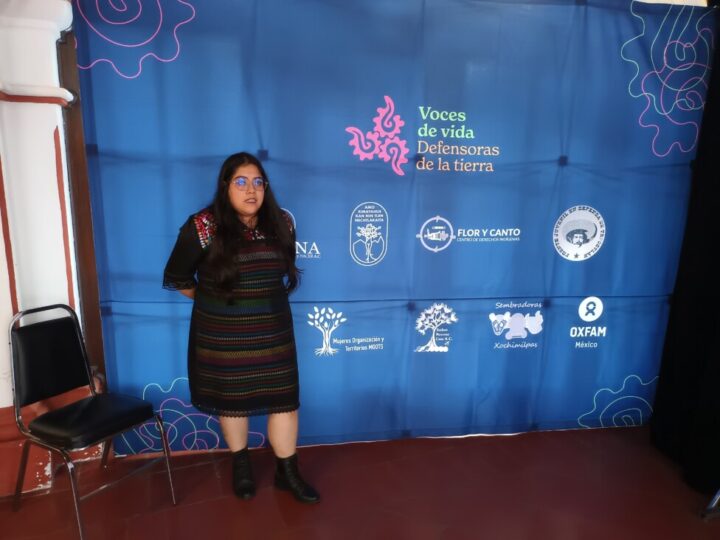
Social anthropologist Tania López is one of the members of the Voices of Life campaign, launched by eight non-governmental organizations on Oct. 12, 2023 to highlight the work of women environmental defenders in Mexico. CREDIT: Emilio Godoy / IPS

Social anthropologist Tania López is one of the members of the Voices of Life campaign, launched by eight non-governmental organizations on Oct. 12, 2023 to highlight the work of women environmental defenders in Mexico. CREDIT: Emilio Godoy / IPS

Still just an empty promise

This risky situation comes in the midst of preparations for the implementation of the Regional Agreement on Access to Information, Public Participation and Justice in Environmental Matters in Latin America and the Caribbean, known as the Escazú Agreement, an unprecedented treaty that aims to mitigate threats to defenders of the environment, in force since April 2021.

Article 9 of the Agreement stipulates the obligation to ensure a safe and enabling environment for the exercise of environmental defense, to take protective or preventive measures prior to an attack, and to take response actions.

The treaty, which takes its name from the Costa Rican city where it was signed, guarantees access to environmental information and justice, as well as public participation in environmental decision-making, to protect activists.

The Escazú Agreement has so far been signed by 24 Latin American and Caribbean countries, 15 of which have ratified it as well.

But its implementation is proceeding at the same slow pace as environmental protection in countries such as Mexico, where there are still no legislative changes to ensure its enforcement.

In August, the seven-person Committee to Support the Implementation of and Compliance with the Escazú Agreement took office. This is a non-contentious, consultative subsidiary body of the Conference of the Parties to the agreement to promote and support its implementation.

Meanwhile, in Mexico, the Escazú National Group, made up of government and civil society representatives, was formed in June to implement the treaty.

During the annual regional Second Forum of Human Rights Defenders, held Sept. 26-28 in Panama, participants called on the region’s governments to strengthen protection and ensure a safe and enabling environment for environmental protectors, particularly women.

While the Mexican women defenders who gathered in Mexico City valued the Escazú Agreement, they also stressed the importance of its dissemination and, even more so, its proper implementation.

Activists Pacheco and Lopez agreed on the need for national outreach, especially to stakeholders.

“We need more information to get out, a lot of work needs to be done, more people need to know about it,” said Pacheco.

The parties to the treaty are currently discussing a draft action plan that would cover 2024 to 2030.

The document calls for the generation of greater knowledge, awareness and dissemination of information on the situation, rights and role of individuals, groups and organizations that defend human rights in environmental matters, as well as on the existing instruments and mechanisms for prevention, protection and response.

It also seeks recognition of the work and contribution of individuals, groups and organizations that defend human rights, capacity building, support for national implementation and cooperation, as well as a follow-up and review scheme for the regional plan.

García the attorney said the regional treaty is just one more tool, however important it may be.

“We are in the phase of seeing how the Escazú Agreement will be applied. The most important thing is effective implementation. It is something new and it will not be ready overnight,” she said.

As it gains strength, the women defenders talk about how the treaty can help them in their work. “If they attack me, what do I do? Pull out the agreement and show it to them so they know they must respect me?” one of the women who are part of the Voices of Life campaign asked her fellow activists.

  Source

Brazil: A Step Forward for Indigenous Peoples’ Rights

Civil Society, Climate Change, Environment, Featured, Headlines, Human Rights, Indigenous Rights, Latin America & the Caribbean, TerraViva United Nations

Opinion

Credit: Evaristo Sa/AFP via Getty Images

MONTEVIDEO, Uruguay, Oct 24 2023 (IPS) – Brazil’s Supreme Court has delivered a long-awaited ruling upholding Brazilian Indigenous peoples’ claims to their traditional land. It did so by rejecting the ‘Temporal Framework’ principle, which only allowed for the demarcation and titling of lands physically occupied by the Indigenous groups who claimed them by 5 October 1988, when the current constitution was adopted. This excluded the numerous Indigenous communities who’d been violently expelled from their ancestral lands before then, including under military dictatorship between 1964 and 1985.


The case was brought in relation to a land dispute in the state of Santa Catarina, but the ruling applies to hundreds of similar situations throughout Brazil.

This was also good news for the climate. Brazil is home to 60 per cent of the Amazon rainforest, a key climate stabiliser due to the enormous amount of carbon it stores and the water it releases into the atmosphere. Most of Brazil’s roughly 800 Indigenous territories – over 300 of which are yet to be officially demarcated – are in the Amazon. And there are no better guardians of the rainforest than Indigenous peoples: when they fend off deforestation, they protect their livelihoods and ways of life. The best-preserved areas of the Amazon are those legally recognised and protected as Indigenous lands.

But there’s been a sting in the tale: politicians backed by the powerful agribusiness lobby have passed legislation to enshrine the Temporal Framework, blatantly ignoring the court ruling.

A tug of war

The Supreme Court victory came after a long struggle. Hundreds of Indigenous mobilisations over several years called for the rejection of the Temporal Framework.

Powerful agribusiness interests presented the Temporal Framework as the proper way of regulating article 231 of the constitution in a way that provides the legal security rural producers need to continue to operate. Indigenous rights groups denounced it as a clear attempt to make theft of Indigenous lands legal. Regional and international human rights mechanisms sided with them: the Inter-American Commission on Human Rights and the United Nations (UN) Special Rapporteur on the rights of Indigenous Peoples warned that the framework contradicted universal and Inter-American human rights standards.

In their 21 September decision, nine of the Supreme Court’s 11 members ruled the Temporal Framework to be unconstitutional. With a track record of agribusiness-friendly rulings, the two judges who backed it had been appointed by former far-right president Jair Bolsonaro, and one of them had also been Bolsonaro’s justice minister.

As the Supreme Court held its hearings and deliberations, political change took hold. Bolsonaro had vowed ‘not to cede one centimetre more of land’ to Indigenous peoples, and the process of land demarcation had remained stalled for years. But in April 2023, President Lula da Silva, in power since January, signed decrees recognising six new Indigenous territories and promised to approve all pending cases before the end of his term in 2026, a promise consistent with the commitment to achieve zero deforestation by 2030. The recognition of two additional reserves in September came alongside news that deforestation in the Brazilian Amazon had fallen by 66 per cent in August compared to the same month in 2022.

Agribusiness fights back

But the agribusiness lobby didn’t simply accept its fate. The powerful ruralist congressional caucus introduced a bill to enshrine the Temporal Framework principle into law, which the Chamber of Deputies quickly passed on 30 May. The vote was accompanied by protests, with Indigenous groups blocking a major highway. They faced the police with their ceremonial bows and arrows and were dispersed with water cannon and teargas.

The Temporal Framework bill continued its course through Congress even after the Supreme Court’s decision. On 27 September, with 43 votes for and 21 against, the Senate approved it as a matter of ‘urgency’, rejecting the substance of the Supreme Court ruling and claiming that in issuing it the court had ‘usurped’ legislative powers.

The Articulation of Indigenous Peoples of Brazil’s (APIB) assessment was that, as well as upholding the Temporal Framework, the bill sought to open the door to commodity production and infrastructure construction in Indigenous lands, among other serious violations of Indigenous rights. For these reasons, Indigenous groups called this the ‘Indigenous Genocide Bill’.

The struggle goes on

As the 20 October deadline for President Lula to either sign or veto the bill approached, a campaign led by Indigenous congresswoman Célia Xakriabá collected almost a million signatures backing her call for a total veto. Along with other civil society groups, APIB sent an urgent appeal to the UN requesting support to urge Lula to veto the bill.

On 19 October the Federal Public Prosecutor’s Office said Lula should veto the bill on the basis that it’s unconstitutional. On the same day, however, senior government sources informed that there wouldn’t be a total veto, but a ‘very large’ partial one. And indeed, the next day it was announced that Lula had partially vetoed the bill. According to a government spokesperson, all the clauses that constituted attacks on Indigenous rights and went against the Constitution were vetoed, while the ones that remained would serve to improve the land demarcation process, making it more transparent.

Even if the part of the bill that wasn’t vetoed doesn’t undermine the Supreme Court ruling, the issue is far from settled. The veto now needs to be analysed at a congressional session on a date yet to be determined. And the agribusiness lobby won’t back down easily. Many politicians own land overlapping Indigenous territories, and many more received campaigns funding from farmers who occupy Indigenous lands.

While further moves by the right-leaning Congress can’t be ruled out, the Supreme Court ruling also has some problems. The most blatant concerns the acknowledgment that there must be ‘fair compensation’ for non-Indigenous people occupying Indigenous lands they acquired ‘in good faith’ before the state considered them to be Indigenous territory. Indigenous groups contend that, while there might be a very small number of such cases, in a context of increasing violence against Indigenous communities, the compensation proposal would reward and further incentivise illegal invasions.

But beneath the surface of political squabbles, deeper changes are taking place that point to a movement that is growing stronger and better equipped to defend Indigenous peoples’ rights.

The 2022 census showed a 90-per-cent increase, from 896,917 to 1.69 million, in the number of Brazilians identifying as Indigenous compared to the census 12 years before. There was no demographic boom behind these numbers – just longstanding work by the Indigenous movement to increase visibility and respect for Indigenous identities. People who’d long ignored and denied their heritage to protect themselves from racism are now reclaiming their Indigenous identities. Not even the violent anti-Indigenous stance of the Bolsonaro administration could reverse this.

Today the Brazilian Indigenous movement is stronger than ever. President Lula owes his election to positioning himself as an alternative to his anti-rights, climate-denying predecessor. He now has the opportunity to reaffirm his commitment to respecting Indigenous peoples’ rights while tackling the climate crisis.

Inés M. Pousadela is CIVICUS Senior Research Specialist, co-director and writer for CIVICUS Lens and co-author of the State of Civil Society Report.

  Source

Housing in Cuba, a Problem with no Solution in Sight

Civil Society, Development & Aid, Economy & Trade, Editors’ Choice, Featured, Headlines, Latin America & the Caribbean, Population, Poverty & SDGs, Regional Categories, TerraViva United Nations

Development & Aid

A "for sale" sign seen outside a house in Centro Habana. As you walk along the streets of the Cuban capital, you see a variety of "for sale" signs on a number of houses. The same is true in cities and towns in Cuba's 168 municipalities. CREDIT: Jorge Luis Baños / IPS

A “for sale” sign seen outside a house in Centro Habana. As you walk along the streets of the Cuban capital, you see a variety of “for sale” signs on a number of houses. The same is true in cities and towns in Cuba’s 168 municipalities. CREDIT: Jorge Luis Baños / IPS

HAVANA, Oct 16 2023 (IPS) – To emigrate to the United States and fulfill her hopes for a better life, Ana Iraida sold almost all of her belongings, including the apartment that, until her departure, saved her from the uncertainty of living in rented housing in Cuba, a country with an unresolved housing crisis.


“I inherited the apartment in Havana from my maternal grandmother, who passed away in 2015. It was small, but comfortable. I sold it for 6,000 dollars to pay for my documents, paperwork and airfare,” the philologist, who like the rest of the people interviewed preferred not to give her last name, told IPS.

“It is difficult to sell, because many people want to emigrate, and they are practically ‘giving away’ the houses. But at the same time hard currency is scarce and a person with thousands of dollars prefers to use them to leave the country.” — Elisa

From Houston, Texas in the U.S., where she now lives, the young woman said that, thanks to loans from friends, “I raised another 4,000 dollars. I got to Nicaragua in December 2022 and from there I continued by land to the U.S. border.”

Ana Iraida said she feels “fortunate” to have had a home that was “furnished and in good condition,” with which she covered her expenses. She said that others “have a more difficult time because they do not have a home of their own.”

In the last two years, emigration from Cuba has skyrocketed amidst the deterioration of the domestic economic situation, fueled by the COVID-19 pandemic, the tightening of the U.S. embargo, partial dollarization of the economy, the fall in the purchasing power of wages and pensions, shortages of essential products and inflation.

Errors and delays in the implementation of reforms to modernize the country and the ineffective monetary system implemented in January 2021 have also played a role.

In this country of 11 million people, in 2022 the exodus led some 250,000 people to the United States alone, the main receiving nation of migrants from this Caribbean island nation, from which it is separated by just 90 miles of sea.

To stem the wave of immigration, on Jan. 5 the U.S. government extended to nationals of Cuba, Nicaragua and Haiti a humanitarian temporary residency permit program, known as “parole”, similar to the one implemented in October 2022 for Venezuelans and previously for other nationalities.

As of the end of August, more than 47,000 Cubans had obtained the humanitarian permit, of whom 45,000 had already immigrated, according to U.S. Customs and Border Protection.

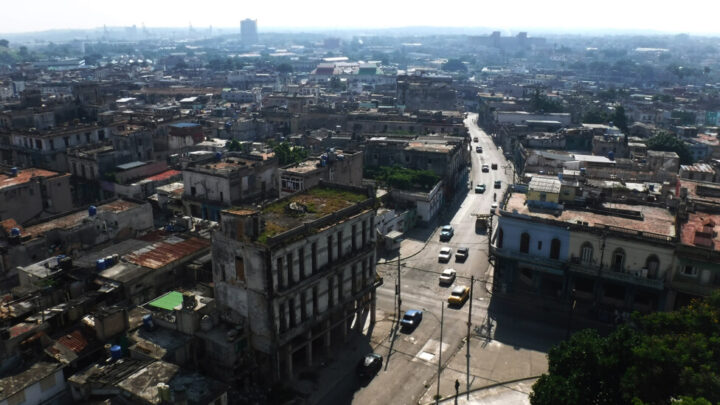
A view of Havana from Cerro, one of its 15 municipalities. This city of 2.2 million inhabitants, the biggest in the country, has the largest housing deficit in Cuba, exceeding 800,000 housing units. CREDIT: Jorge Luis Baños / IPS

A view of Havana from Cerro, one of its 15 municipalities. This city of 2.2 million inhabitants, the biggest in the country, has the largest housing deficit in Cuba, exceeding 800,000 housing units. CREDIT: Jorge Luis Baños / IPS

One of the requirements for the temporary residency permit is to have sponsors who are U.S. citizens or hold some other legal status, in addition to having the financial resources to support the beneficiary or beneficiaries.

Swapping or selling parole

Owning your own home can also be an opportunity allowing whole families to move abroad.

“People are swapping houses for parole status. A few weeks ago I facilitated the exchange of a house for five parole permits to the United States. And in another case, with a residence in Miramar (a wealthy neighborhood in western Havana), nine people were the beneficiaries,” said Damian, a historian who privately engages in buying and selling, for which he charges a commission.

Damián explained to IPS that “residents in the United States ask for 10,000 to 12,000 dollars to provide a guarantee for parole status. The number of people they give a guarantee for depends on the value of the house. When the process is completed, the property is sold to a relative or friend of that person in Cuba.”

Walking through the streets in the Cuban capital, the most varied signs reading “for sale” can be seen on crumbling or remodeled buildings. The same is true in other cities and towns of the country’s 168 municipalities.

On online sites and Facebook groups for buying and selling activities, there is a proliferation of advertisements with photos and information about the properties, such as the number of rooms, the presence of a landline telephone line or an electrical installation that allows the connection of 110 and 220 volt equipment.

Some negotiate the price with or without furniture, others negotiate with buyers who pay cash in hand, or who pay in dollars, euros or make the deposit abroad.

“It is difficult to sell, because many people want to emigrate, and they are practically ‘giving away’ the houses. But at the same time hard currency is scarce and a person with thousands of dollars prefers to use them to leave the country,” said Elisa, a lawyer who told IPS she is interested in settling with her husband and son in Spain.

She said she has been trying to sell her apartment in La Vibora, another Havana neighborhood, for a year. “I can’t find a buyer, not even now that I dropped the price to 10,000 dollars, half the initial price, and it’s furnished,” she complained.

In Cuba’s informal real estate market, offers range from 2,000 dollars or less to a million dollars. The lowest of these figures is far from the average monthly salary, equivalent to 16.50 dollars on the black market.

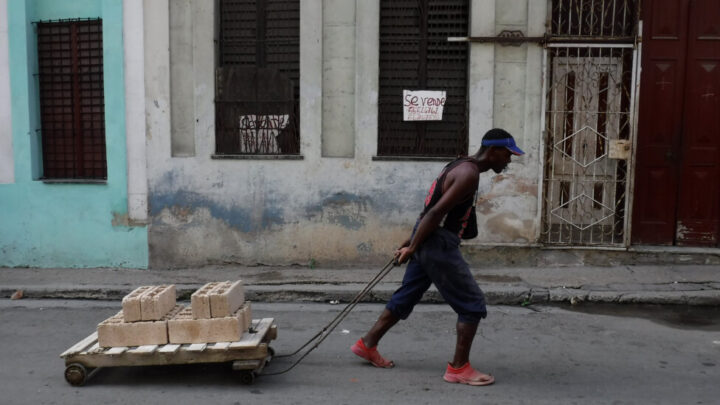
A man pulls a cart loaded with building blocks past a house for sale in the municipality of Centro Habana. In view of the government's diminished construction capacity and the decline of funds for housing, since 2010 the government authorized the free sale of various materials for construction, repairs, remodeling and expansion. CREDIT: Jorge Luis Baños / IPS

A man pulls a cart loaded with building blocks past a house for sale in the municipality of Centro Habana. In view of the government’s diminished construction capacity and the decline of funds for housing, since 2010 the government authorized the free sale of various materials for construction, repairs, remodeling and expansion. CREDIT: Jorge Luis Baños / IPS

Hurdles despite the reforms

Now, Cubans can sell their properties even to move away from the country, a situation very different from 15 years ago, when only swaps of houses between two or more owners were possible. Homes could only be sold to the government, and they were confiscated if the people living there emigrated.

Under laws passed in the early years after the 1959 revolution, most citizens became homeowners.

The Urban Reform Law of 1960 turned housing properties over to those who lived in them, prohibited their sale or lease, and abolished private construction and mortgages.

After decades of prohibitions, in October 2011 the 1988 General Housing Law was amended and the doors were opened to free purchase and sale between Cuban citizens and even foreign residents, endorsed before notaries and with the payment of taxes.

The law also eliminated certain formalities and official regulations on swaps.

Prior to the restitution of the right of ownership of residential units, in 2010 the government approved permits allowing people to build, repair or expand their own homes.

In view of the government’s reduced capacity for construction and the decline in housing funds in that same year, the free sale of cement, sand, gravel, cement blocks and corrugated iron bars was also authorized, which until then had been exclusively centrally allocated or sold in convertible pesos (CUC, a now defunct currency equivalent to the dollar).

The authorities promoted the granting of subsidies to vulnerable families, especially those affected by hurricanes, and micro-credits to build, expand or remodel homes.

These measures helped drive a boom in private construction and repairs.

As in other areas marked by the scarcity of materials, red tape and unequal purchasing power, the granting of housing and sale of materials is not exempt from corruption, theft and poor quality work, which has given rise to repeated complaints from the public.

There is still a housing deficit of more than 800,000 homes, while one third of Cuba’s 3.9 million homes are in fair or poor condition.

The largest deficits are concentrated in Havana, a city of 2.2 million inhabitants, as well as in Holguín, Santiago de Cuba and Camagüey, the other three most populated cities.

In 2019, a Housing Policy was launched, aimed at eliminating the housing shortage within a decade, based on the incentive of local production of construction materials and recyclable inputs, in addition to the contribution from the government and the centrally planned economy.

But the policy has run into hurdles as a result of the economic crisis, and multiple factors such as delays in paperwork and procedures, loss of material resources, unfinished subsidies and financial resources tied up in the banks.

The shortage of foreign currency and insufficient investment stand in the way of increasing production and incorporating equipment to boost construction capacity and sustainability.

Official data show that in 2022, more than 195 million dollars were dedicated to business services, real estate and rental activity, including hotel construction, which represented almost 33 percent of investment in the sector.

On the other hand, only 8.5 million dollars were allocated to housing construction, or 1.4 percent of the total, according to the government’s National Statistics and Information Office (ONEI).

Since 2019, 127,345 housing units were completed and 106,332 were remodeled or repaired, said Vivian Rodriguez, general director of Housing of the Ministry of Construction, during the most recent session of the Council of Ministers, on Oct. 1.

The authorities acknowledged that compliance with the year’s plan of 30,000 new units is under threat. Maintaining this pace would mean eliminating the housing deficit in more than 28 years.

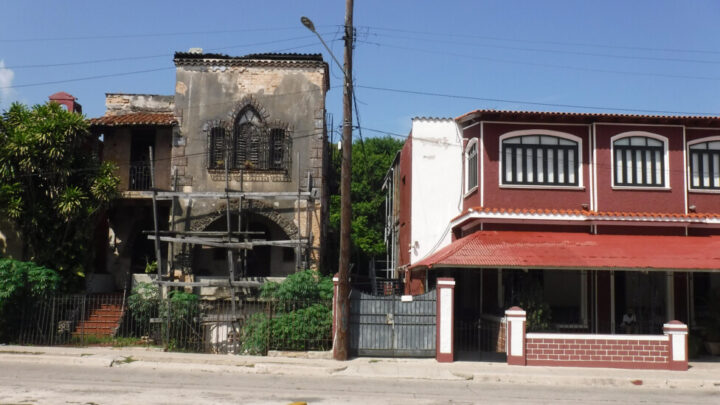
A rundown house stands next to a newly remodeled home on a street in the municipality of Playa, Havana. A third of Cuba's 3.9 million homes are considered to be in fair and poor condition. CREDIT: Jorge Luis Baños / IPS

A rundown house stands next to a newly remodeled home on a street in the municipality of Playa, Havana. A third of Cuba’s 3.9 million homes are considered to be in fair and poor condition. CREDIT: Jorge Luis Baños / IPS

No immediate solution

The lack of housing and the deterioration of existing homes continue without a viable solution in the short or medium term.

On many occasions, people of different generations are forced to live together in small homes, many of which are in a state of disrepair, putting a significant number of families at risk.

Access to housing has also been identified as a factor in the low birth and fertility rates that Cuba has been experiencing for decades.

There is also a problem after tropical cyclones and heavy rains, when centuries-old buildings that have never been remodeled or repaired collapse, or those vulnerable to strong winds are left roofless.

The private practice of professions such as architecture is also not allowed, and although since September 2021 the government has authorized the incorporation of micro, small and medium-sized companies, some of which specialize in the construction and repair of real estate, they still encounter obstacles to their practice.

“There could be many solutions, but in my opinion an essential one is that building materials must be available and at affordable prices; or that houses can be sold to workers so they can pay for them on credit. Otherwise, families will continue to be overcrowded, roofs and walls will collapse on us, or we will grow old without a place of our own,” Orlando, a prep school teacher living in Havana, told IPS.

  Source