How Vote Reflects Farmers’ View on India’s BJP’s Agrarian Policy Amid Climate Change

Active Citizens, Asia-Pacific, Civil Society, Climate Change, Climate Change Justice, Food and Agriculture, Headlines, Humanitarian Emergencies, Sustainable Development Goals, TerraViva United Nations | Analysis

Democracy

Political parties often play lip service to climate change, but farmers in India, faced with unpopular policies and uncertainty in their livelihoods due to climate change, ensured their views were heard during the recent general elections.

Farmers in Kashmir sow rice crops. Farmers voted against the ruling BJP because of its unpopular policies and lack of support, as uncertain weather conditions impact their livelihoods. Credit: Umer Asif/IPS

Farmers in Kashmir sow rice crops. Farmers voted against the ruling BJP because of its unpopular policies and lack of support, as uncertain weather conditions impact their livelihoods. Credit: Umer Asif/IPS

SRINAGAR, Jul 15 2024 (IPS) – On June 4, Ram Das, a 65-year-old farmer from India’s northern state of Haryana, was anxiously waiting for the results of the country’s general elections. It was early morning when he left his home and, along with his fellow villagers, congregated near a tea stall that had a transistor set playing the election results.


By 11 in the morning, Das had already sipped three cups of tea and smoked a few cigarettes. His anxiety was plummeting as the results hinted at a decreasing number of seats for India’s ruling Bharatiya Janata Party (BJP). He, along with the entire hamlet, had voted against the Narendra Modi government. “The farmers are not happy at all. We wanted to teach this government a lesson, and that is what we did,” Das told Inter Press Service. 

Despite securing a third term in government, the BJP’s overall election performance was described as a “shock” to Prime Minister Narendra Modi by several media sources. The party fell short of its goal of winning 400 out of 543 seats, managing to secure only 240 seats compared to 303 in the last elections that were held in the year 2019. Opposition parties saw significant success in states with large farming populations, such as Uttar Pradesh, Haryana, Maharashtra, Punjab, and West Bengal. Consequently, the BJP had to rely on the 28 cumulative seats from its allies to form the government.

An infographic of the number of seats won by India's ruling Bharatiya Janata Party (BJP) in the 2019 and 2024 elections for Rajasthan, Uttar Pradesh, Haryana, and Punjab have the largest farming populations. The blue bars represent the 2019 elections, and the red bars represent the 2024 elections. The numbers on top of the bars indicate the number of seats won by the BJP out of the total seats available in each state. Credit: Umar Manzoor Shah/IPS

An infographic of the number of seats won by India’s ruling Bharatiya Janata Party (BJP) in the 2019 and 2024 elections for Rajasthan, Uttar Pradesh, Haryana, and Punjab have the largest farming populations. The blue bars represent the 2019 elections, and the red bars represent the 2024 elections. The numbers on top of the bars indicate the number of seats won by the BJP out of the total seats available in each state. Credit: Umar Manzoor Shah/IPS

What went wrong and where?

When Narendra Modi first took office in 2014, he promised to reform the agriculture sector and double farmers’ incomes. However, government data from 2022 shows that farmers still live in squalid conditions, earning just Rs 28 ($0.34) per day.

Government data reveals that between 2018 and 2022, a staggering 53,478 farmers took their own lives, overwhelmed by mounting debt, inadequate compensation for their produce, and unpredictable weather conditions. This means 36 farmers were killing themselves every day during this period. “The numbers could be much higher than what is being projected in the government data. This could be the tip of an ice-berg. Many farmer suicides go unreported and never find place in government files,” says Abinav Sinha, a civil society activist based in Indian state of Uttar Pradesh.

In 2020, Modi’s government enacted three controversial agricultural laws without consulting farmers’ groups. This move sparked a massive year-long protest, as farmers feared the laws would lead to increased corporatization of agriculture and the elimination of state-backed protections, such as the minimum support price and the procurement of farm produce by state agencies.

The government ultimately repealed the controversial agricultural laws, but not before enforcing a severe crackdown on the protests. Authorities arrested farmers, barricaded highways to prevent them from reaching New Delhi, and deployed shotguns, pellets, and drones to disperse tear gas on unarmed protesters. As per the various farmers’ associations, over 570 farmers were killed during the protest.

In February of this year, farmers once again took to the streets, this time demanding legal guarantees for a minimum support price (MSP) for crops, among other issues. However, negotiations with government officials failed to yield any conclusive results.

This was the reason that the farmers associations across the country galvanized their efforts into political action and unanimously resolved to vote against the ruling Bharatiya Janata Party (BJP).

June 4: The D-Day

Farmers like Das from Haryana were one amongst the thousands of other farmers who didn’t allow the BJP candidates to even enter their villages for the campaigning. “They were ruthless for us when we sought the rollback of the draconian farm laws. How on earth should we vote for them? We will not even allow them to campaign here,” Das said.

On June 4, this year, election results were announced, and the country was shocked to find the states with a considerable amount of agrarian population voting against the BJP.

In Rajasthan, where the BJP had secured a victory in the state government last December, it won 14 out of 25 seats in the recent elections, a significant drop from winning all 25 seats in 2019.

In Uttar Pradesh, a state where 65 percent of the population relies on agriculture, the BJP managed to win just 33 out of 80 seats, a sharp decline from the 62 seats it secured in 2019 and 71 in 2014.

In Haryana, known as India’s breadbasket, the BJP’s count dropped to five seats out of the 10 available, compared to winning all 10 seats in 2019. The opposition Congress claimed the remaining five seats.

In Punjab, a leading producer of rice and wheat, the BJP failed to win any seats, drawing a blank in the state.

Government Cannot Ignore Climate Change Now

Pranav Shankar, a climate change activist based in New Delhi, told IPS that the general elections in India this year have shown a considerable trend that cannot be ignored, downplayed or undermined. “The farmers have spoken out.  This is the reality. To date, the government has ignored the importance of the farming community. From now on, the government has to remain assiduous towards the farmers’ needs and take measures to tackle climate change that is wreaking havoc in the country and putting the farmers in distress,” Shankar said.

He added that more than 33 electoral officers were killed due to heat stroke during the national elections in India this year. “No one talked about them. Even the government itself seems to have forgotten about those poor souls. This is all very unprecedented,” Shankar said.

Note: This feature is published with the support of Open Society Foundations.

IPS UN Bureau Report

  Source

African Activists Call on the West to Finance Climate Action

Africa, Civil Society, Climate Change Finance, Climate Change Justice, Conferences, Development & Aid, Editors’ Choice, Environment, Featured, Global, Headlines, Human Rights, Humanitarian Emergencies, Sustainable Development Goals, TerraViva United Nations

Climate Change Finance

Activists at Bonn accuse developed countries of frustrating the process on climate finance. Pictured here are Danni Taaffe, Head of Communications at Climate Action Network (CAN), Mohamed Adow of Power Shift Africa and Sven Harmeling, Head of Climate at CAN. Credit: Isaiah Esipisu/IPS

Activists at Bonn accuse developed countries of frustrating the process on climate finance. Pictured here are Danni Taaffe, Head of Communications at Climate Action Network (CAN), Mohamed Adow of Power Shift Africa and Sven Harmeling, Head of Climate at CAN. Credit: Isaiah Esipisu/IPS

BONN, Jun 13 2024 (IPS) – As the technical session of the global climate negotiations enters the final stretch in Bonn, Germany, climate activists from Africa have expressed fears that negotiators from the developed world are dragging their feet in a way to avoid paying their fair share to tackle the climate crisis.

“I think we will be unfair to the snail if we say that the Bonn talks have all along moved at a snail pace,” quipped Mohammed Adow, the Director, Power Shift Africa.


“Ideally, there will be no climate action anywhere without climate finance. Yet what we have seen is that developed countries are frustrating the process, blocking the UAE annual dialogues, which were agreed upon last year in Dubai, to focus on the delivery of finance so as to give confidence to developing countries to implement climate actions,” said Adow.

According to the UN Framework Convention on Climate Change (UNFCCC), the United Arab Emirates (UAE) dialogue was created to focus on climate finance in relation to implementing the first Global Stoke Take (GST-1) outcomes, with the rationale of serving as a follow up mechanism dedicated to climate finance, ensuring response to and/or monitoring of, as may be appropriate and necessary, all climate finance items under the GST

The two-week Bonn technical session of Subsidiary Bodies (SB60) was expected to develop an infrastructure for the New Collective Quantified Goal (NCQG), a climate change funding mechanism to raise the floor of climate finance for developing countries above the current $100 billion annual target.

In 2009, during the 15th Conference of Parties (COP15) of the UNFCCC in Copenhagen, developed countries agreed that by 2020, they would collectively mobilize $100 billion per year to support priorities for developing countries in terms of adaptation to climate crisis, loss and damage, just energy transition and climate change mitigation.

When parties endorsed the Paris Agreement at COP 21 in 2015, they found it wise to set up the NCQG, which has to be implemented at the forthcoming COP 29, whose agenda has to be set at the SB60 in Bonn, providing scientific and technological advice, thereby shaping negotiations in Azerbaijan.

However, activists feel that the agenda being set in Bonn is likely to undermine key outcomes of previous negotiations, especially on climate finance.

“We came to Bonn with renewed hope that the NCQG discussions will be honest and frank with all parties committed to seeing that the finance mechanism will be based on the priorities and needs of developing countries and support country-driven strategies, with a focus on Nationally Determined Contributions (NDCs) and National Adaptation Plans (NAPs),” said Memory Zonde-Kachambwa, the Executive Director, FEMNET.

“Seeing the devastation climate change is causing in our countries in terms of floods, storms, and droughts, among other calamities, it was our hope that the rich countries would be eager and willing to indicate the Quantum as per Article 9.5 of the Paris Agreement so as to allow developing countries to plan their climate action,” she said.

So far, negotiators from the North have been pushing for collective “mobilization of financial resources,” which African activists believe is merely the privatization of climate finance within NCQG, thus surrendering poor countries to climate-debt speculators and further impoverishing countries clutching onto debt.

Also in the spotlight was the Global Goal on Adaptation (GGA), where the activists feel that the means of implementation is being vehemently fought by the parties from developed countries.

“Adaptation must be funded from public resources and must not be seen as a business opportunity open to private sector players,” said Dr. Augustine Njamnshi, an environmental policy and governance law expert and the Executive Secretary of the African Coalition for Sustainable Energy and Access. “Without clear indications on the means of implementation, GGA is an empty shell and it is not fit-for-purpose.”

According to Ambassador Ali Mohammed, the incoming Chair for the African Group of Negotiators (AGN), the SB60 is an opportunity to rebuild trust in the principle of common but differentiated responsibilities and respective capabilities.

“That trust can only be rebuilt if we come out of Bonn with a quantum that adequately covers the needs of the continent,” he said, noting that the figure Africa is asking for, which is to be part of the agenda for COP29, is USD 1.3 trillion per year by 2030.

IPS UN Bureau Report


Uniting for Climate Action: UN, World Bank and UNDRR Leaders Push for Climate Finance, Justice and Nature-Based Solutions for SIDS

Caribbean Climate Wire, Climate Action, Climate Change, Climate Change Finance, Climate Change Justice, Conferences, Development & Aid, Editors’ Choice, Environment, Featured, Headlines, Humanitarian Emergencies, Latin America & the Caribbean, PACIFIC COMMUNITY, Pacific Community Climate Wire, Small Island Developing States, Sustainable Development Goals, TerraViva United Nations

Climate Change Finance

Panelists at SDG Media Zone at SIDS4, Antigua and Barbuda. Credit: Alison Kentish/IPS

Panelists at SDG Media Zone at SIDS4, Antigua and Barbuda. Credit: Alison Kentish/IPS

ANTIGUA & BARBUDA, May 29 2024 (IPS) – As leaders of Small Island Developing States (SIDS) meet for the 4th International Conference on SIDS in Antigua this week, top United Nations and World Bank officials are calling for urgent action to help SIDS tackle their unique challenges and plan for the next decade.


Selwin Hart, UN Special Adviser to the Secretary-General and Assistant Secretary-General of the Climate Action Team, had a frank assessment for a United Nations SDG Media Zone event on the sidelines of the conference, known as SIDS4

“The international community has failed to deliver on its commitments to these small nations, but it’s not too late to make amends,” he said.

Hart says the world has the ‘tools, solutions, technologies, and finance’ to support SIDS, but change lies in the political will of  the countries with the greatest responsibility and capacity, particularly G20 nations, which account for almost 80 percent of global greenhouse gas emissions.

“A mere USD 3 billion of the USD 100 billion goal has been mobilized annually for the small island developing state and you compare that to the USD 36 billion in profit that Exxon Mobil made last year. It represents a tenth of the climate finance that SIDS are attracting and mobilizing. We need to correct these injustices and that has to be at the root of the global response to the demands and needs of  small island developing states.”

Nature-Based Solutions for Nations on the Frontlines of Climate Change
“Both natural and man-made disasters hit SIDS first,” the World Bank’s Global Director of Environment, Natural Resources, and Blue Economy, Valerie Hickey, told the Media Zone. She said that for this reason, the international lending body describes SIDS as “where tomorrow happens today,” a nod to small islands’ role as ‘innovation incubators,’ who must adapt to climate change through the creative and sustainable use of natural capital, biodiversity, and nature-based solutions.

She says nature capital also shifts the narrative, focusing less on the vulnerabilities of SIDS and more on their ingenuity.

“We don’t talk enough about the fact that small islands are where natural capital is the engine of jobs and GDP,” she said. “It is fisheries. It is nature-based tourism. These are critically important for most of the small islands and ultimately deliver not just jobs and GDP but are going to be the only technology for adaptation that is available and affordable, and affordability matters for small islands.”

For small island states seeking to adapt to a changing climate, nature-based solutions and ecosystem based adaptation are essential, but it is also necessary to tackle perennial problems that hinder growth and access to finance. That includes a dearth of current, relevant data.

“The data is too fragmented. It’s sitting on people’s laptops. It’s sitting on people’s shelves. Nobody knows what’s out there and that’s true for the private sector and the public sector,” she said.

“In the Caribbean, where there is excess capital sitting in retail banks, USD 50 billion of that can be used to invest in nature-based solutions judiciously, to work on the kind of longer-term infrastructure that would be fit for purpose both for disaster recovery and long-term growth—it’s not happening for lack of data.”

As part of SIDS4, the world’s small island developing states appear to be tackling this decades-long data problem head-on. At the event’s opening session, Antigua and Barbuda’s Prime Minister Gaston Browne said a much-promoted Centre of Excellence will be established at this conference and that this Global Data Hub for Innovative Technologies and Investment for SIDS will use data for decision-making, ensuring that SIDS’ ten-year Antigua and Barbuda Agenda (ABAS) is led by ‘accuracy and timeliness.’

Reducing Disaster Risk and Early Warning Systems for All

A discussion on SIDS is not complete without acknowledging the disproportionate impact of disasters on the island nations. Assistant Secretary-General and Special Representative of the Secretary-General for Disaster Risk Reduction, Kamal Kishore, says mortality rates and economic losses from disasters are significantly higher in SIDS than the global average.

“If you look at mortality from disasters, the number of deaths normalized by the population of the countries, the mortality rate in SIDS is twice that of the rest of the world. If you look at economic losses as a proportion of GDP, globally it is under one percent; in SIDS, in a single event, countries have lost 30 percent of their GDP. SIDS have lost up to two-thirds of their GDP in a single event.”

Kishore says the ambition to reduce disaster losses must match the scale of the problem. He says early warning systems are a must and have to be seen by all not as generosity but responsibility.

“It is not acceptable that anybody on planet Earth should not have access to advanced cyclone or hurricane warnings. We have the technical wherewithal to generate forecasts and warnings. We have technologies to disseminate it. We know what communities need to do and what local governments need to do in order to respond to those warnings. Why is it not happening?”

The Early Warning for All initiative was launched by UN Secretary General Antonio Guterres in 2022. Kishore says 30 countries have been identified in the initial stage and a third of those countries are SIDS. Gap analyses have already been conducted and a road map has been prepared for strengthening early warning systems. The organization needs money to make it happen.

“The world needs to show some generosity and pick up the bill. It’s not in billions. It’s in millions and it will pay for itself in a single event. You invest in early warning in a country and one major event happens in the next five years, you’ve recovered your investment. The evidence is there that it makes financial sense, but we need to mobilize resources to close that gap.”

The Road Ahead

Thirty years since the first International Conference on Small Island Developing States (SIDS), the three leaders agree that there is hope, but that hope is hinged on action—an approach to development in SIDS that involves financial investment, comprehensive data collection and management and nature-based adaptation measures.

“It’s not too late,” says Selwin Hart. “What we need now is the political will to make things right for small island developing states.”

IPS UN Bureau Report


Small Island Nations Demand Urgent Global Action at SIDS4 Conference

Caribbean Climate Wire, Civil Society, Climate Action, Climate Change, Climate Change Finance, Climate Change Justice, Conservation, Development & Aid, Economy & Trade, Editors’ Choice, Environment, Featured, Headlines, Human Rights, Humanitarian Emergencies, IPS UN: Inside the Glasshouse, Latin America & the Caribbean, PACIFIC COMMUNITY, Pacific Community Climate Wire, Small Island Developing States, Sustainable Development Goals, TerraViva United Nations, Trade & Investment

Conferences

The once-in-a-decade SIDS Conference opened in Antigua and Barbuda today, with a clear message: the world already knows the challenges that SIDS face—now it’s time for action.

King Charles III of Britain addresses the opening ceremony of the Fourth International Conference on Small Island Developing States, May 27, 2024. Credit: Alison Kentish/IPS

King Charles III of Britain addresses the opening ceremony of the Fourth International Conference on Small Island Developing States, May 27, 2024. Credit: Alison Kentish/IPS

ANTIGUA, May 27 2024 (IPS) – “This year has been the hottest in history in practically every corner of the globe, foretelling severe impacts on our ecosystems and starkly underscoring the urgency of our predicament. We are gathered here not merely to reiterate our challenges, but to demand and enact solutions,” declared Antigua and Barbuda Prime Minister Gaston Brown at the opening of the Fourth International Conference on Small Island Developing States on May 27.


The world’s 39 small island developing states are meeting on the Caribbean island this week. It is a pivotal, once-a-decade meeting for small states that contribute little to global warming, but are disproportionately impacted by climate change. The Caribbean leader reminded the world that SIDS are being forced to survive crises that they did not create.

“The scales of equity and justice are unevenly balanced against us. The large-scale polluters whose CO2 emissions have fuelled these catastrophic climate changes bear a responsibility—an obligation of compensation to aid in our quest to build resilience,” he said.

“The Global North must honor its commitments, including the pivotal pledge of one hundred billion dollars in climate financing to assist with adaptation and mitigation as well as the effective capitalization and operationalization of the loss and damage fund. These are imperative investments in humanity, in justice, and in the equitable future of humanity.”

Urgent Support Needed from the International Community

United Nations Secretary General Antonio Guterres told the gathering that the previous ten years have presented significant challenges to SIDS and hindered development. These include extreme weather events and the COVID-19 pandemic. He says SIDS, islands that are “exceptionally beautiful, exceptionally resilient, but exceptionally vulnerable,” need urgent support from the international community, led by the nations that are both responsible for the challenges they face and have the capacity to deal with them.

“The idea that an entire island state could become collateral damage for profiteering by the fossil fuel industry, or competition between major economies, is simply obscene,” the Secretary General said, adding, “Small Island Developing States have every right and reason to insist that developed economies fulfill their pledge to double adaptation financing by 2025. And we must hold them to this commitment as a bare minimum. Many SIDS desperately need adaptation measures to protect agriculture, fisheries, water resources and infrastructure from extreme climate impacts you did virtually nothing to create.”

Antigua and Barbuda Agenda for SIDS (ABAS)

The theme for SIDS4 is Charting the Course Toward Resilient Prosperity and the small islands have been praised for collective action in the face of crippling crises. Their voices were crucial to the establishment of the United Nations Framework Convention on Climate Change and the landmark 2015 Paris Agreement.

Out of this conference will come the Antigua and Barbuda Agenda for SIDS (ABAS). President of the UN General Assembly, Dennis Francis, says that programme of action will guide SIDS on a path to resilience and prosperity for the next decade.

“ The next ten years will be critical in making sustained concrete progress on the SIDS agenda – and we must make full use of this opportunity to supercharge our efforts around sustainability,” he said.

The SIDS4 conference grounds in Antigua and Barbuda will be a flurry of activity over the next four days. Apart from plenaries, there are over 170 side events hosted by youth, civil society organizations, non-governmental organizations, and universities, covering a range of issues from renewable energy to climate financing.

They have been reminded by Prime Minister Gaston Browne that this is a crucial juncture in the history of small island developing states, where “actions, or failure to act, will dictate the fate of SIDS and the legacy left for future generations.”

IPS UN Bureau Report

  Source

Snowless Winter and a Climate Crisis: Kashmir’s ‘Unprecedented’ Weather

Asia-Pacific, Civil Society, Climate Change, Climate Change Justice, Editors’ Choice, Environment, Featured, Food and Agriculture, Food Security and Nutrition, Headlines, Natural Resources, Sustainable Development Goals, TerraViva United Nations

Climate Change

Local Muslims held special prayer ceremonies in January for snowfall. Credit: Umar Manzoor Shah/IPS

Local Muslims held special prayer ceremonies in January for snowfall. Credit: Umar Manzoor Shah/IPS

SRINAGAR, India, Feb 20 2024 (IPS) – Abdul Gani Malik, a 75-year-old goldsmith living in Kashmir’s capital, Srinagar, has witnessed eras of tranquility and turbulence in the Himalayan region. What he has not seen, however, is a snowless Kashmir during the winter.


Malik still works at his shop, located in one of the jam-packed markets of the old city area of Kashmir’s capital, intricately lacing colorful emeralds on dazzling gold necklaces. While conversing with IPS, he mentions that the winter in Kashmir has never been so terrible and terrifying as it has been this year.

He recalls how, during the 40-day harshest winter period from December 21 to January 30, snow would accumulate to about six or seven feet, freezing and making pathways treacherous even for city dwellers. In the mountainous region, according to Malik, the snow would last for several months, regulating temperatures during the summer and providing water and food.

“Now is a different tale. The mountains appear dry and dead. The rivers are carrying no water, and our woods are bereft of life. This is an absolute apocalypse,” Malik said.

The region of Kashmir is located in the north-western complex of the Himalayan ranges, with marked relief variation, snow-capped summits, antecedent drainage, complex geological structure, and rich temperate vegetation and fauna.

Kashmir’s winter is traditionally divided into three parts: Chilay Kalan (old man winter), Chilay Khuarud (young winter), and Chilay Bacha (kiddy winter). The coldest part, called Chilay Kalan, starts on December 21 and ends at the end of January. It is during this period that snowfall is expected.

“The temperatures during this period plummet to even minus 8 to 10 degrees Celsius, and when it snows, it accumulates in glaciers. The snowfall in the later period is of no use,” says Abdul Ghani Malik.

He was part of the congregational prayers held across Kashmir for snowfall. Local Muslims, who constitute more than 90 percent of the local population, decided in January to hold special prayers for snowfall in all major mosques. “We prayed, and we hope God listens to our plight.”

According to Abid Ali, a student of environmental sciences from Kashmir, Kashmir’s livelihood depends on snowfall, and if it doesn’t snow, things are going to take a terrible shape.

“The region’s electricity system, agriculture, and tourism are all dependent on snowfall. The dry winter will prove catastrophic for the local populace,” Abid said.

Kashmir, as per estimates, reported a 79 percent precipitation deficit through December of last year. Indian meteorologists claim that unusual weather is linked to global warming and El Niño, the sporadic climate phenomenon that can create warm, dry conditions in the Indian subcontinent and other parts of Asia.

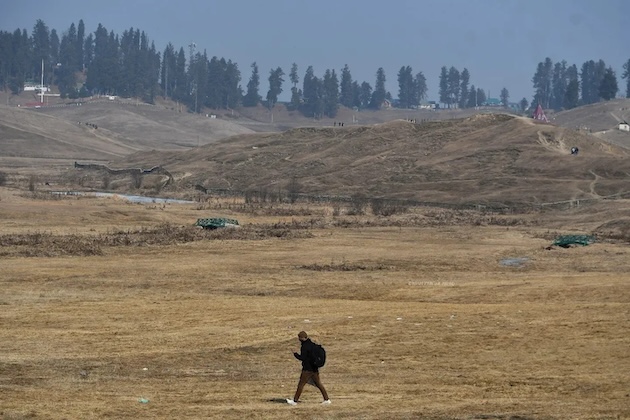
A man walks through an area in Kashmir where low snowfall is causing concern as the region’s economy is highly dependent on it. Credit: Umar Manzoor Shah/IPS

A man walks through an area in Kashmir where low snowfall is causing concern as the region’s economy is highly dependent on it. Credit: Umar Manzoor Shah/IPS

Threat to Agriculture

In Kashmir, 60 percent of the state’s revenue comes from agriculture and horticulture, and about 80 percent of the population lives in rural areas.

However, over the years, the valley has experienced irregular patterns of precipitation. In the first five months of 2022, Kashmir saw a 38 percent rain shortage, according to data provided by the Meteorological Department (MeT) in Srinagar.

The data reveals that the Kashmir Valley has experienced a significant lack of pre-monsoon precipitation over the years. From March 1 to May 31, 2022, the region got 99.5 mm of rain, 70 percent lower than average.

Comparatively, between March and May of each of the following years—2017, 2018, 2019, 2020, and 2021—there was a deficit of 16, 28, 35, and 26 percent, respectively. The dry winter this year is already throwing life out of gear for the farmers.

Abdul Karim Ganaie, a farmer hailing from south Kashmir’s Pulwama, says the threats are menacingly looming large, and people cannot do anything other than watch helplessly as the crisis unfolds.

When IPS contacted Choudhary Mohammad Iqbal, the director of agriculture in Kashmir, he stated that the department was closely monitoring the situation and would be issuing a warning to the farmers in the coming months.

“We accept that the situation is going to prove worrisome for Kashmir’s farming community, but we have to adopt a strategy to ensure minimal losses. We are working on that front,” Choudhary said.

Tourism under Cloud

The famous tourist destinations in Kashmir are also witnessing a dip in tourist arrivals, putting the people associated with this business in dire straits. In January, the famous tourist resorts recorded the lowest arrival of foreign and domestic tourists, with only 30 percent occupancy in hotels.

It snows at last but too little, too late!

Finally, in the first week of February, when the harshest 40-day-long spell was already over, it snowed in most of the areas of Kashmir. However, according to experts, the snow would yield the fewest results as it is not possible to accumulate for an extended period.

What is important, says Mehraj Ahmad, a research scholar working on climate change in Kashmir, is that the snow must accumulate in the higher reaches for as long as possible until the arrival of summers.

“The snowfall of February or March carries the least significance when compared with the snowfall of January. Therefore, we really are keeping our fingers crossed and praying for the safeguard of our lives against the dark, dreadful effects of climate change,” Ahmad said.

IPS UN Bureau Report

IPS UN Bureau, IPS UN Bureau Report, India, Kashmir

  Source

Amidst a Horrendous 2023, Civil Society is Fighting Back Society

Armed Conflicts, Biodiversity, Civil Society, Climate Change, Climate Change Justice, COP28, Economy & Trade, Education, Environment, Featured, Global, Green Economy, Headlines, Health, Human Rights, TerraViva United Nations

Opinion

TORONTO, Canada, Dec 22 2023 (IPS) – The year 2023 has brought so much tragedy, with incomprehensible loss of lives, whether from wars or devastating ‘natural’ disasters, while our planet has seen yet more records broken as our climate catastrophe worsens.

And so as the clock ticks towards the (mostly western) New Year, readers are traditionally subjected by media outlets like ours to the ‘yearender’ – usually a roundup of main events over the previous 12 months, one horror often overshadowed by the next.


Farhana Haque Rahman

So forgive us if for 2023 IPS takes a somewhat different approach, highlighting how humanity can do better, and how the big depressing picture should not obscure the myriad small but positive steps being taken out there.

COP28, the global climate conference held this month in Dubai, could neatly fit the ‘big depressing’ category. Hosted by a petrostate with nearly 100,000 people registered to attend, many of them lobbyists for fossil fuels and other polluters, it would be natural to address its outcomes with scepticism.

However, while Yamide Dagnet, Director for Climate Justice at the Open Society Foundations, described COP28 as “imperfect”, she said it also marked “an important and unprecedented step forward in our ‘course correction’ for a just transition towards resilient and greener economies.”

UN climate chief Simon Stiell acknowledged shortcomings in the compromise resolutions on fossil fuels and the level of funding for the Loss and Damages Fund. But the outcome, he said, was also the “beginning of the end” for the fossil fuel era.

Imperfect as it was and still based on old structures, COP28 hinted at the possible: a planetary approach to governance where common interests spanning climate, biodiversity and the whole health of Earth outweigh and supersede the current dominant global system of rule by nation states.

As we have tragically witnessed in 2023, the existing system – as vividly reflected in the repetitive stalemate among the five veto-bearing members of the UN Security Council – is failing to find resolution to the major conflicts of this year, Russia-Ukraine and Israel-Gaza. Not to mention older and half-forgotten conflicts in places like Myanmar (18.6 million people in need of humanitarian aid) and in eastern Democratic Republic of Congo (seven million displaced).

The unrestrained destruction of Gaza and the disproportionate killings of over 17,000, (now the death toll is “at least 20,000 people” according to Palestinian officials) mostly civilians– in retaliation for 1,200 killings by Hamas and 120 hostages in captivity– have left the Palestinians in a state of deep isolation and weighed down by a feeling of being deserted by the world at large.

The United Nations and the international community have remained helpless– with UN resolutions having no impact– while American pleas for restrained aerial bombings continue to be ignored by the Israelis in an act of defiance, wrote IPS senior journalist Thalif Deen.

The hegemony of the nation-state system is surely not going to disappear soon but – without wanting to sound too idealistic — its foundations are being chipped away by civil society where interdependence prevails over the divide and rule of the existing order. And so for a few examples encountered in our reporting:

CIVICUS Lens, standing for social justice and rooted in the global south, offers analysis of major events from a civil society perspective, such as its report on the security crisis gripping Haiti casting doubt over the viability of an international plan to dispatch a Kenya-led police contingent.

Education Cannot Wait, a global fund for education in emergencies and protracted crises, lobbied at COP28 for a $150 million appeal to support school-aged children facing climate shocks, such as the devastating drought in Somalia and Ethiopia, and floods in Pakistan where many of the 26,000 schools hit in 2022 remain closed.

Leprosy, an ancient but curable disease, had been pegged back in terms of new case numbers but the onset of the COVID-19 pandemic in 2020 made it harder for patients to get treatment and for new cases to be reported. Groups such as the Sasakawa Health Foundation are redoubling efforts to promote early detection and treatment.

With 80 percent of the world’s poorest living closer to the epicenters of climate-induced disasters, civil society is hammering at the doors of global institutions to address the challenges of adaptation and mitigation.

Lobbying on the sidelines of COP28 in Dubai was activist Joshua Amponsem, co-director of the Youth Climate Justice Fund who questioned why weather-resilient housing was not yet a reality in Mozambique’s coastal regions despite the increasing ferocity of tropical cyclones.

“My key message is really simple. The clock is ticking for food security in Africa,” Dr Simeon Ehui told IPS as the newly appointed Director General of the International Institute of Tropical Agriculture which works with partners across sub-Saharan Africa to tackle hunger, poverty and natural resource degradation.

Dr Alvaro Lario, President of the International Fund for Agricultural Development (IFAD), which has received record-breaking pledges in support of its largest ever replenishment, warns that under current trends 575 million people will still be living in extreme poverty in 2030.

“Hunger remains a political issue, mostly caused by poverty, inequality, conflict, corruption and overall lack of access to food and resources. In a world of plenty, which produces enough food to feed everyone, how can there be hundreds of millions going hungry?” he asked.

Empowering communities in a bid to protect and rejuvenate the ecosystems of Pacific communities is the aim of the Unlocking Blue Pacific Prosperity conservation effort launched at COP28 by Palau’s President Surangel Whipps who noted that the world was not on track to meet any of the 17 sustainable development goals or climate goals by 2030.

A scientist with a life-long career studying coral reefs, David Obura was appointed this year as the new chair of IPBES, the Intergovernmental Science-Policy Platform on Biodiversity and Ecosystem Services (IPBES).

We really have reached planetary limits and I think interest in oceans is rising because we have very dramatically reached the limits of land,” says Dr Obura, “What the world needs to understand is how strongly nature and natural systems, even when highly altered such as agricultural systems, support people and economies very tangibly. It’s the same with the ocean.”

An ocean-first approach to the fight against climate change is also the pillar of a Dalhousie University research program, Transforming Climate Action, launched last May and funded by the Canadian government. Traditional knowledges of Indigenous People will be a focus.

As Max Roser, an economist making academic research accessible to all, reminds us: for more people to devote their energy to making progress tackling large global problems, we should ensure that more people know that it is possible.

Focusing on the efforts of civil society and projecting hope amidst all the heartbreak of 2023 might come across as futile and wasted, but in its coverage IPS will continue to highlight efforts and successes, big and small, that deserve to be celebrated.

Farhana Haque Rahman is the Executive Director of IPS Inter Press Service Noram and Senior Vice President of IPS; she served as the elected Director General of IPS from 2015 to 2019. A journalist and communications expert who lived and worked in Africa, Asia, Europe and North America, she is a former senior official of the United Nations Food and Agriculture Organization FAO and the International Fund for Agricultural Development IFAD.

IPS UN Bureau

  Source