Solar Energy Gives Important Boost to Small-scale Farmers in Chile

Active Citizens, Civil Society, Climate Action, Climate Change, Development & Aid, Economy & Trade, Editors’ Choice, Energy, Environment, Featured, Food and Agriculture, Headlines, Integration and Development Brazilian-style, Latin America & the Caribbean, Population, Projects, Regional Categories, Water & Sanitation

Energy

Myriam Miller and Freddy Vargas stand next to one of the three greenhouses on their farm, where tomatoes are growing, anticipating an optimal harvest this year. The couple uses no chemical fertilizers to ensure the healthy development of thousands of plants on their farm in Mostazal, a municipality in central Chile. CREDIT: Orlando Milesi / IPS

Myriam Miller and Freddy Vargas stand next to one of the three greenhouses on their farm, where tomatoes are growing, anticipating an optimal harvest this year. The couple uses no chemical fertilizers to ensure the healthy development of thousands of plants on their farm in Mostazal, a municipality in central Chile. CREDIT: Orlando Milesi / IPS

MOSTAZAL, Chile , Feb 2 2024 (IPS) – The installation of photovoltaic panels to use solar energy to irrigate small farms is expanding quickly in Chile because it lowers costs and optimizes the use of scarce water resources.


This long, narrow South American country that stretches from the northern Atacama Desert to the southern Patagonia region and from the Andes Mountains to the Pacific Ocean is extremely rich in renewable energies, especially solar and wind power.

“Solar panels have made an immensely important contribution to our energy expenditure. Without them we would consume a lot of electricity.” — Myriam Miller

Last year, 36.6 percent of Chile’s electricity mix was made up of Non-Conventional Renewable Energies (NCREs), whose generation in May 2023 totaled 2392 gigawatt hours (GWh), including 1190 GWh of solar power.

This boom in the development of alternative energies has been mainly led by large companies that have installed solar panels throughout the country, including the desert. The phenomenon has also reached small farmers throughout this South American country who use solar energy.

In family farming, solar energy converted into electricity is installed with the help of resources from the government’s Agricultural Development Institute (Indap), which promotes sustainable production of healthy food among small farmers, incorporating new irrigation techniques.

In 2020 alone, the last year for which the institute provides data, Indap promoted 206 new irrigation projects that incorporated NCREs with an investment of more than 2.1 million dollars.

That year, of the projects financed and implemented, 182 formed part of the Intra-predial Irrigation Program, 17 of the Minor Works Irrigation Program and seven of the Associative Irrigation Program. The investment includes solar panels for irrigation systems.

Within this framework, 2025 photovoltaic panels with an installed capacity of 668 kilowatts were installed, producing 1002 megawatt hours and preventing the emission of 234 tons of carbon dioxide.
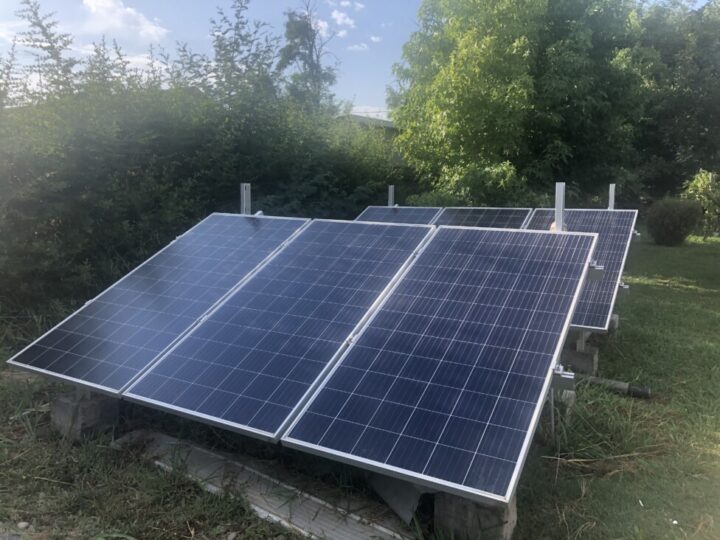
The six solar panels installed on the small farm of Myriam Miller and Freddy Vargas, in the municipality of Mostazal, south of Santiago, Chile, allow them to pump water to their three greenhouses with thousands of tomato plants and to their vegetable garden. They also drastically reduced their electric energy expenditure. CREDIT: Orlando Milesi / IPS

The six solar panels installed on the small farm of Myriam Miller and Freddy Vargas, in the municipality of Mostazal, south of Santiago, Chile, allow them to pump water to their three greenhouses with thousands of tomato plants and to their vegetable garden. They also drastically reduced their electric energy expenditure. CREDIT: Orlando Milesi / IPS

An experience in Mostazal

“Solar panels have made an immensely important contribution to our energy expenditure. Without them we would consume a lot of electricity,” 50-year-old farmer Myriam Miller told IPS at her farm in the municipality of Mostazal, 66 km south of Santiago, where some 54,000 people live in different communities.

Miller has half a hectare of land, with a small portion set aside for three greenhouses with nearly 1,500 tomato plants. Other tomato plants grow in rows outdoors, including heirloom varieties whose seeds she works to preserve, such as oxheart and pink tomatoes.

Indap provided 7780 dollars in financing to install the solar panels on her land. Meanwhile, she and her husband, Freddy Vargas, 51, who run their farm together, contributed 10 percent of the total cost.

In 2023, Miller and Vargas built a third greenhouse to increase their production, which they sell on their own land.

“We’re producing around 8,000 kilos of tomatoes per season. This year we will exceed that goal. We’re happy because we’re moving ahead little by little and improving our production year,” Miller said as she picked tomatoes.

On the land next to the tomato plants, the couple grows vegetables, mainly lettuce, some 7,000 heads a year. They also have fruit trees.

Vargas told IPS that they needed electricity to irrigate the greenhouses because “it’s not easy to do it by hand.”
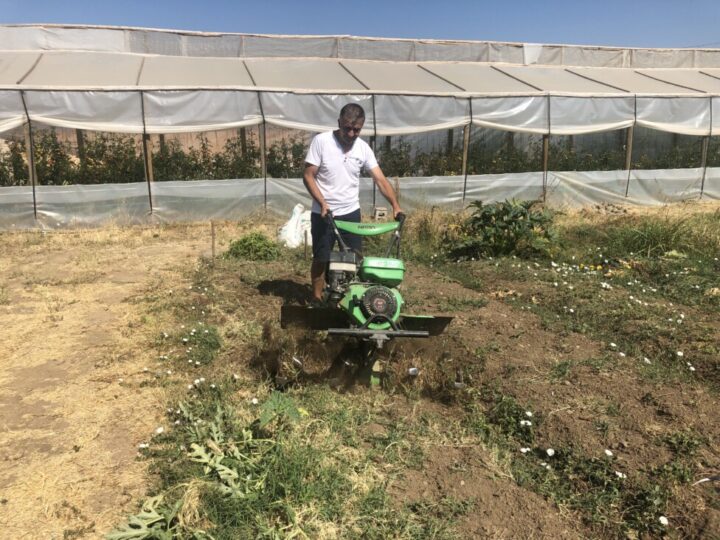
Freddy Vargas turns the soil on his farm in the municipality of Mostazal, south of Santiago, Chile. Lettuce is his star vegetable, with thousands of heads sold on the farm. The farmer plans to buy a mini-tractor to alleviate the work of plowing the land. CREDIT: Orlando Milesi / IPS

Freddy Vargas turns the soil on his farm in the municipality of Mostazal, south of Santiago, Chile. Lettuce is his star vegetable, with thousands of heads sold on the farm. The farmer plans to buy a mini-tractor to alleviate the work of plowing the land. CREDIT: Orlando Milesi / IPS

The farm has two wells that hold about 30,000 liters of water that arrives once a week from a dam located two kilometers away. This is the water they use to power the pumps to irrigate the greenhouses.

“We have water rights and Indap provided us with solar panels and tools to automate irrigation. They gave us four panels and we made an additional investment, with our own funds, and installed six,” Vargas explained.

The couple consumes between 250 and 300 kilowatts per month and the surplus energy they generate is injected into the household grid.

“We don’t have storage batteries, which are more expensive. Every month the electric company sends us a bill detailing the total we have injected into the grid and what we have consumed. They calculate it and we pay the difference,” Vargas said.

The average savings in the cost of consumption is 80 percent.

“I haven’t paid anything in the (southern hemisphere) summer for years. In the winter I spend 30,000 to 40,000 pesos (between 33 and 44 dollars) but I only pay between 5,000 and 10,000 pesos a month (5.5 to 11 dollars) thanks to the energy I generate,” the farmer said.

Above and beyond the savings, Miller stressed the “personal growth and social contribution we make with our products that go to households that need healthier food. We feel good about contributing to the environment.”

“We have a network, still small, of agroecological producers. There is a lack of information among the public about what people eat,” she added.

Their tomatoes are highly prized. “People come to buy them because of their flavor and because they are very juicy. Once people taste them, they come back and recommend them by word of mouth,” Miller said.

She is optimistic and believes that in the municipalities of Mostazal and nearby Codegua, young people are more and more interested in contributing to the planet, producing their own food and selling the surplus.

“We just need a little support and more interest in youth projects in agriculture to raise awareness that just as we take care of the land, it also gives to us,” she said.
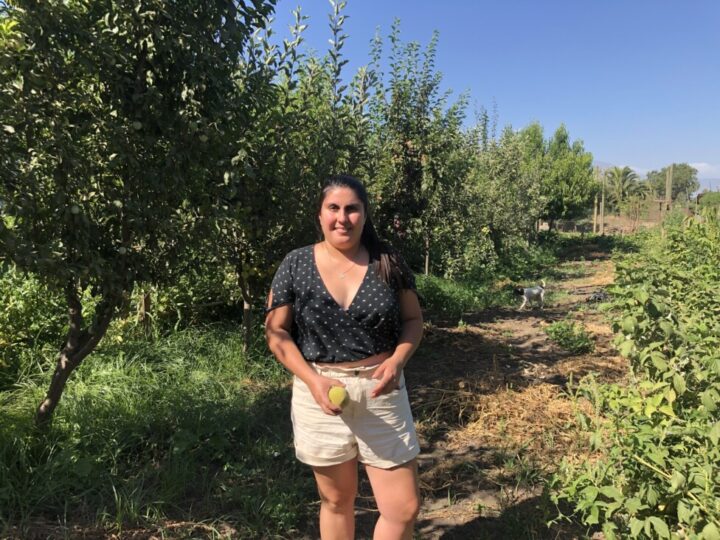
Valentina Martínez stands on her father's small plot of land in the municipality of María Pinto, north of Santiago, Chile. The fruit trees provide the shade needed to keep the planted vegetables from being scorched by the strong southern hemisphere summer sun in central Chile. CREDIT: Orlando Milesi / IPS

Valentina Martínez stands on her father’s small plot of land in the municipality of María Pinto, north of Santiago, Chile. The fruit trees provide the shade needed to keep the planted vegetables from being scorched by the strong southern hemisphere summer sun in central Chile. CREDIT: Orlando Milesi / IPS

A pesticide-free new generation

Valentina Martínez, 32, is an environmental engineer. Together with her father, Simón, 75, they work as small farmers in the municipality of María Pinto, 60 kilometers north of Santiago. She has a 0.45 hectare plot and her father has a 0.35 hectare plot.

Both have just obtained funding from the Transition to Sustainable Agriculture (TAS) project, which operates within Indap, and they are excited about production without chemical fertilizers and are trying to meet the goal of securing another larger loan that would enable them to build a greenhouse and expand fruit and vegetable production on the two farms.

“It’s a two-year program. In the first year you apply and they give you an incentive of 450,000 pesos (500 dollars) focused on buying technology. I’ve invested in plants, fruit trees, worms, and containers for making preserves,” Valentina told IPS.

In the second year, depending on the results of the first year, they will apply for a fund of 3900 dollars for each plot, to invest in their production.

“This year my father and I will apply for solar panels to improve irrigation,” said Valentina, who is currently dedicated to producing seedlings.

“My father liked the idea of producing without agrochemicals to combat pests,” she said about Simón, who has a fruit tree orchard and also grows vegetables.

In María Pinto there are 380 small farmers on the census, but the real number is estimated at about 500. Another 300 are medium-sized farmers.
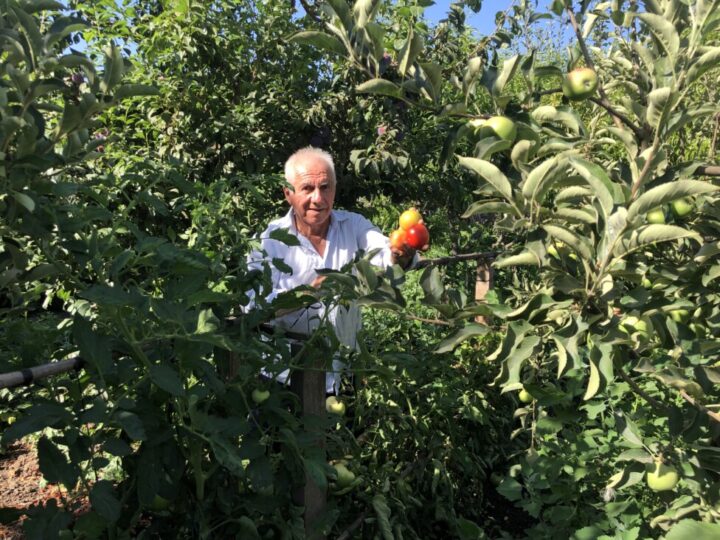
Simón Martínez, 75, proudly shows some of the citrus fruits harvested on his farm where he practices agroecology and does not use agrochemicals. He and his daughter Valentina won a contest to continue improving the sustainability of their farming practices on their adjoining plots, located outside the Chilean town of María Pinto. CREDIT: Orlando Milesi / IPS

Simón Martínez, 75, proudly shows some of the citrus fruits harvested on his farm where he practices agroecology and does not use agrochemicals. He and his daughter Valentina won a contest to continue improving the sustainability of their farming practices on their adjoining plots, located outside the Chilean town of María Pinto. CREDIT: Orlando Milesi / IPS

The rest of the area is monopolized by large agricultural companies dedicated to monocultures for export. Most of them have citrus, avocado, cherry and peach trees, as well as some walnut trees, and they all make intensive use of chemical fertilizers.

Chile exports mainly copper, followed by iron. But it also stands out for its sales of fish, cellulose pulp and fruit. In 2023, it exported 2.3 million tons of fruit, produced by large farms and bringing in 5.04 billion dollars. Agriculture represents 4.3 percent of the country’s GDP.

Family farming consists of some 260,000 small farms, which account for 98 percent of the country’s farms, according to the government’s Office of Agrarian Studies and Policies (Odepa).

Family farms produce 40 percent of annual crops and 22 percent of total agricultural production, which is key to feeding the country’s 19.7 million people.

Valentina is excited about TAS and the meetings she has had with other young farmers.

“It’s fun. We’re all on the same page and interested in what each other is doing. We start in December and January and it lasts all year. The young people are learning about sustainable agriculture and that there are more projects to apply for,” she explained.

She said that 15 young people in María Pinto have projects with pistachio trees, fruit trees, greenhouse gardens, outdoor gardens, animal husbandry and orchards. They are all different and receive group and individual training.

The training is provided by Indap and the Local Development Program (Prodesal), its regional representatives and the Foundation for the Promotion and Development of Women (Prodemu).

“The idea is that more people can learn about and realize the benefits of sustainable agriculture for their own health and for their land, which in a few years will be impossible due to the spraying of monocultures,” Valentina said.

It targets large entrepreneurs who produce avocado and broccoli in up to four harvests a year, both water-intensive crops, even on high hillsides.

“We need to come together, do things properly and recruit more people to create a legal group to reach other places and be able to organize projects. When you exist as an organization, you can also reach other places and say I am no longer one person, we are 15, we are 20, 100 and we need this,” she said.

  Source

Myanmar’s Military Catastrophe: Three Years and Counting

Asia-Pacific, Civil Society, Crime & Justice, Democracy, Featured, Gender Violence, Headlines, Human Rights, Migration & Refugees, TerraViva United Nations

Opinion

Credit: Sirachai Arunrugstichai/Getty Images

LONDON, Feb 1 2024 (IPS) – The military must have expected an easier ride. Three years ago, it ousted Myanmar’s democratically elected government. But the coup has been met with fierce resistance, unleashing a bloody conflict with no end in sight.


Civil society has scrambled to respond to humanitarian needs, defend human rights and seek a path to peace. Last year, civil society organisations in Myanmar and the region developed and endorsed a five-point agenda that calls for an international response to end military violence, including through sanctions, an arms embargo and a referral of Myanmar to the International Criminal Court – a call the UN Security Council hasn’t so far heeded.

Civil society is also demanding that the key regional body, the Association of Southeast Asian Nations (ASEAN), takes the conflict more seriously and engages beyond the junta, particularly with democratic forces and civil society.

So far civil society’s calls haven’t been heard. But intensifying violence proves that the approaches tried to far have failed. Staying on the same path is a recipe for further carnage.

Violence and repression

Three years on from the coup, the military doesn’t control significant sections of the ethnically diverse country. People’s defence forces are fighting an armed campaign in support of the ousted National Unity Government, often in alliance with long-established ethnic militia groups.

In October 2023, three armed groups in Myanmar’s north joined the conflict against the junta, forming the Brotherhood Alliance. The resulting offensive in Shan state saw the rebels capture the border town of Laukkai and cut off key trading routes with China. The UN stated that this was the biggest escalation in fighting since the coup. A ceasefire in the region was supposedly agreed in January following China-brokered talks, but fighting resumed.

It seems clear the junta won’t win this conflict any time soon. Morale among armed forces is collapsing and soldiers defecting, deserting or surrendering in growing numbers. Even pro-junta voices on social media have begun to criticise military leaders.

Pushed into a corner, the military is lashing out, committing mass killings, burning villages and unleashing indiscriminate airstrikes to compensate for its struggles on the ground. The deadliest strike so far came in April 2023, when 168 people, including 40 children, were reported killed in the village of Pa Zi Gyi.

This was no one-off. The UN Special Rapporteur on the situation of human rights in Myanmar has reported that the junta continues to bomb hospitals, schools, villages and camps for displaced people. Attacks on civilians include mass killings, torture, sexual violence and forced labour, and the junta also obstructs essential humanitarian aid supplies.

In September 2023, the UN High Commissioner for Human Rights, Volker Türk, condemned this violence as ‘inhumanity in its vilest form’. Research suggests that most of the military’s senior commanders are responsible for war crimes.

The humanitarian impacts are deep. By the end of 2023, over 2.6 million people had been displaced, 628,000 of them since the Brotherhood Alliance launched its campaign. The UN assesses that 18.6 million need humanitarian help and 5.3 million need it urgently. But aid workers are being targeted: at least 142 were arrested or detained last year.

The restriction of humanitarian work is part of wider repression. Assistance Association for Political Prisoners, a human rights organisation, reports that since the coup 4,468 people have been killed by the junta and pro-military groups. Almost 20,000 people are in detention, among them many activists and protesters charged with offences such as treason and sedition. Torture in prison is widespread, and 34 political prisoners died in detention in 2023.

The junta is doing everything it can to try to control the narrative. It’s believed that 64 journalists are currently detained. Internet shutdowns, website blocking and arrests for social media comments are routine occurrences. Last November, the junta took control of the Broadcasting Council, which oversees TV and radio outlets.

In August 2023, the junta extended the state of emergency, in effect since the coup, for a further six months. The elections that it promised on seizing power are nowhere in sight, and even if they eventually come, they won’t serve any purpose other than trying to legitimise military power.

International action needed

The junta faces strong domestic opposition and has no real international legitimacy but crucially, pressure from the regional body is weak.

ASEAN claims to be following a long-discredited plan, the Five-Point Consensus, which dates back to April 2021. The violence unleashed by the junta against civilians shows it can’t be trusted to act in good faith, but ASEAN still claims to believe it’s possible to involve it in an ‘inclusive dialogue’. At its annual summit in May 2023, ASEAN members reiterated their support for the failed plan, despite civil society’s calls.

ASEAN members are mostly repressive states, and some, including Cambodia and Thailand, have shown signs of seeking to normalise relations with the junta. ASEAN continues to allow junta representatives to attend some of its meetings. This year’s chair, Laos, is an authoritarian state that will have no interest in restoring democracy in Myanmar.

Elsewhere, however, the junta may be running out of friends. China was untroubled by military rule, but it doesn’t want unrest on its border. A potential breakthrough came from the US government in October 2023, when it imposed sanctions on the previously untouchable Myanma Oil and Gas Enterprise (MOGE), the state-owned corporation that’s the regime’s main source of foreign income. The European Union also stepped up its sanctions in December 2023, including against two companies providing arms and generating income for the junta.

It remains essential to keep the junta diplomatically isolated and to cut economic relations with the many companies it depends on, including MOGE. It’s vital to stop supplying arms to the junta and, above all, to stop selling it the jet fuel it needs to carry out airstrikes.

A UN Human Rights Council resolution adopted in April 2023 condemned the junta’s violence but failed to call for responses such as bans on the sale of weapons or aviation fuel. Events since then have made it sadly clear that decisive action can no longer wait.

Andrew Firmin is CIVICUS Editor-in-Chief, co-director and writer for CIVICUS Lens and co-author of the State of Civil Society Report.

  Source

Serbia’s Suspicious Election

Civil Society, Crime & Justice, Democracy, Europe, Featured, Headlines, Human Rights, LGBTQ, Press Freedom, TerraViva United Nations

Opinion

Credit: Vladimir Zivojinovic/Getty Images

LONDON, Jan 26 2024 (IPS) – Serbia’s December 2023 elections saw the ruling party retain power – but amid a great deal of controversy.

Civil society has cried foul about irregularities in the parliamentary election, but particularly the municipal election in the capital, Belgrade. In recent times Belgrade has been a hotbed of anti-government protests. That’s one of the reasons it’s suspicious that the ruling Serbian Progressive Party (SNS) came first in the city election.


Allegations are that the SNS had ruling party supporters from outside Belgrade temporarily register as city residents so they could cast votes. On election day, civil society observers documented large-scale movements of people into Belgrade, from regions where municipal elections weren’t being held and from Bosnia and Herzegovina and Montenegro. Civil society documented irregularities at 14 per cent of Belgrade voting stations. Many in civil society believe this made the crucial difference in stopping the opposition winning.

The main opposition coalition, Serbia Against Violence (SPN), which made gains but finished second, has rejected the results. It’s calling for a rerun, with proper safeguards to prevent any repeat of irregularities.

Thousands have taken to the streets of Belgrade to protest about electoral manipulation, rejecting the violation of the most basic principle of democracy – that the people being governed have the right to elect their representatives.

A history of violations

The SNS has held power since 2012. It blends economic neoliberalism with social conservatism and populism, and has presided over declining respect for civic space and media freedoms. In recent years, Serbian environmental activists have been subjected to physical attacks. President Aleksandar Vučić attempted to ban the 2022 EuroPride LGBTQI+ rights march. Journalists have faced public vilification, intimidation and harassment. Far-right nationalist and anti-rights groups have flourished and also target LGBTQI+ people, civil society and journalists.

The SNS has a history of electoral irregularities. The December 2023 vote was a snap election, called just over a year and a half since the previous vote in April 2022, which re-elected Vučić as president. In 2022, the Organization for Security and Co-operation in Europe (OSCE) pointed to an ‘uneven playing field’, characterised by close ties between major media outlets and the government, misuse of public resources, irregularities in campaign financing and pressure on public sector staff to support the SNS.

These same problems were seen in December 2023. Again, the OSCE concluded there’d been systemic SNS advantages. Civil society observers found evidence of vote buying, political pressure on voters, breaches of voting security and pressure on election observers. During the campaign, civil society groups were vilified, opposition officials were subjected to physical and verbal attacks and opposition rallies were prevented.

But the ruling party has denied everything. It’s slurred civil society for calling out irregularities, accusing activists of trying to destabilise Serbia.

Backdrop of protests

The latest vote was called following months of protests against the government. These were sparked by anger at two mass shootings in May 2023 in which 17 people were killed.

The shootings focused attention on the high number of weapons still in circulation after the wars that followed the break-up of Yugoslavia and the growing normalisation of violence, including by the government and its supporters.

Protesters accused state media of promoting violence and called for leadership changes. They also demanded political resignations, including of education minister Branko Ružić, who disgracefully tried to blame the killings on ‘western values’ before being forced to quit. Prime Minister Ana Brnabić blamed foreign intelligence services for fuelling protests. State media poured abuse on protesters.

These might have seemed odd circumstances for the SNS to call elections. But election campaigns have historically played to Vučić’s strengths as a campaigner and give him some powerful levers, with normal government activities on hold and the machinery of the state and associated media at his disposal.

Only this time it seems the SNS didn’t think all its advantages would be quite enough and, in Belgrade at least, upped its electoral manipulation to the point where it became hard to ignore.

East and west

There’s little pressure from Serbia’s partners to both east and west. Its far-right and socially conservative forces are staunchly pro-Russia, drawing on ideas of a greater Slavic identity. Russian connections run deep. In the last census, 85 per cent of people identified themselves as affiliated with the Serbian Orthodox Church, strongly in the sway of its Russian counterpart, in turn closely integrated with Russia’s repressive machinery.

The Serbian government relies on Russian support to prevent international recognition of Kosovo. Russian officials were only too happy to characterise post-election protests as western attempts at unrest, while Prime Minister Brnabić thanked Russian intelligence services for providing information on planned opposition activities.

But states that sit between the EU and Russia are being lured on both sides. Serbia is an EU membership candidate. The EU wants to keep it onside and stop it drifting closer to Russia, so EU states have offered little criticism.

Serbia keeps performing its balancing act, gravitating towards Russia while doing just enough to keep in with the EU. In the 2022 UN resolution on Russia’s invasion of Ukraine, it voted to condemn Russia’s aggression and suspend it from the Human Rights Council. But it’s resisted calls to impose sanctions on Russia and in 2022 signed a deal with Russia to consult on foreign policy issues.

The European Parliament is at least prepared to voice concerns. In a recent debate, many of its members pointed to irregularities and its observation mission noted problems including media bias, phantom voters and vilification of election observers.

Other EU institutions should acknowledge what happened in Belgrade. They should raise concerns about electoral manipulation and defend democracy in Serbia. To do so, they need to support and work with civil society. An independent and enabled civil society will bring much-needed scrutiny and accountability. This must be non-negotiable for the EU.

Andrew Firmin is CIVICUS Editor-in-Chief, co-director and writer for CIVICUS Lens and co-author of the State of Civil Society Report.

  Source

The Ghost of Oil Haunts Mexico’s Lacandona Jungle

Civil Society, Conservation, Development & Aid, Economy & Trade, Editors’ Choice, Energy, Environment, Featured, Headlines, Human Rights, Indigenous Rights, Integration and Development Brazilian-style, Latin America & the Caribbean, Natural Resources, Projects, Regional Categories

Energy

Lacandona, the great Mayan jungle that extends through the state of Chiapas in southern Mexico, is home to natural wealth and indigenous peoples' settlements that are once again threatened by the probable reactivation of abandoned oil wells. Image: Ceiba

Lacandona, the great Mayan jungle that extends through the state of Chiapas in southern Mexico, is home to natural wealth and indigenous peoples’ settlements that are once again threatened by the probable reactivation of abandoned oil wells. Image: Ceiba

MEXICO CITY, Jan 19 2024 (IPS) – The Lacandona jungle in the southern Mexican state of Chiapas is home to 769 species of butterflies, 573 species of trees, 464 species of birds, 114 species of mammals, 119 species of amphibians and reptiles, and several abandoned oil wells.


The oil wells have been a source of concern for the communities of the great Mayan jungle and environmental organizations since the 1970s, when oil prospecting began in the area and gradually left at least five wells inactive, whether plugged or not.

“The situation is always complex, due to legal loopholes that do not delimit the jungle, the natural protected areas are not delimited, it has been a historical mess. The search for oil has always been there.” — Fermín Domínguez

Now, Mexico’s policy of increasing oil production, promoted by the federal government, is reviving the threat of reactivating oil industry activity in the jungle ecosystem of some 500,000 hectares located in the east of the state, which has lost 70 percent of its forest in recent decades due to deforestation.

A resident of the Benemérito de las Américas municipality, some 1,100 kilometers south of Mexico City, who requested anonymity for security reasons, told IPS that a Mexican oil services company has contacted some members of the ejidos – communities on formerly public land granted to farm individually or cooperatively – trying to buy land around the inactive wells.

“They say they are offering work. We are concerned that they are trying to restart oil exploration, because it is a natural area that could be damaged and already has problems,” he said.

Adjacent to Benemérito de las Américas, which has 23,603 inhabitants according to the latest records, the area where the inactive wells are located is within the 18,348 square kilometers of the protected Lacandona Jungle Region.

It is one of the seven reserves of the ecosystem that the Mexican government decreed in 2016 and where oil activity in its subsoil is banned.

Between 1903 and 2014, the state-owned oil company Petróleos Mexicanos (Pemex) drilled five wells in the Lacandona jungle, inhabited by some 200,000 people, according to the autonomous governmental National Hydrocarbons Commission (CNH), in charge of allocating hydrocarbon lots and approving oil and gas exploration plans. At least two of these deposits are now closed, according to the CNH.

The Montes Azules Biosphere Reserve, in the Lacandona jungle in the southern Mexican state of Chiapas, faces the threat of oil exploration, which would add to phenomena such as deforestation, drought and forest fires that have occurred in recent years. Image: Semarnat

The Montes Azules Biosphere Reserve, in the Lacandona jungle in the southern Mexican state of Chiapas, faces the threat of oil exploration, which would add to phenomena such as deforestation, drought and forest fires that have occurred in recent years. Image: Semarnat

The Lacantun well is located between a small group of houses and the Montes Azules Biosphere Reserve (RBMA), the most megadiverse in the country, part of Lacandona and near the border with Guatemala. The CNH estimates the well’s proven oil reserves at 15.42 million barrels and gas reserves at 2.62 million cubic feet.

Chole, Tzeltal, Tzotzil and Lacandon Indians inhabit the jungle.

Other inactive deposits in the Benemérito de las Américas area are Cantil-101 and Bonampak-1, whose reserves are unknown.

In the rural areas of the municipality, the local population grows corn, beans and coffee and manages ecotourism sites. But violence has driven people out of Chiapas communities, as has been the case for weeks in the southern mountainous areas of the state due to border disputes and illegal business between criminal groups.

In addition, the Zapatista National Liberation Army (EZLN), an indigenous organization that staged an uprising on Jan. 1, 1994 against the marginalization and poverty suffered by the native communities, is still present in the region.

Chiapas, where oil was discovered at the beginning of the 20th century, is among the five main territories in terms of production of crude oil and gas in this Latin American country, with 10 hydrocarbon blocks in the northern strip of the state.

In November, Mexico extracted 1.64 million barrels of oil and 4.9 billion cubic feet of gas daily. The country currently ranks 20th in the world in terms of proven oil reserves and 41st in gas.

Historically, local communities have suffered water, soil and air pollution from Pemex operations.

As of November, there were 6,933 operational wells in the country, while Pemex has sealed 122 of the wells drilled since 2019, although none in Chiapas, according to a public information request filed by IPS.

Since taking office in December 2018, leftist President Andrés Manuel López Obrador has strengthened Pemex and the also state-owned Federal Electricity Commission by promoting the extraction and consumption of fossil fuels, to the detriment of renewable energy.

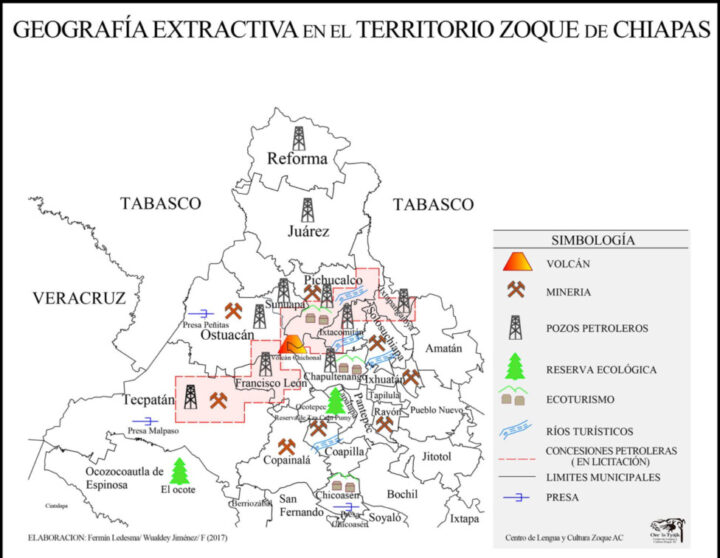
The state of Chiapas is home to hydroelectric power plants, mining projects, hydrocarbon exploitation blocks and a section of the Mayan Train, the most emblematic megaproject of the current Mexican government. Image: Center for Zoque Language and Culture AC

The state of Chiapas is home to hydroelectric power plants, mining projects, hydrocarbon exploitation blocks and a section of the Mayan Train, the most emblematic megaproject of the current Mexican government. Image: Center for Zoque Language and Culture AC

Territory under siege

The RBMA is one of Mexico’s 225 natural protected areas (NPAs) and its 331,000 hectares are home to 20 percent of the country’s plant species, 30 percent of its birds, 27 percent of its mammals and 17 percent of its freshwater fish.

Like all of the Lacandona rainforest, the RBMA faces deforestation, the expansion of cattle ranching, wildlife trafficking, drought, and forest fires.

Fermín Ledesma, an academic at the public Universidad Autónoma Chapingo, said possible oil exploration could aggravate existing social and environmental conflicts in the state, in addition to growing criminal violence and the historical absence of the State.

“The situation is always complex, due to legal loopholes that do not delimit the jungle, the natural protected areas are not delimited, it has been a historical mess. The search for oil has always been there,” he told IPS from Tuxtla Gutiérrez, the capital of Chiapas.

The researcher said “it is a very complex area, with a 50-year agrarian conflict between indigenous peoples, often generated by the government itself, which created an overlapping of plans and lands.”

Ledesma pointed to a contradiction between the idea of PNAs that are depopulated in order to protect them and the historical presence of native peoples.

From 2001 to 2022, Chiapas lost 748,000 hectares of tree cover, equivalent to a 15 percent decrease since 2000, one of the largest sites of deforestation in Mexico, according to the international monitoring platform Global Forest Watch. In 2022 alone, 26,800 hectares of natural forest disappeared.

In addition, this state, one of the most impoverished in the country, has suffered from the presence of mining, the construction of three hydroelectric plants and, now, the Mayan Train, the Mexican government’s most emblematic megaproject inaugurated on Dec. 15, one of the seven sections of which runs through the north of the state.

But there are also stories of local resistance against oil production. In 2017, Zoque indigenous people prevented the auction of two blocks on some 84,000 hectares in nine municipalities that sought to obtain 437.8 million barrels of crude oil equivalent.

The anonymous source expressed hope for a repeat of that victory and highlighted the argument of conducting an indigenous consultation prior to the projects, free of pressure and with the fullest possible information. “With that we can stop the wells, as occurred in 2017. We are not going to let them move forward,” he said.

Ledesma the researcher questioned the argument of local development driven by natural resource extraction and territorial degradation as a pretext.

“They say it’s the only way to do it, but that’s not true. It leaves a trail of environmental damage, damage to human health, present and future damage. It is much easier for the population to accept compensation or give up the land, because they see it is degraded. A narrative is created that they live in an impoverished area and therefore they have to relocate. This has happened in other areas,” he said.

  Source

Trapped and Trafficked—Fishers Tell of Forced Labor Horror

Active Citizens, Africa, Asia-Pacific, Civil Society, Economy & Trade, Editors’ Choice, Environment, Featured, Headlines, Human Rights, Human Trafficking, Humanitarian Emergencies, Labour, Migration & Refugees, TerraViva United Nations

Human Trafficking

Workers take a break after unloading fish from the Sor Somboon 19 fishing vessel. Initial screenings conducted by Greenpeace revealed that the crew of this Thai trawler met internationally accepted definitions of forced labour. Credit: Greenpeace

Workers take a break after unloading fish from the Sor Somboon 19 fishing vessel. Initial screenings conducted by Greenpeace revealed that the crew of this Thai trawler met internationally accepted definitions of forced labour. Credit: Greenpeace

BRATISLAVA, Jan 19 2024 (IPS) – “The thing is that when you come from an African country, they know that you’re basically trapped,” says Noel Adabblah.


“You have the wrong documents; you can’t go home because you’ve already borrowed money there to get here, and you won’t risk losing what work you have, no matter how bad, because of that. They know all the tricks.” 

The 36-year-old is speaking from Dublin, where he has managed to make a new life for himself after becoming a victim of what recent reports have shown to be widespread and growing forced labour in fishing fleets across the globe.

Adabblah, from Tema in Ghana, and three friends signed up with a recruitment agency back home to work as fishers on boats in the UK. They paid the equivalent of 1,200 EUR to be placed in jobs and were given letters of invitation and guarantees by their new employers, who said they would be met in Belfast, Northern Ireland, and who agreed to take care of all their documents and visas. Their employment contracts stated the men would be paid 1,000 GBP per month and employed for 12 months, with an option to reduce or extend that by three months upon mutual consent.

But when they arrived in January 2018, they were taken to Dublin and later split up. In the following months, they were taken to do various jobs at different ports in Ireland, sometimes late at night with no idea where they were going.

“We thought we were going there to sail and fish, but when we got there, we saw the boats were not ready; they were in poor condition, and we couldn’t fish, so the owner of the boats got us to do other jobs instead,” Adabblah tells IPS.

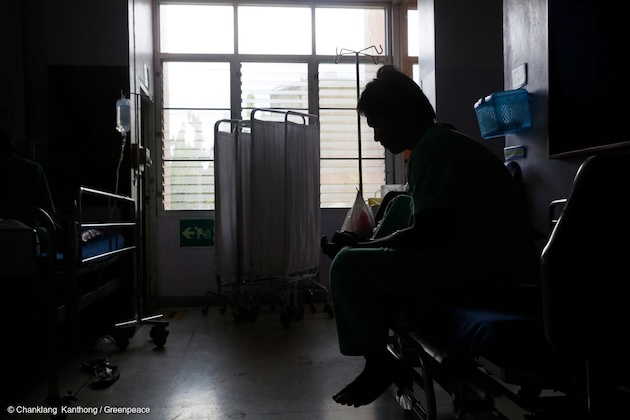
Cambodian fishermen from the fishing vessel Sor Somboon 19 recovers from beriberi at Ranong Hospital. The crew met internationally accepted definitions of victims of forced labour. Thai government investigations determined that the hospitalizations and deaths from the beriberi outbreak aboard Sor Somboon 19 were directly caused by a business model based on transshipment at sea. Credit: Greenpeace

A Cambodian fisher from the fishing vessel Sor Somboon 19 recovers from beriberi at Ranong Hospital. The crew met internationally accepted definitions of victims of forced labour. Credit: Greenpeace

“But after a few months, we said this is not what we came here to do. We had an argument over pay—he said he had no boats to fish with and wanted to lay us off, told us to go home. But we said no, that we had a 12-month contract we had signed for. He said he wouldn’t pay us, but could try to get us another job with someone else, but we said we couldn’t do that because the visas we had only applied to working for him. He told us if we didn’t like it, we could go home.”

It is at this point that many victims of forced labour often simply accept their fate and either go home or do whatever their employer wants. But Adabblah and his friends were determined to see the terms of their contract met, and they contacted the International Transport Workers’ Federation (ITF).

However, their problems deepened as they discovered they did not have the right documents for their work.

“We had no idea of the difference between Ireland and the UK. We thought the papers were OK. But when we went to the ITF, we realized they weren’t,” explains Adabblah.

At that point, the Irish police were obliged to open an investigation into the case.

Adabblah, who stayed in Ireland and has since managed to find work in the construction industry, says he heard nothing about the case until last year. “I heard that the police had said there was not enough evidence to pursue a conviction,” he says. Forced labour does not exist as an offense on the Irish statute books, so such cases are investigated under human trafficking legislation.

Regardless of the lack of a conviction in his case, he is clear that what he and his friends experienced was forced labour.

“They treated us badly. We worked 20-hour shifts some days. Once, when I was ill and couldn’t go on the boat, they said that if I couldn’t do the job, I could go home. They say stuff like that to threaten you,” he says.

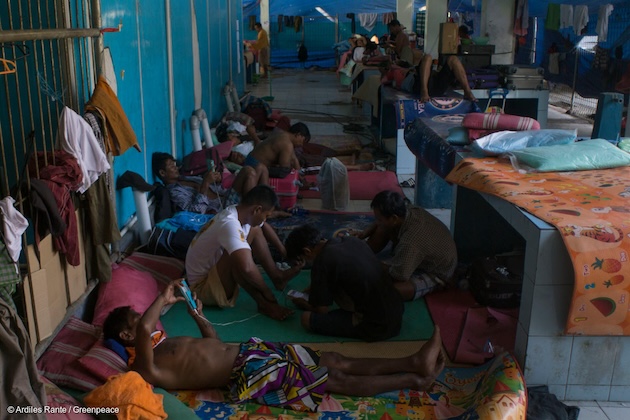
Burmese fishermen in temporary shelter in Ambon port, Indonesia. Hundreds of trafficked workers are waiting to be sent back home, with many facing an uncertain future. The forced labour and trafficking survivors interviewed by Greenpeace Southeast Asia detailed beatings and food deprivation for anyone who tried to escape. The tuna fishermen on their vessels were forced to work 20-22 hour days for little to no pay, often deprived of basic necessities like showers.

Burmese fishers in temporary shelter in Ambon Port, Indonesia. Hundreds of trafficked workers are waiting to be sent back home, with many facing an uncertain future. The forced labour and trafficking survivors interviewed by Greenpeace Southeast Asia detailed beatings and food deprivation for anyone who tried to escape. The tuna fishermen on their vessels were forced to work 20–22 hours a day for little to no pay, often deprived of basic necessities like showers. Credit: Greenpeace

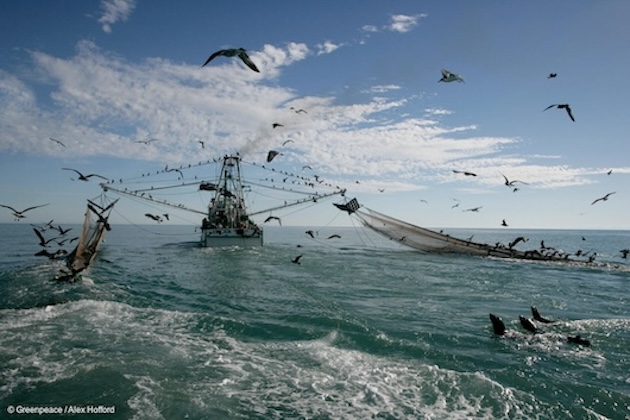
A commercial shrimp trawler is pursued by three Sea Lions near San Felipe. Shrimp trawlers, often entering into marine reserves illegally, pose a great threat to the marine environment at the northern end of the Gulf of California, due to the variety of marine wildlife, including Sea Lions that get caught in their bottom-trawling nets. The Greenpeace vessel 'MY Esperanza' is currently in Mexico to highlight the threats to the 'world's aquarium' from over-fishing, destructive tourism development, pollution and marine habitat loss.

A commercial shrimp trawler is pursued by three Sea Lions near San Felipe.
Shrimp trawlers, often entering into marine reserves illegally, pose a great threat to the marine environment at the northern end of the Gulf of California, due to the variety of marine wildlife, including Sea Lions, that get caught in their bottom-trawling nets. Credit: Greenpeace

Adabblah’s experience is far from unique among workers in the world’s fishing fleets. A recent report by the Financial Transparency Coalition, an international grouping of NGOs, said that more than 128,000 fishers were trapped in forced labour aboard fishing vessels in 2021. Its authors say there is a “human rights crisis” of forced labour aboard commercial fishing vessels, leading to horrific abuses and even deaths.

They point out that many of these victims of forced labour are from the global South, something that the people behind these crimes use to their advantage, experts say.

Michael O’Brien of the ITF’s Fisheries Section told IPS: “Those employing vulnerable migrants in forced labour scenarios rely upon the vulnerability of the victim, the potential lack of legal status of the victim in the country where they are working, and the victim’s reliance on an income that is unavailable to them in their country of origin.”

Mariama Thiam, an investigative journalist in Senegal who did research for the Financial Transparency Coalition report, said fishers often do not know what they are signing up for.

“Usually there is a standard contract that the fisher signs, and often they sign it without understanding it fully,” she told IPS.  “Most Senegalese fishermen have a low level of education. The contract is checked by the national fishing agency, which sees it, says it looks okay, approves it, and the fishers then go, but the fishers don’t understand what’s in it.”

Then, once they have started work, the men are so desperate to keep their jobs that they will put up with whatever conditions they have to.

“All the fishers I have spoken to say they have had no choice but to do the work because they cannot afford to lose their jobs—their families rely on them. Some of them were beaten or did not have any days off; captains systematically confiscate all their passports when they go on board—the captains say that if the fishermen have their passports, some will go on shore when they are in Europe and stay on there, migrating illegally,” she said.

“In the minds of Senegalese fishermen, their priority is salary. They can tolerate human rights abuses and forced labour if they get their salary,” Thiam added.

Adabblah agrees, adding though that this allows the criminals behind the forced labour to continue their abuses.

“The thing is that a lot of people are afraid to speak up because of where they are from, and they end up being too scared to say anything even if they are really badly treated. There are lots of people who are in the same situation as I was or experiencing much worse, but if no one speaks up, how can [criminals] be identified?” he says.

Experts on the issue say the owners of vessels where forced labour is alleged to have occurred hide behind complex corporate structures and that many governments take a lax approach to uncovering ultimate beneficial ownership information when vessels are registered or fishing licenses are applied for.

This means those behind the abuses are rarely identified, let alone punished.

“In Senegal, what happens is that the government doesn’t want to share information on owner control of boats. No one can get information on it, not journalists, not activists, sometimes not even people in other parts of government itself,” said Thiam.

Other problems include a lack of legislation to even deal with the problem. For instance, Thiam highlighted that fishers in Senegal work under a collective convention dating back to 1976 that does not mention forced labour.

O’Brien added: “In the Irish context, there has never been a prosecution for human trafficking for labour exploitation in fisheries or any other sector.

“There is a school of thought among progressive lawyers that we need a separate offense on the statute books of ‘labour exploitation’ to obtain convictions. In the case of fishers, some remedies can be obtained via the labour and maritime authorities, but these are lower-level offenses that do not have a dissuasive effect on the vessel owners.”

Victims also face difficulties seeking redress in their home countries.

Complaints to recruiting agencies in fishers’ home countries often come to nothing and can end up having serious consequences.

“The thing about the agency I dealt with at home and other agencies like it is that if you complain to them, they will just say that you are talking too much and you should come home and solve the situation there, and then when you get home, they just blacklist you and you won’t get any fishing work ever again; they will just recruit someone else,” says Adabblah.

Although Adabblah did not see the justice he had hoped for, he is aware his story has ended better than many other victims of forced labour. He, along with his three friends, have made new lives in Ireland, and he is hoping to soon begin the process of becoming a naturalised Irish citizen.

He urges anyone who finds themselves in the same situation to not stay quiet, and instead contact an organization like the ITF or something similar.

Doing so may not always bring victims a satisfactory resolution to their problems, but each publicized case may end up having a long-term positive effect on stopping others from being abused, said O’Brien.

“The ITF has significant resources but not enough to match the scale of the problem. The cases we take up like Noel’s are the tip of the iceberg. However, we use these cases, with the consent of the victims, to highlight the problem with governments and, in turn, campaign for changes in the law,” he said.

IPS UN Bureau Report

  Source

Guatemala’s Chance for a New Beginning

Civil Society, Crime & Justice, Democracy, Featured, Headlines, Indigenous Rights, Latin America & the Caribbean, TerraViva United Nations

Opinion

Credit: Emmanuel Andres/AFP via Getty Images

MONTEVIDEO, Uruguay, Jan 18 2024 (IPS) – Guatemala’s new president, Bernardo Arévalo, was expected to be sworn in on 14 January at 2pm –the 14th at 14:00, as people repeated in anticipation for months. It was a momentous event – but it wasn’t guaranteed to happen.


One year earlier, Arévalo – co-founder of the progressive Movimiento Semilla (Seed Movement), a political party born out of widespread 2015 anti-corruption protests – was largely unknown, freshly selected as his party’s presidential candidate. He wasn’t on the radar of opinion polls. A long chain of unlikely events later, he’s become the first Guatemalan president in living memory who doesn’t belong to the self-serving elites who Guatemalans call ‘the corrupt pact’, which he has credibly promised to dismantle.

The fear this caused among corrupt elite that has long ruled Guatemala was reflected in a series of attempts to try to stop Arévalo’s inauguration. The huge and sustained citizen mobilisation that came in response can largely be credited with keeping alive the spark of democracy in Guatemala.

Last-minute delays

All the Guatemalan Congress needed to do on the morning of 14 January was certify its newly elected members so the body could swear in the new president. But this routine administrative procedure was dragged on for many hours. The Indigenous movement, at the forefront of the months-long protests that had successfully kept at bay successive attempts to reverse the election results, called on Indigenous communities throughout Guatemala to remain on the alert.

In the late afternoon the Secretary General of the Organization of American States, Luis Almagro, surrounded by members of numerous foreign delegations, read a declaration calling on Congress to hand over power, ‘as required by the Constitution’, to the president-elect. This signalled that the world was watching.

As tensions mounted, Semilla reached an agreement for one of its representatives to be elected as president of Congress. This allowed the certification process to resume, and Arévalo was finally sworn in shortly after midnight. Night-long celebrations followed.

A coup attempt in stages

Arévalo’s election was unexpected. He only made it into the 20 August runoff because several other contenders not to the elite’s liking had been disqualified ahead of the first round. His candidacy wasn’t blocked because he scored so poorly in the polls. People’s expectations were extremely low, and first place went to invalid votes.

But once Arévalo entered the runoff, his rise was unstoppable. Death threats soon poured in, and an assassination plot involving state and non-state forces came to light days before the runoff.

As soon as the first-round results were announced, nine parties submitted complaints about supposed ‘irregularities’ that had gone undetected by all international observers. Their supporters converged outside the Supreme Electoral Tribunal (TSE) calling for a rerun.

The Constitutional Court instead ordered a recount and instructed the TSE to suspend official certification until complaints were resolved. Following the recount, the TSE eventually endorsed the results two weeks later.

But meanwhile, Attorney General Consuelo Porras Argueta, an official under US sanctions for corruption, launched an investigation into Semilla for alleged irregularities in its registration process and had its offices raided. She also ordered two raids on TSE offices, and when the TSE officially announced Arévalo as one of the runoff contenders, she ordered Semilla’s suspension. The Constitutional Court however blocked this order and the runoff ran its course. Arévalo took 58 per cent of the vote, compared to 37.2 per cent for the pro-establishment candidate.

Efforts to stop Arévalo’s inauguration began immediately, with yet another attempt by the Public Prosecutor to have Semilla suspended. The Constitutional Court continued to receive and reject legal challenges until the day of the inauguration.

For 100 days, two different visions of Guatemala wrestled with each other: people eager for change protested nonstop while corrupt forces linked to organised crime strove to preserve their privileges at any cost.

Democracy on life support

Guatemala has long been classified as a ‘hybrid regime‘ with a mix of democratic and authoritarian traits. Under outgoing president Alejandro Giammattei, civic freedoms steadily deteriorated. State institutions grew even weaker, ransacked by predatory elites and coopted by organised crime.

One of the last acts of Giammattei’s predecessor and ally, Jimmy Morales, was to end the work of the International Commission against Impunity in Guatemala (CICIG). Charged with supporting and strengthening state institutions to investigate and prosecute serious crimes, CICIG helped file over 120 cases in the Guatemalan justice system and its joint investigations with the Attorney General’s Office led to over 400 convictions.

Under Giammattei, the Attorney General’s Office dismantled all anti-corruption efforts and criminalised those in the legal profession who’d worked alongside CICIG. Impunity flourished. Transparency International’s 2022 Corruption Perceptions Index found evidence of strong influence by organised crime over politics and politicians, with some crime bosses seeking and securing office.

It’s no wonder that Guatemalans’ trust in state institutions hit rock bottom. According to the latest Latinobarómetro report, in 2021 satisfaction with the performance of democracy stood at a meagre 25 per cent.

Challenges ahead

Arévalo came to the presidency on a credible anti-corruption platform. But dismantling dense webs of complicity, rooting out entrenched corruption and rebuilding state institutions are no easy tasks.

Among the many challenges is a highly fragmented Congress in which 16 parties are represented, with Semilla on only 23 out of 160 seats. A large majority of Congress remains on the payroll of the interests Arévalo has promised to take on, along with most of the justice system. The 14 January events made clear that the ‘corrupt pact’ will do anything it can to stop Arévalo.

Arévalo’s to-do list is long, ranging from reducing political spending and improving social services to reversing laws that criminalise protest and establishing an effective protection mechanism for human rights defenders. At the top is forcing the resignation of Attorney General Consuelo Porras, the highest official presiding over a judicial network set up to ensure the impunity of the ‘corrupt pact’.

Arévalo can’t remove the Attorney General unilaterally, and so will have to negotiate her departure. This will be a key early test of the hope invested in him to keep democracy alive. Many more are sure to come.

Inés M. Pousadela is CIVICUS Senior Research Specialist, co-director and writer for CIVICUS Lens and co-author of the State of Civil Society Report.

  Source