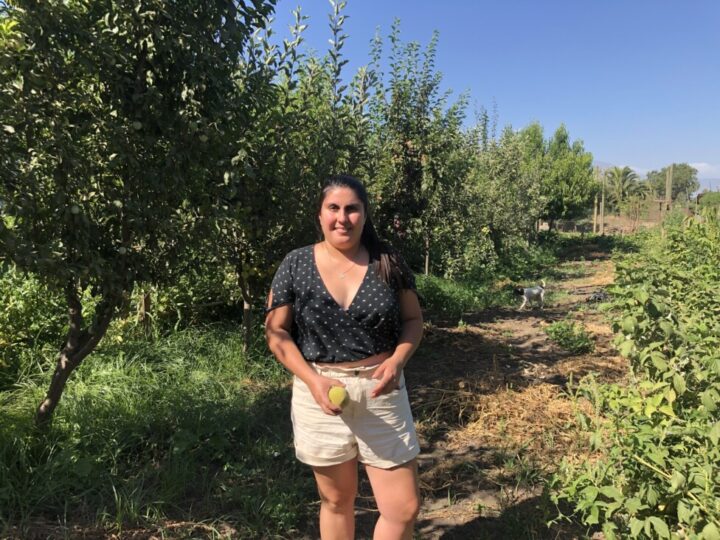
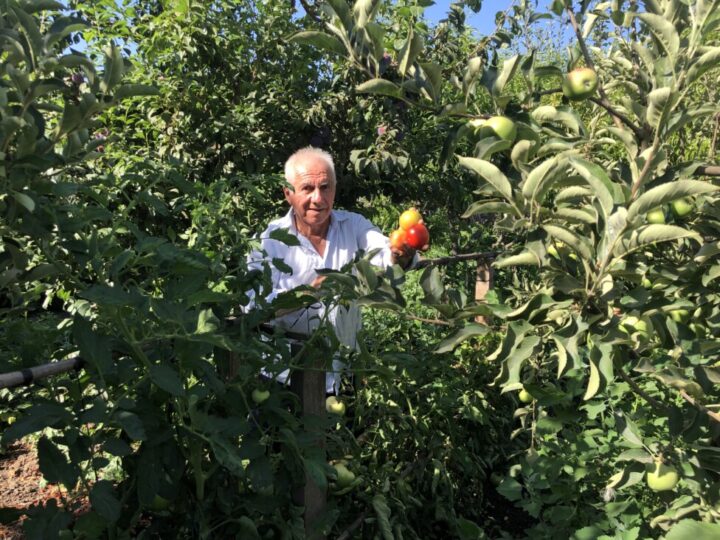
Transforming food systems is key to solving food insecurity on the African continent. A powerful and unified effort is needed to ensure food systems are transformed to be robust enough to support the population. Credit: Joyce Chimbi/IPS
NAIROBI, Jan 16 2024 (IPS) – As hunger and food insecurity deepen, Africa is confronting an unprecedented food crisis. Estimates show that nearly 282 million people on the continent, or 20 percent of the population, are undernourished. Numerous challenges across the African continent threaten the race to achieve food security; research and innovative strategies are urgently needed to transform current systems as they are inadequate to address the food crisis.
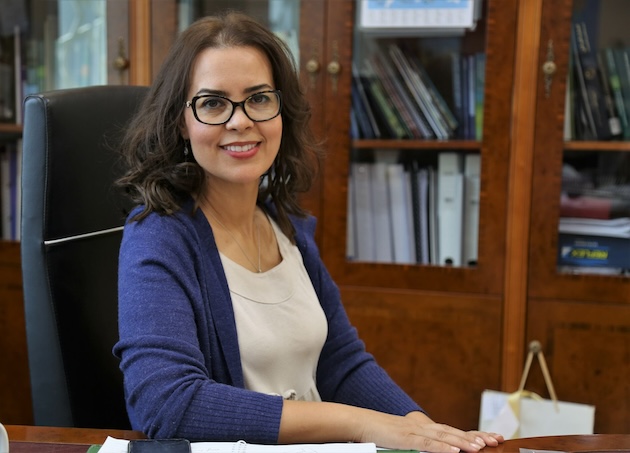
Transforming food systems is key. A powerful and unified effort is needed to equip food systems to advance human and planetary health to their full potential. This was the message as CGIAR entered a new era under the leadership of Dr Ismahane Elouafi, the Executive Managing Director. Named one of the most influential Africans of 2023, she continues to stress the need to use science and innovation to unlock Africa’s potential to meet its food needs.
Dr Ismahane Elouafi, the CGIAR’s newly appointed Executive Managing Director. Credit: FAO
During her inaugural field visit to an IITA center in Ibadan, Nigeria, alongside Dr Simeon Ehui, IITA’s Director General and CGIAR Regional Director for Continental Africa, she oversaw extensive discussions on transforming food systems and leveraging science and technology.
“At COP28 in Dubai, UAE, there was high-level recognition and a wonderful spotlight on science and innovation. CGIAR has an opportunity to represent science and innovation at large, representing the whole community at large. We can cut down poverty and stop malnutrition, and we have the tools—we just need to bring them to the farmers,” she said.
CGIAR continues to create linkages between agricultural and tech stakeholders, emphasizing digital innovation for agricultural development. CGIAR-IITA explores leveraging ICTs to tackle agricultural challenges, boost productivity, ensure sustainability, and enhance food security, featuring presentations, discussions, workshops, and networking across sectors.
There was a significant focus on the CGIAR TAAT model as a tool to use technology to address Africa’s worsening food crisis. TAAT Technologies for African Agricultural Transformation (TAAT) is a key flagship programme of the African Development Bank’s Feed Africa strategy for 2016 to 2025.
“We have the technology, and all hands are on deck to ensure that no one sleeps hungry. There are severe food insecurities on the continent today, deepening rural poverty and malnutrition. We have the capacity to achieve food security,” Ehui emphasized.
IITA’s Dr Kenton Dashiell spoke about TAAT in the context of strategic discussions around policy and government engagement. Emphasizing the need for the government, private sector, and other key stakeholders to create effective and efficient food systems transformation paths. As a major continent-wide initiative designed to boost agricultural productivity across the continent by rapidly delivering proven technologies to millions of farmers, TAAT can deliver a food-secure continent.
Elouafi stressed the need to ensure that technology is in the hands of farmers. in line with TAAT, which aims to double crop, livestock, and fish productivity by expanding access to productivity-increasing technologies to more than 40 million smallholder farmers across Africa by 2025. In addition, TAAT seeks to generate an additional 120 million metric tons.
IITA’s Bernard Vanlauwe spoke about sustainable intensification with the aim of increasing production and improving the livelihoods of smallholder farmers in sub-Saharan Africa. Farmers are increasingly dealing with higher temperatures and shorter rainy seasons, affecting the production of staple foods such as maize. Further stressing the need for improved crop varieties to meet Africa’s pressing food insecurities.
Elouafi stressed that the needs are great, in particular, eliminating extreme poverty, ending hunger and malnutrition, turning Africa into a net food exporter, and positioning Africa at the top of the agricultural value chains. She emphasized the need to leverage progress made thus far, building on the commitments of Dakar 1, the 1st Summit of the World’s Regions on Food Security held in Dakar in January 2010, where representatives and associations of regional governments from the five continents noted that the commitments made at the World Food Summit in 2002 had had little effect and that the food crisis had only worsened.
Elouafi said the UN Food System Summit in 2021 and the 2023 Dakar 2 Summit, with an emphasis on building sustainable food systems and aligning government resources, development partners, and private sector financing to unleash Africa’s food production potential, were important meetings to build on. The commitments made at these high-level meetings had already created a pathway towards ending hunger, food insecurity, and malnutrition and transforming food systems to meet the most pressing food needs today.
It is estimated that Africa’s agricultural output could increase from USD 280 billion per year to USD 1 trillion by 2030. The visit and ensuing discussions highlighted how investing in raising agricultural productivity, supporting infrastructure, and climate-smart agricultural systems, with private sector investments, government support, and resources from multinational financial institutions, all along the food value chain, can help turn Africa into a breadbasket for the world. Private sector actors will be particularly urged to commit to the development of critical value chains.
A “for sale” sign seen outside a house in Centro Habana. As you walk along the streets of the Cuban capital, you see a variety of “for sale” signs on a number of houses. The same is true in cities and towns in Cuba’s 168 municipalities. CREDIT: Jorge Luis Baños / IPS
HAVANA, Oct 16 2023 (IPS) – To emigrate to the United States and fulfill her hopes for a better life, Ana Iraida sold almost all of her belongings, including the apartment that, until her departure, saved her from the uncertainty of living in rented housing in Cuba, a country with an unresolved housing crisis.
“I inherited the apartment in Havana from my maternal grandmother, who passed away in 2015. It was small, but comfortable. I sold it for 6,000 dollars to pay for my documents, paperwork and airfare,” the philologist, who like the rest of the people interviewed preferred not to give her last name, told IPS.
“It is difficult to sell, because many people want to emigrate, and they are practically ‘giving away’ the houses. But at the same time hard currency is scarce and a person with thousands of dollars prefers to use them to leave the country.” — Elisa
From Houston, Texas in the U.S., where she now lives, the young woman said that, thanks to loans from friends, “I raised another 4,000 dollars. I got to Nicaragua in December 2022 and from there I continued by land to the U.S. border.”
Ana Iraida said she feels “fortunate” to have had a home that was “furnished and in good condition,” with which she covered her expenses. She said that others “have a more difficult time because they do not have a home of their own.”
In the last two years, emigration from Cuba has skyrocketed amidst the deterioration of the domestic economic situation, fueled by the COVID-19 pandemic, the tightening of the U.S. embargo, partial dollarization of the economy, the fall in the purchasing power of wages and pensions, shortages of essential products and inflation.
Errors and delays in the implementation of reforms to modernize the country and the ineffective monetary system implemented in January 2021 have also played a role.
In this country of 11 million people, in 2022 the exodus led some 250,000 people to the United States alone, the main receiving nation of migrants from this Caribbean island nation, from which it is separated by just 90 miles of sea.
To stem the wave of immigration, on Jan. 5 the U.S. government extended to nationals of Cuba, Nicaragua and Haiti a humanitarian temporary residency permit program, known as “parole”, similar to the one implemented in October 2022 for Venezuelans and previously for other nationalities.
As of the end of August, more than 47,000 Cubans had obtained the humanitarian permit, of whom 45,000 had already immigrated, according to U.S. Customs and Border Protection.
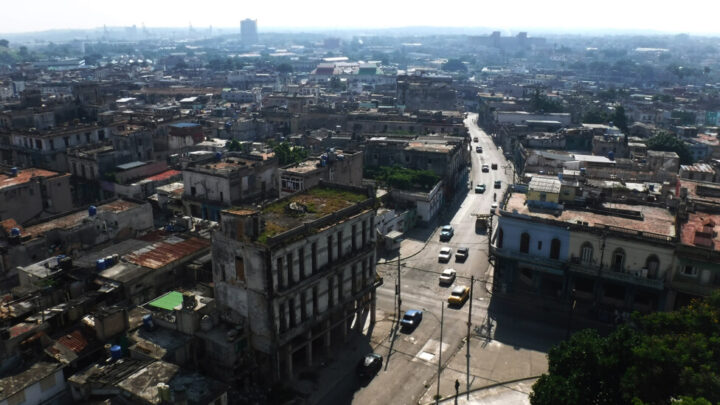
A view of Havana from Cerro, one of its 15 municipalities. This city of 2.2 million inhabitants, the biggest in the country, has the largest housing deficit in Cuba, exceeding 800,000 housing units. CREDIT: Jorge Luis Baños / IPS
One of the requirements for the temporary residency permit is to have sponsors who are U.S. citizens or hold some other legal status, in addition to having the financial resources to support the beneficiary or beneficiaries.
Swapping or selling parole
Owning your own home can also be an opportunity allowing whole families to move abroad.
“People are swapping houses for parole status. A few weeks ago I facilitated the exchange of a house for five parole permits to the United States. And in another case, with a residence in Miramar (a wealthy neighborhood in western Havana), nine people were the beneficiaries,” said Damian, a historian who privately engages in buying and selling, for which he charges a commission.
Damián explained to IPS that “residents in the United States ask for 10,000 to 12,000 dollars to provide a guarantee for parole status. The number of people they give a guarantee for depends on the value of the house. When the process is completed, the property is sold to a relative or friend of that person in Cuba.”
Walking through the streets in the Cuban capital, the most varied signs reading “for sale” can be seen on crumbling or remodeled buildings. The same is true in other cities and towns of the country’s 168 municipalities.
On online sites and Facebook groups for buying and selling activities, there is a proliferation of advertisements with photos and information about the properties, such as the number of rooms, the presence of a landline telephone line or an electrical installation that allows the connection of 110 and 220 volt equipment.
Some negotiate the price with or without furniture, others negotiate with buyers who pay cash in hand, or who pay in dollars, euros or make the deposit abroad.
“It is difficult to sell, because many people want to emigrate, and they are practically ‘giving away’ the houses. But at the same time hard currency is scarce and a person with thousands of dollars prefers to use them to leave the country,” said Elisa, a lawyer who told IPS she is interested in settling with her husband and son in Spain.
She said she has been trying to sell her apartment in La Vibora, another Havana neighborhood, for a year. “I can’t find a buyer, not even now that I dropped the price to 10,000 dollars, half the initial price, and it’s furnished,” she complained.
In Cuba’s informal real estate market, offers range from 2,000 dollars or less to a million dollars. The lowest of these figures is far from the average monthly salary, equivalent to 16.50 dollars on the black market.
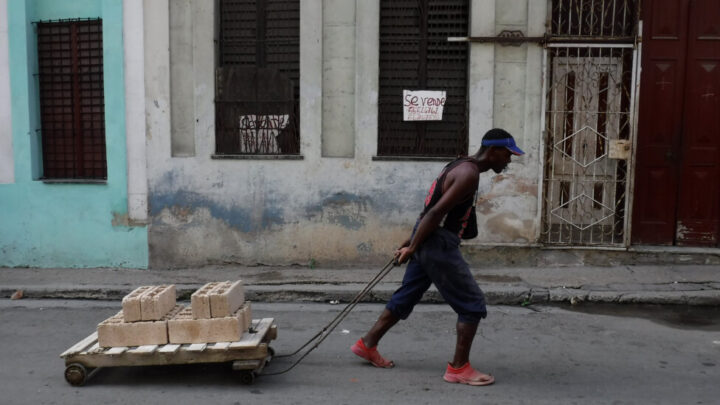
A man pulls a cart loaded with building blocks past a house for sale in the municipality of Centro Habana. In view of the government’s diminished construction capacity and the decline of funds for housing, since 2010 the government authorized the free sale of various materials for construction, repairs, remodeling and expansion. CREDIT: Jorge Luis Baños / IPS
Hurdles despite the reforms
Now, Cubans can sell their properties even to move away from the country, a situation very different from 15 years ago, when only swaps of houses between two or more owners were possible. Homes could only be sold to the government, and they were confiscated if the people living there emigrated.
Under laws passed in the early years after the 1959 revolution, most citizens became homeowners.
The Urban Reform Law of 1960 turned housing properties over to those who lived in them, prohibited their sale or lease, and abolished private construction and mortgages.
After decades of prohibitions, in October 2011 the 1988 General Housing Law was amended and the doors were opened to free purchase and sale between Cuban citizens and even foreign residents, endorsed before notaries and with the payment of taxes.
The law also eliminated certain formalities and official regulations on swaps.
Prior to the restitution of the right of ownership of residential units, in 2010 the government approved permits allowing people to build, repair or expand their own homes.
In view of the government’s reduced capacity for construction and the decline in housing funds in that same year, the free sale of cement, sand, gravel, cement blocks and corrugated iron bars was also authorized, which until then had been exclusively centrally allocated or sold in convertible pesos (CUC, a now defunct currency equivalent to the dollar).
The authorities promoted the granting of subsidies to vulnerable families, especially those affected by hurricanes, and micro-credits to build, expand or remodel homes.
These measures helped drive a boom in private construction and repairs.
As in other areas marked by the scarcity of materials, red tape and unequal purchasing power, the granting of housing and sale of materials is not exempt from corruption, theft and poor quality work, which has given rise to repeated complaints from the public.
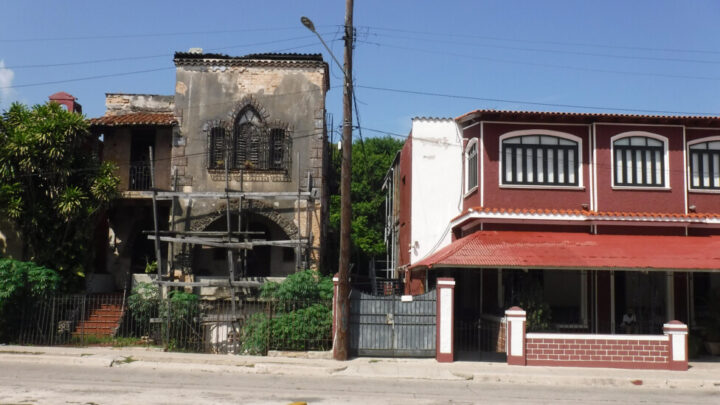
There is still a housing deficit of more than 800,000 homes, while one third of Cuba’s 3.9 million homes are in fair or poor condition.
The largest deficits are concentrated in Havana, a city of 2.2 million inhabitants, as well as in Holguín, Santiago de Cuba and Camagüey, the other three most populated cities.
In 2019, a Housing Policy was launched, aimed at eliminating the housing shortage within a decade, based on the incentive of local production of construction materials and recyclable inputs, in addition to the contribution from the government and the centrally planned economy.
But the policy has run into hurdles as a result of the economic crisis, and multiple factors such as delays in paperwork and procedures, loss of material resources, unfinished subsidies and financial resources tied up in the banks.
The shortage of foreign currency and insufficient investment stand in the way of increasing production and incorporating equipment to boost construction capacity and sustainability.
Official data show that in 2022, more than 195 million dollars were dedicated to business services, real estate and rental activity, including hotel construction, which represented almost 33 percent of investment in the sector.
Since 2019, 127,345 housing units were completed and 106,332 were remodeled or repaired, said Vivian Rodriguez, general director of Housing of the Ministry of Construction, during the most recent session of the Council of Ministers, on Oct. 1.
The authorities acknowledged that compliance with the year’s plan of 30,000 new units is under threat. Maintaining this pace would mean eliminating the housing deficit in more than 28 years.
A rundown house stands next to a newly remodeled home on a street in the municipality of Playa, Havana. A third of Cuba’s 3.9 million homes are considered to be in fair and poor condition. CREDIT: Jorge Luis Baños / IPS
No immediate solution
The lack of housing and the deterioration of existing homes continue without a viable solution in the short or medium term.
On many occasions, people of different generations are forced to live together in small homes, many of which are in a state of disrepair, putting a significant number of families at risk.
Access to housing has also been identified as a factor in the low birth and fertility rates that Cuba has been experiencing for decades.
There is also a problem after tropical cyclones and heavy rains, when centuries-old buildings that have never been remodeled or repaired collapse, or those vulnerable to strong winds are left roofless.
The private practice of professions such as architecture is also not allowed, and although since September 2021 the government has authorized the incorporation of micro, small and medium-sized companies, some of which specialize in the construction and repair of real estate, they still encounter obstacles to their practice.
“There could be many solutions, but in my opinion an essential one is that building materials must be available and at affordable prices; or that houses can be sold to workers so they can pay for them on credit. Otherwise, families will continue to be overcrowded, roofs and walls will collapse on us, or we will grow old without a place of our own,” Orlando, a prep school teacher living in Havana, told IPS.
In this, the fourth of IPS’ Youth Thought Leaders series, the author looks at suicide rates in older persons and concludes we should break barriers and celebrate the diversity each generation brings.
An image illustrating the ‘No-senior zone’ in a Korean café. Credit: The Nation
SEOUL, Oct 13 2023 (IPS) – Growing up in a culture that values respect for elders, I was acutely aware of the importance of caring for our aging population. However, my journey to understanding the gravity of this issue truly began with a personal anecdote. I watched my grandmother, a pillar of strength throughout my childhood, gradually withdraw from the vibrant world in which she once thrived. The cheerful twinkle in her eyes began to dim, replaced by an eerie sense of isolation.
Some may argue that these figures are insignificant, but the persistence of a high suicide rate cannot be dismissed. Moreover, they are poised to become even more critical as we approach a world where, according to WHO, the elderly population over the age of 60 is expected to double by 2050, and those 80 years or older are projected to triple.
So how severe are the elderly suicide rates due to isolation in Korea and Japan? Well, research highlights that this is due to the significant rise in the elderly population. Such an increase has been concurrent with the rising elderly suicide rates. The Global Burden of Disease study emphasizes that the global elderly suicide rate is almost triple the suicide rates across all other age groups. For example, in South Korea alone, there has been a 300% increase in elderly suicide rates.
If the world’s elderly population has increased overall, why is it that the elderly suicide rates within Korea and Japan have been especially severe? This was particularly confusing as I believed that due to cultural and social standards of filial piety and respecting your elders, such suicide rates would be low. However, I found the answer to my own question when I visited Korea in July this year.
When I arrived in the country, one of the first things I did was to visit a cafe to meet with a friend. However, as I was about to enter the cafe, I saw a group of elderly men and women leaving the cafe while comforting each other, saying, “It’s okay; it’s not the first time we’ve been rejected.” As I later found out, this was because the cafe was a ‘no-senior zone.’
Similar to how some places are designated as ‘no-kid zones,’ this cafe, and others, did not allow people over the age of 60 to enter. According to Lee Min-ah at Chung-Ang University, “The continuous emergence of ‘no-something zones’ in our society means that exclusion among groups is increasing, while efforts to understand each other are disappearing.”
I also discovered that age discrimination is also present in other aspects of the elderly’s life, more specifically, in the workplace. According to a survey by the National Human Rights Commission of Korea, in 2018, 59 percent of the Korean elderly found it difficult to be employed due to age restrictions, and a further 44 percent experienced ageism within their workplace. The increase in discrimination against the elderly has heightened their sense of isolation, eventually leading to cases of suicide in extreme circumstances.
Jung Soon Park, the Secretary General of World Smart Sustainable Cities Organization (WeGo) with the author Hyunsung (Julie) Lee.
Interview with Jung Soon Park, the Secretary General of WeGo at the Seoul Global Center
I wanted to learn more about the current action being taken to help the elderly feel more included in our society, as I believed this would be key to preventing isolation-related suicide cases. To gain further insight, I decided to interview Jung Soon Park, the Secretary General of the World Smart Sustainable Cities Organization (WeGo).
WeGo is an international association of local governments, smart tech solution providers, and institutions committed to transforming cities worldwide into smart and sustainable cities through partnerships. I believe that by interviewing the Secretary General of WeGo, I would be able to learn more about the specific solutions that governments and organizations are implementing collaboratively.
Through my interview, I gained an understanding that the South Korean government and social organizations are currently focusing on addressing age discrimination, recognizing it as a key factor in isolationism.
Park mentioned that one specific approach to resolving this issue involves the use of ‘meta spaces’ and technological wristbands. She emphasized that in today’s technology-driven world, enabling the elderly to adapt to such technology could bridge the generation gap between the younger and older generations. She further explained that meta spaces, allowing for anonymous communication, and technological wristbands, which could include features like a metro card and direct access to emergency services, would facilitate the elderly’s integration into modern society. Park concluded that enabling the elderly to adapt efficiently to the current social setting could break down the generational barrier between youth and the elderly, fostering a direct connection between these two disparate groups.
During my research, I coincidentally came across a website called Meet Social Value (MSV). MSV is a publishing company that specializes in writing and publishing insightful articles about contemporary social issues. Their most recent article, titled ‘Senior,’ delves into the social challenges faced by the elderly in Korean society and explores solutions involving inclusive designs and spaces.
MSV serves as a prime example of how contemporary social organizations are taking steps to address the issue of elderly discrimination. This is especially significant because, through youthful and trendy engagement on social media, it becomes easier to raise awareness of this issue among younger generations.
Meet Social Value’s most recent article, titled ‘Senior,’ delves into the social challenges faced by the elderly in Korean society and explores solutions involving inclusive designs and spaces.
As I continued my research, I started pondering what I, as an 18-year-old, could do to contribute to resolving this issue. Even though I’m still a student, I wanted to find ways to make a difference, especially after witnessing age discrimination and its consequences firsthand.
I found the answer to my question when I learned about the initiatives undertaken by the government of Murakami City and the Murakami City Social Welfare Council to bridge the gap between the youth and senior citizens. They introduced the Murakami City Happy Volunteer Point System, which aimed to encourage more people to assist seniors through various volunteering activities such as nursing facility support, hospital transportation services, and operating dementia cafes, among others. The system rewarded volunteers with points that could be exchanged for prepaid cards, creating an incentive for more individuals to get involved in helping their senior citizens.
Taking this into consideration, I believe that the younger generation, especially students, may contribute by creating such an incentivization system. For example, students may create senior volunteering clubs within their schools and take turns volunteering and connecting with elderly citizens every weekend. By doing so, clubs may incentivize their members through points which may later be traded for a snack or lunch at the school cafeteria. Through small incentives, this may naturally encourage more students to participate and thus naturally allow for the youth to create a relationship with the elderly, hence contributing to mitigating the issue of elderly isolation.
The webpage of the Murakami City Happy Volunteer Point System contains the system’s details.
In Korea’s battle against ageism, we find ourselves at a turning point. To navigate this societal shift successfully, we must recognize that age discrimination not only undermines the dignity of our elders but also hampers our collective progress. The solution requires a comprehensive approach. Policy reforms are crucial, emphasizing stringent anti-ageism measures in the public space and the workplace. Equally significant solutions are awareness campaigns to challenge stereotypes and foster inter-generational understanding.
However, true change starts with the youth. By confronting our biases and engaging in volunteering activities, we can break down barriers and celebrate the diverse experiences each age group brings. Through such efforts, we can create a society where age is not a determinant of worth but a source of strength and wisdom. It’s a journey demanding our collective commitment, but one that will lead us towards a more inclusive and harmonious future for all.
A view of Caracas from the south side of the narrow valley where it sits, dotted with houses and residential buildings where full occupancy was the norm until a few years ago. As a result of the massive migration of young people and adults, more and more homes are left unoccupied or inhabited only by the elderly and young children. CREDIT: Humberto Márquez / IPS
CARACAS, Oct 4 2023 (IPS) – Gladys swore she would not cry in front of her small children, but she still had to wipe away a couple of tears when she turned her head and looked, perhaps for the last time, at her dream house on Margarita Island in Venezuela, from where she migrated, driven by a lack of income and by fear.
“It hurts to leave your own home, the most precious material asset for a family like ours (she works in administration, her husband is a mechanic, and they have two boys), but we lost our jobs and were robbed in broad daylight in the middle of the city. That led us to decide to emigrate,” she told IPS from Miami, Florida in the U.S.
Due to the economic, social and political crisis, which gave rise to a complex humanitarian emergency, 7.7 million Venezuelans, according to United Nations agencies, have migrated from this country, the vast majority in the last decade, and the flow is not slowing down, especially to other countries in the region.
“It hurts to leave your own home, the most precious material asset for a family like ours, but we lost our jobs and were robbed in broad daylight in the middle of the city. That led us to decide to emigrate.” — Gladys
The family of Gladys, who like other people who talked to IPS preferred not to give her last name, tried their luck in Colombia, Panama and Spain, before finally settling in the United States, “and the worry about the house followed us like a shadow, but fortunately we made a deal with an enterprising young man who takes care of it, improves it and pays a modest rent.”
There are thousands like her. Migrants try not to leave their homes empty and abandoned, because they could lose them. For this reason, since most migrants are adults in their most productive age and young people, relatives of other ages remain in the homes, giving Venezuela the appearance of being a country of elderly people and children.
“I have to close up my home,” said Juan Manuel Flores, from San Antonio de Los Altos, a satellite city of Caracas with many middle class houses. “The neighbors will take care of it. It took us more than five years to build it and it cost between 150,000 and 200,000 dollars. Now I can’t get more than 60,000 dollars for it. We are not just going to give it away for that price.”
Flores, a teacher at a school where he earns less than 200 dollars a month, is preparing to travel to Spain, where his wife and adult daughters have gone ahead of him. “I will return to Venezuela when the country and its economy improve, and housing prices will rise again,” he told IPS, although without much conviction.
Solitude eats away at houses and buildings even in sought-after areas of the residential and commercial municipality of Chacao, in eastern Caracas. The real estate and construction market is suffering in Venezuela from the general economic crisis and in particular from the oversupply of housing created by those leaving the country. CREDIT: Humberto Márquez / IPS
Why not rent out their house? “Because the laws and the authorities always favor the tenant, and if they have children it is impossible to get them out when the lease is up, whether they pay the rent or not, and they end up staying in the house for years,” said Nancy, a pastry chef, also from San Antonio, who left a niece in charge of her apartment when she moved to Brazil last year.
Selling is also not an option in most cases, because the magnitude of the exodus over the last decade has so depressed demand that the most that can be obtained for a property is 15 or 20 percent of the value it had 15 years ago, if you are lucky. So selling a home even if you want to is a long, difficult process that provides meager results.
Those who have no other choice say that they are not selling their home but “giving it away” for whatever they can get, with great regret, mostly to internal migrants from other parts of the country, who “take refuge” in Caracas because outside the capital there are recurrent power outages, and scarcity of water and fuel, in addition to other shortages.
“Real estate deteriorates, ceases to serve those who need it and remains an important asset that produces nothing for the owner, for example a migrant who needs to pay rent as soon as they arrive in another country,” Roberto Orta, president of the Venezuelan Real Estate Chamber, told IPS.
The businessman said “this is an issue that, we have proposed, should be addressed with political will in order to reform the laws that constrain the real estate market, to benefit both landlords and tenants. Up to 250,000 homes could be freed up in five years.”
A view of the working-class neighborhood of 23 de Enero on the west side of Caracas. In low-income barrios, closed, empty houses are almost non-existent, as those who decide to emigrate look for relatives to move in, to avoid the risk of the homes being invaded or robbed. CREDIT: Humberto Márquez / IPS
A trade is born
In the residential buildings located in Caracas and other cities, closing up an apartment and moving outside the country is not the same as leaving a house abandoned to solitude and neglect, because the neighbors, for their own safety and in order to pay the common expenses, keep watch and take care to prevent strangers from occupying the empty apartments.
But houses, especially middle-class homes, are an attractive and easy target for crime and even for people who want to occupy them by de facto means. That is why a new profession has appeared: the home caretaker.
“I have taken care of three houses in housing developments in the southeast (of Caracas), it’s the way I make ends meet,” said Daniel, who also works as a self-employed gardener. “I would go to one house twice a week, three times a week to another, and every day to another.”
He explains that in the last house “the owners were Portuguese business owners who went away and left three dogs. I would go to a pet food store to pick up the food, feed the dogs, check around the house and that was it.”
Family friends of the owners have now taken charge of the dogs and Daniel no longer receives payment for taking care of them. “I don’t have an account in dollars, I was paid through a restaurant friend of the owners, who does have an offshore account,” he said.
To pay for caretakers from abroad, intermediaries are indispensable, since in Venezuela, whose currency has been made nearly worthless by the economic crisis, there is a de facto dollarization, without agreement from the U.S. authorities, who also use sanctions to block the transactions of government bodies.
Daniel is saving up to join one of the groups forming in Antímano, the working-class neighborhood where he lives in the southwest of the capital, to migrate as well. He said that “I didn’t leave a few weeks ago because I hadn’t sold my motorcycle yet, otherwise right now I would be in the Darien,” the dangerous jungle between Colombia and Panama that thousands of migrants cross every day.
A more successful caretaker is Arturo, who is in charge of two houses with large living rooms, corridors, yards, a swimming pool and parking area. He is paid a modest fee to care for and maintain the homes, but is authorized to rent them out for social gatherings and parties.
“In both cases the owners are people with good incomes, they left with their children to study abroad and plan to return in a few years if conditions in the country change. They would like to find their homes as they left them,” he said.
When he rents out the property for a day or a night, guests can use the yards, swimming pool and even awnings, tables and chairs. But Arturo closes off access to the more private parts of the house and hires assistants to watch out for damages or disturbances. “I live well, I keep up the houses and each one brings me about 3,000 dollars in profits per month,” Arturo said.
President Nicolás Maduro delivers a batch of houses in the northwestern state of Falcón, which form part of the 4.6 million homes that the government claims to have built and provided to Venezuelan families since 2013. The figure is questioned by organizations dedicated to monitoring economic and social rights. CREDIT: Minhvi
No empty houses in the shantytowns
In the shantytowns of the cities and towns of this country – which has a population of 33.7 million according to government figures and 28 million according to university studies – the situation is different and there are hardly any empty or unoccupied houses.
“In the shantytowns, no house is left empty. The very next day someone can invade it, occupy it, or take what is left inside by those who left, furniture or household goods. Someone stays in charge, the grandfather or in-laws, a trusted neighbor, or a relative is brought from the interior of the country,” explained Alejandra, from the Gramoven area.
She lives in a shantytown of informally constructed dwellings in the northwest of Caracas, similar to the ones that cover most of the many hills and hollows occupied by the capital’s most disadvantaged inhabitants.
“Many people leave, the young people emigrate, my children want to leave through the Darien jungle. But nobody leaves their house empty. If you do, you lose it,” Alejandra said.
In Santa Bárbara del Zulia, on the hot plains south of western Lake Maracaibo, “the situation is the same,” Julio, a bricklayer who migrated to Colombia for four years and has returned to care for his elderly parents, told IPS.
“You can’t leave your house alone in these towns,” said Julio. “When my parents went to Maracaibo and Caracas for medical treatment, they went and came back quickly, because the Community Council warned them not to leave their house empty for too long, because they would not be able to ward off people who wanted to occupy it.”
The Community Councils are committees set up by the government to represent and manage community affairs – such as the distribution of bags of subsidized food to poor families – and they channel decisions by the government.
“But people are leaving anyway. It’s something that won’t stop as long as people here earn only a pittance and can’t even eat properly (the minimum wage and official pensions in Venezuela are equivalent to four dollars a month). People care about their houses, but food has to come first,” said Julio.
View of a row of houses practically abandoned by most of their inhabitants in a town in eastern Venezuela. Migration from the countryside and small towns to large cities and oil producing areas marked the 20th century in Venezuela. And today, migration from this country mainly to other Latin American nations has become a regional crisis. CREDIT: VV
A matter for the government and the business community
While the plight of people leaving their homes continues to drag on, the government of President Nicolás Maduro announces more or less twice a year the construction of hundreds of thousands of new homes, in a program initiated by his late predecessor Hugo Chávez (1999-2013), called “Venezuela’s Great Housing Mission”.
According to official figures, since 2011, 4.6 million homes have been built and delivered by the Mission, mostly residential complexes to which the president goes to personally hand over the keys of one or more houses to their new inhabitants.
In accordance with the Mission, the occupants are tenants, not owners, so they cannot sell the homes. If they leave, the home can be reassigned to new tenants. To avoid this, those who choose to move to another city or country first look for relatives who can move into the house, and thus keep it.
However, the official figures on the number of homes built is not borne out by anecdotal evidence, to judge by the myriad of informal self-built houses still occupied in the slums, and by reports from business and civil society organizations.
The Chamber of Construction reports that the sector has decreased 96 percent in the last 10 years, and that its members employ 20,000 workers, down from 1.2 million in better times, while cement companies are working at 10 percent of their capacity and the steel industry at seven percent.
The civil society organization Provea, which specializes in the study of economic, social and cultural rights, has compared and contrasted the figures of the Housing Mission – which have not been audited, according to Provea – with independent studies, and reached the conclusion that the government has built and delivered only 130,856 housing units in 10 years.
In 1955 the Venezuelan writer Miguel Otero Silva (1908-1985) published his famous novel “Casas Muertas” (Dead Houses), describing the decline of Ortiz, a town in the central plains, caused by the loss of its population due to malaria and emigration to the big cities and oil production centers.
The flow of Venezuelan emigration in this century has not been enough to turn this into a country of dead houses. But its many closed doors bear witness to a collapse that has pushed millions of its inhabitants abroad, as do the small number of lights that are lit at night in the buildings of Caracas and other cities.
LIMA, Sep 28 2023 (IPS) – Nearly 700,000 people have migrated internally in Peru due to the effects of climate change. This mass displacement is a clear problem in this South American country, one of the most vulnerable to the global climate crisis due to its biodiversity, geography and 28 different types of climates.
“We recognize migration due to climate change as a very tangible issue that needs to be addressed,” Pablo Peña, a geographer who is coordinator of the Emergency and Humanitarian Assistance Unit of the International Organization for Migration (IOM) in Peru, told IPS.
In an interview with IPS at the UN agency’s headquarters in Lima, Peña reported that according to the international Internal Displacement Monitoring Center, the number of people displaced within Peru’s borders by disasters between 2008 and 2022 is estimated at 659,000, most of them floods related to climate disturbances.
“We recognize migration due to climate change as a very tangible issue that needs to be addressed.” — Pablo Peña
In this Andean country of 33 million inhabitants, there is a lack of specific and centralized data to determine the characteristics of migration caused by environmental and climate change factors.
Peña said that through a specific project, the IOM has collaborated with the Peruvian government in drafting an action plan aimed at preventing and addressing climate-related forced migration, on the basis of which a pilot project will begin in October to systematize information from different sources on displacement in order to incorporate the environmental and climate component.
“We aim to be able to define climate migrants and incorporate them into all regulations,” said the expert. The project, which includes gender, rights and intergenerational approaches, is being worked on with the Ministries of the Environment and of Women and Vulnerable Populations.
He added that this type of migration is multidimensional. “People can say that they left their homes in the Andes highlands because they had nothing to eat due to the loss of their crops, and that could be interpreted, superficially, as forming part of economic migration because they have no means of livelihood. But that cause can be associated with climatic variables,” Peña said.
Pablo Peña, coordinator of the Emergency and Humanitarian Assistance Unit of the International Organization for Migration (IOM) in Peru, stands in front of the headquarters of this United Nations agency in Lima. He highlights the need to address the situation of internal migration driven by the impacts of climate change. CREDIT: Mariela Jara / IPS
The Central Reserve Bank, in charge of preserving monetary stability and managing international reserves, lowered in its September monthly report Peru’s economic growth projection to 0.9 percent for this year, partly due to the varied impacts of climate change on agriculture and fishing.
This would affect efforts to reduce the poverty rate, which stands at around 30 percent in the country, where seven out of every 10 workers work in the informal sector, and would drive up migration of the population in search of food and livelihoods.
“The World Bank estimates that by 2050 there will be more than 10 million climate migrants in Latin America,” said Peña.
The same multilateral institution, in its June publication Peru Strategic Actions Toward Water Security, points out that people without economic problems are 10 times more resistant than those living in poverty to climatic impacts such as floods and droughts, which are increasing at the national level.
The country is currently experiencing the Coastal El Niño climate phenomenon, which in March caused floods in northern cities and droughts in the south. The official National Service of Meteorology and Hydrology warned that in January 2024 it could converge with the El Niño Southern Oscillation (ENSO) global phenomenon, accentuating its impacts.
El Niño usually occurs in December, causing the sea temperature to rise and altering the rainfall pattern, which increases in the north of the country and decreases in the south.
The manager of Natural Resources of the Piura regional government, Juan Aguilar, described the vulnerability to climate change of this northern coastal region of Peru at a September meeting organized by the IOM in Lima. The official explained that the El Niño climate phenomenon has become more intense and frequent due to the effects of climate change, which aggravates its impacts on the population, such as severe flooding this year. CREDIT: Mariela Jara / IPS
Reluctance to migrate to safer areas
Piura, a northern coastal department with an estimated population of just over two million inhabitants, has been hit by every El Niño episode, including this year’s, which left more than 46,000 homes damaged, even in areas that had been rebuilt.
Juan Aguilar, manager of Natural Resources of the Piura regional government, maintains that the high vulnerability to ENSO is worsening with climate change and is affecting the population, communication routes and staple crops.
At an IOM workshop on Sept. 5 in Lima, the official stressed that Piura is caught up in both floods and droughts, in a complex context for the implementation of spending on prevention, adaptation and mitigation.
Aguilar spoke to IPS about the situation of people who, despite having lost their homes for climatic reasons, choose not to migrate, in what he considers to be a majority trend.
“People are not willing overall to move to safer areas, even during El Niño 2017 when there were initiatives to relocate them to other places; they prefer to wait for the phenomenon to pass and return to their homes,” he added.
View of the Rimac River as it passes through the municipality of Lurigancho-Chosica, in the Peruvian province of Lima. In this town, many families are still living in housing in areas at high risk, which is exacerbated during the rainy season that begins in December and has intensified due to climate change and the increased recurrence of the El Niño climate phenomenon. CREDIT: Mariela Jara / IPS
He explained that this attitude is due to the fact that they see the climatic events as recurrent. “They say, I already experienced this in such and such a year, and there is a resignation in the sense of saying that we are in a highly vulnerable area, it is what we have to live with, God and nature have put us in these conditions,” Aguilar said.
He acknowledged that with regard to this question, public policies have not made much progress. “For example after 2017 a law was passed to identify non-mitigable risk zones, and that has not been enforced despite the fact that it would help us to implement plans to relocate local residents to safer areas,” he added.
The regional official pointed out that “we do not have an experience in which the State says ‘I have already identified this area, there is so much housing available here for those who want to relocate’ , because the social cost would be so high.”
“We have not seen this, and the populace has the feeling that if they are going to start somewhere else, the place they abandon will be taken by someone else, and they say: ‘what is the point of me moving, if the others will be left here’,” Aguilar said.
Paulina Vílchez, 72, has always lived in the Peruvian municipality of Lurigancho-Chosica. Despite the fear every year that the Rimac River might flood and that mudslides could occur in one of the 21 ravines in the area, she has never thought of moving away. “I’m not going to go to an empty plot to start all over again, that’s why I’ve stayed. I leave everything in the hands of God,” she said. CREDIT: Mariela Jara / IPS
The fear of starting over
Some 40 km from the Peruvian capital, in Lurigancho-Chosica, one of the 43 municipalities of the province of Lima, the local population is getting nervous about the start of the rainy season in December, which threatens mudslides in some of its 21 ravines. The most notorious due to their catastrophic impact occurred in 1987, 2017, 2018 and March of this year.
Landslides, known in Peru by the Quechua indigenous term “huaycos”, have been part of the country’s history, due to the combination of the special characteristics of the rugged geography of the Andes highlands and the ENSO phenomenon.
In an IPS tour of the Chosica area of Pedregal, one of the areas vulnerable to landslides and mudslides due to the rains, there was concern in the municipality about the risks they face, but also a distrust of moving to a safer place to start over.
“I came here to Pedregal as a child when this was all fields where cotton and sugar cane were planted. I have been here for more than sixty years and we have progressed, we no longer live in shacks,” said 72-year-old Paulina Vílchez, who lives in a nicely painted two-story house built of cement and brick.
On the first floor she set up a bodega, which she manages herself, where she sells food and other products. She did not marry or have children, but she helped raise two nieces, with whom she still lives in a house that is the fruit of her parents’ and then her own efforts and which represents decades of hard work.
Vílchez admits that she would like to move to a place where she could be free of the fear that builds up every year. But she said it would have to be a house with the same conditions as the one she has managed to build with so much effort. “I’m not going to go to an empty plot to start all over again, that’s why I’ve stayed. I leave everything in the hands of God,” she told IPS.
Maribel Zavaleta’s home in the Peruvian municipality of Chosica is built of wood, near the Rimac River and just a meter from the train tracks. She arrived there in 1989, relocated after a mud, water and rock slide two years earlier in another part of the town. She constantly worries that another catastrophe will happen again, and says she would relocate if she were guaranteed safer land and materials to build a new house. CREDIT: Mariela Jara / IPS
Very close to the Rimac River and next to the railway tracks that shake her little wooden house each time the train passes by lives Maribel Zavaleta, 50, born in Chosica, and her family of two daughters, a son, and three granddaughters.
“I came here in 1989 with my mom, she was a survivor of the 1987 huayco, and we lived in tents until we were relocated here. But it’s not safe; in 2017 the river overflowed and the house was completely flooded,” she told IPS.
Zavaleta started her own family at the age of 21, but is now separated from her husband. Her eldest son lives with his girlfriend on the same property, and her older daughter, who works and helps support the household, has given her three granddaughters. The youngest of her daughters is 13 and attends a local municipal school.
“I work as a cleaner and what I earn is only enough to cover our basic needs,” she said. She added that if she were relocated again it would have to be to a plot of land with a title deed and materials to build her house, which is now made of wood and has a tin roof, while her plot of land is fenced off with metal sheets.
“I can’t afford to improve my little house or leave here. I would like the authorities to at least work to prevent the river from overflowing while we are here,” she said, pointing to the rocks left by the 2017 landslide that have not been removed.
Asian Parliamentarians believe it’s important to prioritise spending on ageing and youth populations. Credit: APDA
NEW DELHI, Sep 5 2023 (IPS) – Legislators from around the world, this week, officially submitted to the Sherpa of the G20 meeting set for September in New Delhi a declaration calling on governments to prioritise spending on ageing, youth, gender, human security, and other burning population issues.
The submission to the G20 Sherpa follows a workshop held on August 22 in New Delhi to discuss the Declaration first presented at the G7 Hiroshima summit in April by the Global Conference of Parliamentarians on Population and Development (GCPPD) under the UNFPA.
“We have now submitted the Declaration to Amitabh Kant, Sherpa to the G-20 so that it can be taken up,” Manmohan Sharma, Executive Secretary of the Indian Association of Parliamentarians on Population and Development (IAPPD), told IPS.
Lawmakers met in New Delhi to discuss the prioritisation of resources to prepare a declaration to the G20. Credit: APDA
Keizo Takemi, member of the House of Councillors, Japan, and Chair of the AFPPD, observed that India faced many challenges that are hard to overcome, and these included the large size of its population, limited school attendance, and a high rate of unemployment. “Prioritisation of population issues is the most important,” he emphasised.
Hooda, a leader of the opposition Congress party from the state of Haryana, said he was concerned at the dwindling budgetary outlay in social sectors like health and education over the last few years in India. “Currently, for some reason, inclusive growth in education and health has fallen,” he told delegates.
A presentation to the workshop by Suneeta Mukherjee indicated that India is among the top five nations leading the ‘out-of-school’ category, with 1.4 million children in the 6-11-years-old age category not attending school. Also, out of every 100 students, 29 per cent drop out of school before completing elementary education.
Mukherjee, an Indian career bureaucrat who has served at the UNFPA, said the situation appeared to be worsening at the upper primary level given that the dropout rate at the upper primary level had gone up to 3 per cent in 2021-2022 while it was only 1.9 per cent in 2020-2021. The annual dropout rate of secondary school students was 14.6 in 2020-2021.
Citing recent studies in her presentation, Mukherjee said 36 per cent of Indians between the ages of 15 and 34 believe that unemployment is the biggest problem facing the country. She said one survey showed 40 per cent of graduates identified unemployment as their most pressing concern.
Said P.J. Kurien, chairperson of IAPPD: “It is important that all MPs take up population-related issues. They need to ask what percentage of the budget is devoted to education and health and ensure that every child goes to school with special attention given to girls.”
Echoing Kurien, Sharma said it was up to members of parliament to ensure that no child is left out in his or her constituency. “The solution is in your hands, but the prioritisation is missing.”
Delegates outlined at the workshop legislative steps taken by Parliamentarians in their countries in implementing the International Conference on Population Development’s Programme of Action and 2030 Agenda.
Josephine Veronique Lacson-Noel, Member, House of Representatives of the Philippines, said over the last two decades, her country had enacted such legislations as the Magna Carta of Women, Reproductive Health Law, 105-Day Expanded Maternity Leave, Act Prohibiting Child Marriage, Universal Health Care Act, Youth Council Reform and Empowerment Act, and an Act to enable conditional cash transfers.
On the anvil, she said, is the Adolescent Pregnancy Prevention Bill, a law to recognise, evaluate and redistribute unpaid care and domestic work done by women, and another to accord social protection for older persons and the promotion of active aging.
For 2023, the budget allocation for reproductive health was $14.9 million dollars, and that for training teachers to implement comprehensive sexuality education was $13.8 million, Lacson-Noel said.
Andrea W. Wojnar, UNFPA India representative and country director for Bhutan, said with the right expertise and skills, India’s 1.4 billion people could be turned into 1.4 billion opportunities.
Wojnar said India, with its large youth cohort — its 254 million youth in the 15-24 age bracket — can be a source of innovation and solutions, especially if girls and women are provided educational opportunities and skills to access new technologies and are empowered to fully exercise their reproductive rights and choices.
With close to 50 per cent of its population below the age of 25, India has a time-bound opportunity to benefit from the demographic dividend, according to Wojnar.
“Women and girls should be at the centre of sexual and reproductive policies and programmes. When rights, choices, and equal value of all people are truly respected and held, only then can we unlock a future of infinite possibilities,” Wojnar said in a statement.
“As the national fertility rate falls below 2.1 (the replacement level), India is at a unique historical opportunity, witnessing a great demographic transition as a youthful nation,” Wojnar said, adding that India also has the largest number of outmigrants and is affected by ageing, urbanisation and issues around sustainable development.
Wojnar warned that, overall, the Asia Pacific region was six times more likely to be affected by disaster events than other regions and is highly susceptible to changing weather patterns, calling for special attention by governments.
The Declaration presented to the Sherpa of the G-20 called on governments, among other things, to implement comprehensive legislation and policies that address all forms of gender-based violence and eradicate harmful practices such as child marriage, early and forced.
It also called for investment in sexual and reproductive health and rights, as well as comprehensive sexuality education toward making future societies economically dynamic and for building peaceful, inclusive, and sustainable societies. Support for political and economic participation by women and girls could ensure the development of societies that guarantee liberty and individual choice for women and girls, it said.
Governments were asked to promote and assure equitable access to health innovation, finance, technology, and medicines in the global community which can support human security, leaving no one behind.
Acknowledgement of the grave impacts of environment/climate change and global warming was important, as also the need to promote policies that address the needs of geographically vulnerable countries, which is a threat to health and human security, the Declaration said.
Investing in young people by providing decent work opportunities and enabling them to become a driving force for sustainable development was important as also addressing active and healthy ageing to enhance people’s overall quality of life by improving areas such as health and long-term care through resilient universal health coverage, physical security, and income stability.
Governments were also asked to enact national legislation and policies and ensure political will through allocation, oversight, and monitoring of budgetary resources to build universal health coverage, which is vital to enhance the global health framework.