Trapped and Trafficked—Fishers Tell of Forced Labor Horror

Active Citizens, Africa, Asia-Pacific, Civil Society, Economy & Trade, Editors’ Choice, Environment, Featured, Headlines, Human Rights, Human Trafficking, Humanitarian Emergencies, Labour, Migration & Refugees, TerraViva United Nations

Human Trafficking

Workers take a break after unloading fish from the Sor Somboon 19 fishing vessel. Initial screenings conducted by Greenpeace revealed that the crew of this Thai trawler met internationally accepted definitions of forced labour. Credit: Greenpeace

Workers take a break after unloading fish from the Sor Somboon 19 fishing vessel. Initial screenings conducted by Greenpeace revealed that the crew of this Thai trawler met internationally accepted definitions of forced labour. Credit: Greenpeace

BRATISLAVA, Jan 19 2024 (IPS) – “The thing is that when you come from an African country, they know that you’re basically trapped,” says Noel Adabblah.


“You have the wrong documents; you can’t go home because you’ve already borrowed money there to get here, and you won’t risk losing what work you have, no matter how bad, because of that. They know all the tricks.” 

The 36-year-old is speaking from Dublin, where he has managed to make a new life for himself after becoming a victim of what recent reports have shown to be widespread and growing forced labour in fishing fleets across the globe.

Adabblah, from Tema in Ghana, and three friends signed up with a recruitment agency back home to work as fishers on boats in the UK. They paid the equivalent of 1,200 EUR to be placed in jobs and were given letters of invitation and guarantees by their new employers, who said they would be met in Belfast, Northern Ireland, and who agreed to take care of all their documents and visas. Their employment contracts stated the men would be paid 1,000 GBP per month and employed for 12 months, with an option to reduce or extend that by three months upon mutual consent.

But when they arrived in January 2018, they were taken to Dublin and later split up. In the following months, they were taken to do various jobs at different ports in Ireland, sometimes late at night with no idea where they were going.

“We thought we were going there to sail and fish, but when we got there, we saw the boats were not ready; they were in poor condition, and we couldn’t fish, so the owner of the boats got us to do other jobs instead,” Adabblah tells IPS.
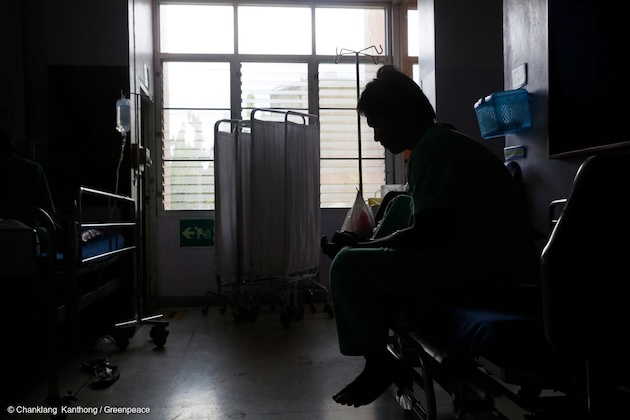
Cambodian fishermen from the fishing vessel Sor Somboon 19 recovers from beriberi at Ranong Hospital. The crew met internationally accepted definitions of victims of forced labour. Thai government investigations determined that the hospitalizations and deaths from the beriberi outbreak aboard Sor Somboon 19 were directly caused by a business model based on transshipment at sea. Credit: Greenpeace

A Cambodian fisher from the fishing vessel Sor Somboon 19 recovers from beriberi at Ranong Hospital. The crew met internationally accepted definitions of victims of forced labour. Credit: Greenpeace

“But after a few months, we said this is not what we came here to do. We had an argument over pay—he said he had no boats to fish with and wanted to lay us off, told us to go home. But we said no, that we had a 12-month contract we had signed for. He said he wouldn’t pay us, but could try to get us another job with someone else, but we said we couldn’t do that because the visas we had only applied to working for him. He told us if we didn’t like it, we could go home.”

It is at this point that many victims of forced labour often simply accept their fate and either go home or do whatever their employer wants. But Adabblah and his friends were determined to see the terms of their contract met, and they contacted the International Transport Workers’ Federation (ITF).

However, their problems deepened as they discovered they did not have the right documents for their work.

“We had no idea of the difference between Ireland and the UK. We thought the papers were OK. But when we went to the ITF, we realized they weren’t,” explains Adabblah.

At that point, the Irish police were obliged to open an investigation into the case.

Adabblah, who stayed in Ireland and has since managed to find work in the construction industry, says he heard nothing about the case until last year. “I heard that the police had said there was not enough evidence to pursue a conviction,” he says. Forced labour does not exist as an offense on the Irish statute books, so such cases are investigated under human trafficking legislation.

Regardless of the lack of a conviction in his case, he is clear that what he and his friends experienced was forced labour.

“They treated us badly. We worked 20-hour shifts some days. Once, when I was ill and couldn’t go on the boat, they said that if I couldn’t do the job, I could go home. They say stuff like that to threaten you,” he says.
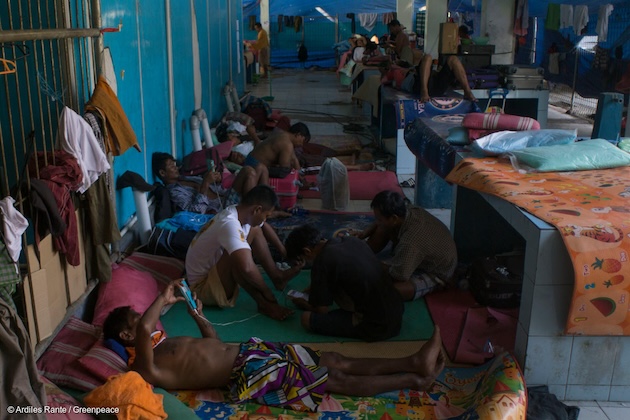
Burmese fishermen in temporary shelter in Ambon port, Indonesia. Hundreds of trafficked workers are waiting to be sent back home, with many facing an uncertain future. The forced labour and trafficking survivors interviewed by Greenpeace Southeast Asia detailed beatings and food deprivation for anyone who tried to escape. The tuna fishermen on their vessels were forced to work 20-22 hour days for little to no pay, often deprived of basic necessities like showers.

Burmese fishers in temporary shelter in Ambon Port, Indonesia. Hundreds of trafficked workers are waiting to be sent back home, with many facing an uncertain future. The forced labour and trafficking survivors interviewed by Greenpeace Southeast Asia detailed beatings and food deprivation for anyone who tried to escape. The tuna fishermen on their vessels were forced to work 20–22 hours a day for little to no pay, often deprived of basic necessities like showers. Credit: Greenpeace
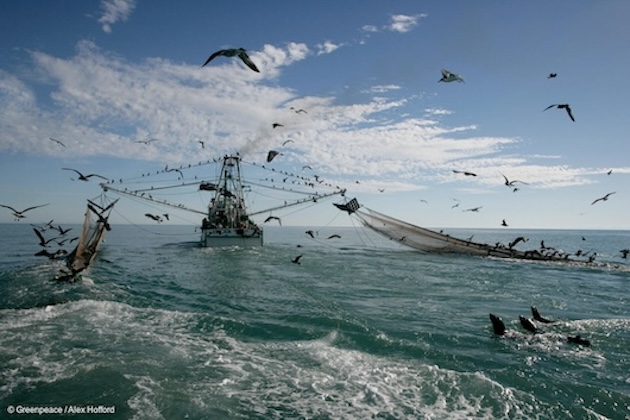
A commercial shrimp trawler is pursued by three Sea Lions near San Felipe. Shrimp trawlers, often entering into marine reserves illegally, pose a great threat to the marine environment at the northern end of the Gulf of California, due to the variety of marine wildlife, including Sea Lions that get caught in their bottom-trawling nets. The Greenpeace vessel 'MY Esperanza' is currently in Mexico to highlight the threats to the 'world's aquarium' from over-fishing, destructive tourism development, pollution and marine habitat loss.

A commercial shrimp trawler is pursued by three Sea Lions near San Felipe.
Shrimp trawlers, often entering into marine reserves illegally, pose a great threat to the marine environment at the northern end of the Gulf of California, due to the variety of marine wildlife, including Sea Lions, that get caught in their bottom-trawling nets. Credit: Greenpeace

Adabblah’s experience is far from unique among workers in the world’s fishing fleets. A recent report by the Financial Transparency Coalition, an international grouping of NGOs, said that more than 128,000 fishers were trapped in forced labour aboard fishing vessels in 2021. Its authors say there is a “human rights crisis” of forced labour aboard commercial fishing vessels, leading to horrific abuses and even deaths.

They point out that many of these victims of forced labour are from the global South, something that the people behind these crimes use to their advantage, experts say.

Michael O’Brien of the ITF’s Fisheries Section told IPS: “Those employing vulnerable migrants in forced labour scenarios rely upon the vulnerability of the victim, the potential lack of legal status of the victim in the country where they are working, and the victim’s reliance on an income that is unavailable to them in their country of origin.”

Mariama Thiam, an investigative journalist in Senegal who did research for the Financial Transparency Coalition report, said fishers often do not know what they are signing up for.

“Usually there is a standard contract that the fisher signs, and often they sign it without understanding it fully,” she told IPS.  “Most Senegalese fishermen have a low level of education. The contract is checked by the national fishing agency, which sees it, says it looks okay, approves it, and the fishers then go, but the fishers don’t understand what’s in it.”

Then, once they have started work, the men are so desperate to keep their jobs that they will put up with whatever conditions they have to.

“All the fishers I have spoken to say they have had no choice but to do the work because they cannot afford to lose their jobs—their families rely on them. Some of them were beaten or did not have any days off; captains systematically confiscate all their passports when they go on board—the captains say that if the fishermen have their passports, some will go on shore when they are in Europe and stay on there, migrating illegally,” she said.

“In the minds of Senegalese fishermen, their priority is salary. They can tolerate human rights abuses and forced labour if they get their salary,” Thiam added.

Adabblah agrees, adding though that this allows the criminals behind the forced labour to continue their abuses.

“The thing is that a lot of people are afraid to speak up because of where they are from, and they end up being too scared to say anything even if they are really badly treated. There are lots of people who are in the same situation as I was or experiencing much worse, but if no one speaks up, how can [criminals] be identified?” he says.

Experts on the issue say the owners of vessels where forced labour is alleged to have occurred hide behind complex corporate structures and that many governments take a lax approach to uncovering ultimate beneficial ownership information when vessels are registered or fishing licenses are applied for.

This means those behind the abuses are rarely identified, let alone punished.

“In Senegal, what happens is that the government doesn’t want to share information on owner control of boats. No one can get information on it, not journalists, not activists, sometimes not even people in other parts of government itself,” said Thiam.

Other problems include a lack of legislation to even deal with the problem. For instance, Thiam highlighted that fishers in Senegal work under a collective convention dating back to 1976 that does not mention forced labour.

O’Brien added: “In the Irish context, there has never been a prosecution for human trafficking for labour exploitation in fisheries or any other sector.

“There is a school of thought among progressive lawyers that we need a separate offense on the statute books of ‘labour exploitation’ to obtain convictions. In the case of fishers, some remedies can be obtained via the labour and maritime authorities, but these are lower-level offenses that do not have a dissuasive effect on the vessel owners.”

Victims also face difficulties seeking redress in their home countries.

Complaints to recruiting agencies in fishers’ home countries often come to nothing and can end up having serious consequences.

“The thing about the agency I dealt with at home and other agencies like it is that if you complain to them, they will just say that you are talking too much and you should come home and solve the situation there, and then when you get home, they just blacklist you and you won’t get any fishing work ever again; they will just recruit someone else,” says Adabblah.

Although Adabblah did not see the justice he had hoped for, he is aware his story has ended better than many other victims of forced labour. He, along with his three friends, have made new lives in Ireland, and he is hoping to soon begin the process of becoming a naturalised Irish citizen.

He urges anyone who finds themselves in the same situation to not stay quiet, and instead contact an organization like the ITF or something similar.

Doing so may not always bring victims a satisfactory resolution to their problems, but each publicized case may end up having a long-term positive effect on stopping others from being abused, said O’Brien.

“The ITF has significant resources but not enough to match the scale of the problem. The cases we take up like Noel’s are the tip of the iceberg. However, we use these cases, with the consent of the victims, to highlight the problem with governments and, in turn, campaign for changes in the law,” he said.

IPS UN Bureau Report

  Source

Hindu Woman Doctor Confident of Election In Pakistan Polls

Asia-Pacific, Democracy, Editors’ Choice, Education, Featured, Freedom of Expression, Gender, Headlines, Human Rights, Population, Religion, TerraViva United Nations, Women in Politics, Women’s Health

Women in Politics

On the campaign trail: Dr Saveera Parkash, a nominee for the Pakistan People’s Party. She is the first Hindu woman to run in Pakistan's general election Credit: Ashfaq Yusufzai/IPS

On the campaign trail: Dr Saveera Parkash, a nominee for the Pakistan People’s Party. She is the first Hindu woman to run in Pakistan’s general election Credit: Ashfaq Yusufzai/IPS

PESHAWAR, Jan 18 2024 (IPS) – A woman medical graduate from the Hindu community is making waves, as she is the first minority woman to contest the Pakistan Parliamentary election for a general seat, and she does so in the face of deep-rooted religious traditions and wealthy political opponents.


Dr Saveera Parkash, a nominee of the Pakistan People’s Party (PPP) for the February 8 polls, is sure of her victory despite her religion.

“I have been witnessing the support that I am getting from the Muslim-dominated district of Buner in Khyber Pakhtunkhwa province,” Parkash told IPS in an interview. 

“My slogan is addressing issues of pollution, women’s empowerment, gender equality, female representation, and their health issues, in addition to ensuring respect for all religions,” she elaborated.

Born to a Christian mother and Hindu father, she has lived in a Muslim-dominated community; therefore, interfaith harmony is on her wishlist.

“Interfaith harmony is extremely significant because we have seen enmity among different religious sects on flimsy grounds.”

“We have to inculcate a sense of brotherhood among all schools of thought and pave the way for lasting peace in the area. We have to respect our religious places and shun differences, as all religions advocate peace and harmony,” she says.

Candidates in Buner, one of the 36 districts of Khyber Pakhtunkhwa that remained thick with militants from 2007 to 2010, are likely to witness a hard contest as the women and youngsters have shown support for the first-ever minority female candidate.

The Khyber Pakhtunkhwa Assembly, one of Pakistan’s four provinces, has 145 elected members, 115 regular seats, 26 reserved for women, and 4 for non-Muslims.

Pakistan is home to 4.4 million Hindus, which is 2.4 percent of the total population.

Her father, a medical doctor and late leader of the PPP and twice Prime Minister Benazir Bhutto, who was assassinated by militants in December 2007 in the garrison city of Rawalpindi, inspire her, she says.

“While my ideal is Mother Teresa, my main focus will be women’s education. The overall literacy rate is 48 percent, but only 25 percent of females are literate; therefore, I want to spread awareness about the importance of women’s education,” she says.

Additionally, it is very important to end favoritism and nepotism and ensure merit in the appointment of teachers, especially women.

After completing medical education in July 2022, she saw the issues women visiting hospitals faced and decided to enter politics instead of continuing her career as a doctor, as she believed issues needed to be resolved at the policy level.

“We need more women doctors, nurses, and paramedics to encourage female patients to visit hospitals. Currently, the number of female health workers is extremely low, due to which most of the women don’t come to hospitals because they don’t want to be seen by male doctors,” she says.

“My big advantage is that I belong to a middle-class family, and the people will vote for me because I am approachable to my electorate.”

The promotion of women’s rights is her main objective.

“We have to scale up awareness regarding women’s rights to property inheritance and their right to education. I sense victory in the polls, as I know the people listen to me and would reject opponents for their bright future.”

So, how does she feel the run-up to the election is going?

“In our district, 75 percent of voters are under 30, and they are well-informed about the issues they are facing. I may be lacking wisdom and knowledge compared to senior politicians, but my sincerity will lead to my success,” says the 25-year-old, who routinely wears a headscarf.

Because she is trying to reach a young electorate, her campaigning includes the wide use of social media, apart from the traditional approaches of public meetings and house-to-house canvassing.

Highlighting corruption is also part of her election campaign.

At the moment, she is concentrating on a smooth run-up so she can win popular support in her constituency

“Voters in my constituency call me ‘sister’ and ‘daughter,’ which gives me immense strength,” she said.

Parkash said she wanted to follow in the footsteps of her father, Oam Prakash, a retired doctor, and serve the people.

Securing a space for women is vital for development, as they have been suppressed and neglected in all areas.

She said “serving humanity is in my blood” due to her medical background, highlighting that her dream to become an elected legislator stemmed from having experienced poor management and helplessness in government hospitals as a doctor.

Most people in the area endorse her candidacy, regardless of her Hinduism or political affiliation. Voters appreciate her bravery for challenging traditional policies

The Election Commission of Pakistan makes it mandatory for all political parties to award 5 percent of seats to women in general seats.

Political analyst Muhammad Zahir Shah, at the University of Peshawar, said that Parkash has created history by contesting the general election.

“We have been seeing women becoming members of the assembly on reserved seats. They don’t contest elections but are nominated by parties on the basis of the seats they win in the election,” Shah said.

In the past, some women have fought elections, but they were Muslim; therefore, they don’t draw as much media and public attention, but the case of Parkash is unprecedented.

She is well educated and belongs to the Hindu community while standing for vote in an area where 95 percent of the voters are Muslims.

“She is contesting on the PPP’s ticket, which isn’t a popular political party, but it seems that she will make her presence felt during the electioneering,” Shah said. Already, she has hit headlines, and if the election takes place in a fair and transparent manner, there is a greater likelihood that she will emerge victorious,” he said.

IPS UN Bureau Report

  Source

New Era: Unlocking Africa’s Agriculture Potential Through CGIAR TAAT Model

Africa, Biodiversity, Civil Society, Climate Change, COP28, Development & Aid, Editors’ Choice, Featured, Food and Agriculture, Food Security and Nutrition, Food Sustainability, Headlines, Human Rights, Humanitarian Emergencies, Population, Poverty & SDGs, Sustainable Development Goals, TerraViva United Nations, Trade & Investment

Food and Agriculture

Transforming food systems is key to solving food insecurity on the African continent. A powerful and unified effort is needed to ensure food systems are transformed to be robust enough to support the population. Credit: Joyce Chimbi/IPS

Transforming food systems is key to solving food insecurity on the African continent. A powerful and unified effort is needed to ensure food systems are transformed to be robust enough to support the population. Credit: Joyce Chimbi/IPS

NAIROBI, Jan 16 2024 (IPS) – As hunger and food insecurity deepen, Africa is confronting an unprecedented food crisis. Estimates show that nearly 282 million people on the continent, or 20 percent of the population, are undernourished. Numerous challenges across the African continent threaten the race to achieve food security; research and innovative strategies are urgently needed to transform current systems as they are inadequate to address the food crisis.


Transforming food systems is key. A powerful and unified effort is needed to equip food systems to advance human and planetary health to their full potential. This was the message as CGIAR entered a new era under the leadership of Dr Ismahane Elouafi, the Executive Managing Director. Named one of the most influential Africans of 2023, she continues to stress the need to use science and innovation to unlock Africa’s potential to meet its food needs.

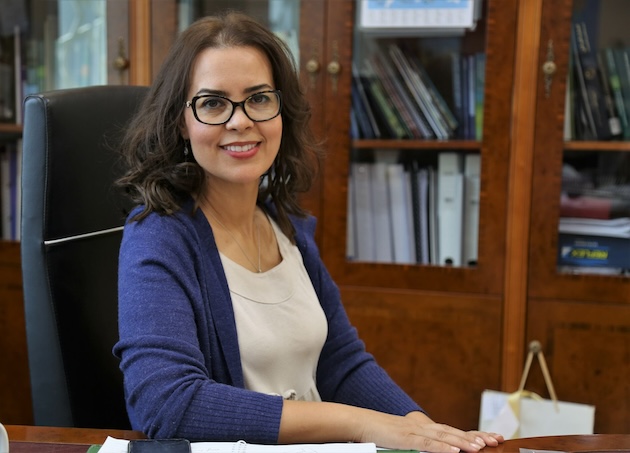
Dr Ismahane Elouafi, the CGIAR’s newly appointed Executive Managing Director. Credit: FAO

Dr Ismahane Elouafi, the CGIAR’s newly appointed Executive Managing Director. Credit: FAO

During her inaugural field visit to an IITA center in Ibadan, Nigeria, alongside Dr Simeon Ehui, IITA’s Director General and CGIAR Regional Director for Continental Africa, she oversaw extensive discussions on transforming food systems and leveraging science and technology.

“At COP28 in Dubai, UAE, there was high-level recognition and a wonderful spotlight on science and innovation. CGIAR has an opportunity to represent science and innovation at large, representing the whole community at large. We can cut down poverty and stop malnutrition, and we have the tools—we just need to bring them to the farmers,” she said.

CGIAR continues to create linkages between agricultural and tech stakeholders, emphasizing digital innovation for agricultural development. CGIAR-IITA explores leveraging ICTs to tackle agricultural challenges, boost productivity, ensure sustainability, and enhance food security, featuring presentations, discussions, workshops, and networking across sectors.

There was a significant focus on the CGIAR TAAT model as a tool to use technology to address Africa’s worsening food crisis. TAAT Technologies for African Agricultural Transformation (TAAT) is a key flagship programme of the African Development Bank’s Feed Africa strategy for 2016 to 2025.

“We have the technology, and all hands are on deck to ensure that no one sleeps hungry. There are severe food insecurities on the continent today, deepening rural poverty and malnutrition. We have the capacity to achieve food security,” Ehui emphasized.

IITA’s Dr Kenton Dashiell spoke about TAAT in the context of strategic discussions around policy and government engagement. Emphasizing the need for the government, private sector, and other key stakeholders to create effective and efficient food systems transformation paths. As a major continent-wide initiative designed to boost agricultural productivity across the continent by rapidly delivering proven technologies to millions of farmers, TAAT can deliver a food-secure continent.

Elouafi stressed the need to ensure that technology is in the hands of farmers. in line with TAAT, which aims to double crop, livestock, and fish productivity by expanding access to productivity-increasing technologies to more than 40 million smallholder farmers across Africa by 2025. In addition, TAAT seeks to generate an additional 120 million metric tons.

IITA’s Bernard Vanlauwe spoke about sustainable intensification with the aim of increasing production and improving the livelihoods of smallholder farmers in sub-Saharan Africa. Farmers are increasingly dealing with higher temperatures and shorter rainy seasons, affecting the production of staple foods such as maize. Further stressing the need for improved crop varieties to meet Africa’s pressing food insecurities.

Elouafi stressed that the needs are great, in particular, eliminating extreme poverty, ending hunger and malnutrition, turning Africa into a net food exporter, and positioning Africa at the top of the agricultural value chains. She emphasized the need to leverage progress made thus far, building on the commitments of Dakar 1, the 1st Summit of the World’s Regions on Food Security held in Dakar in January 2010, where representatives and associations of regional governments from the five continents noted that the commitments made at the World Food Summit in 2002 had had little effect and that the food crisis had only worsened.

Elouafi said the UN Food System Summit in 2021 and the 2023 Dakar 2 Summit, with an emphasis on building sustainable food systems and aligning government resources, development partners, and private sector financing to unleash Africa’s food production potential, were important meetings to build on. The commitments made at these high-level meetings had already created a pathway towards ending hunger, food insecurity, and malnutrition and transforming food systems to meet the most pressing food needs today.

It is estimated that Africa’s agricultural output could increase from USD 280 billion per year to USD 1 trillion by 2030. The visit and ensuing discussions highlighted how investing in raising agricultural productivity, supporting infrastructure, and climate-smart agricultural systems, with private sector investments, government support, and resources from multinational financial institutions, all along the food value chain, can help turn Africa into a breadbasket for the world. Private sector actors will be particularly urged to commit to the development of critical value chains.

IPS UN Bureau Report

  Source

Fear as Russian Anti-LGBT Law Comes into Effect

Civil Society, Crime & Justice, Democracy, Editors’ Choice, Europe, Featured, Freedom of Expression, Gender, Headlines, Human Rights, LGBTQ, TerraViva United Nations

Human Rights

The Russian Supreme Court ruling making the “international LGBT movement” an extremist organization will come into effect on January 9, 2024. Graphic: IPS

The Russian Supreme Court ruling making the “international LGBT movement” an extremist organization will come into effect on January 9, 2024. Graphic: IPS

BRATISLAVA, Jan 3 2024 (IPS) – “This is what you get after ten years of state propaganda and brainwashing,” says Anatolii*.

The Moscow-based LGBT rights activist’s ire is directed at a recent ruling by Russia’s Supreme Court declaring the “international LGBT movement” an extremist organization.


Details of the ruling, made on November 30 after a closed hearing, have yet to be made public—it will not be enforced until January 9, 2024, and until then, no one is likely to be any the wiser about its practical implementation, says Anatolii.

But its vagueness—critics point out that no “international LGBT movement” exists as an organization—has already fueled fears that it could lead to the arbitrary prosecution of anyone involved in any activities supporting the LGBT community.

And the potential punishments for such support are draconian, with participating in or financing an extremist organization carrying a maximum 12-year prison sentence under Russian law.

In the weeks since the ruling was announced, fear has spread among LGBT people.

“Russian queers are really scared,” Anatolii tells IPS.

But while fearful, many see it as the latest, if potentially the most drastic, act in a decade-long campaign by the Kremlin to marginalise and vilify the LGBT community in the country through legislation and political rhetoric.

The first legislative attack on the community came in 2013, not long after Vladimir Putin had returned to power as President, when a law came into effect banning “the propaganda of non-traditional sexual relations” to anyone under the age of 18.

This was followed by increasingly homophobic political discourse, and Kremlin campaigns—prominently backed by the country’s powerful Orthodox Church—promoting ‘traditional family values’ in society and casting LGBT activism as a product of the degenerate West and a threat to Russian identity.

Then in 2022, the ban on “LGBT propaganda” was extended to cover all public information or activities supporting LGBT rights or displaying non-heterosexual orientation and implicitly linked the LGBT community with paedophilia—the law refers to the “propaganda of nontraditional sexual relations and/or preferences, paedophilia, and sex change.”

A ban on same sex marriage has also been written into the constitution; authorities have labelled a number of LGBT organizations as “foreign agents,” stigmatizing them and forcing them to adhere to a set of funding and bureaucratic requirements that can be liquidating, and earlier this year a law was passed banning transgender people officially or medically changing their gender.

With each new piece of pernicious legislation, and an accompanying rise in intensity and normalization of homophobic hate speech from politicians, the LGBT community has suffered, its members say.

“The Supreme Court ruling is just a continuation of Russia’s homophobic policies. The amount of physical violence against LGBT people has been growing in Russia for 10 years. After each such law, it intensifies even more noticeably,” Yaroslav Rasputin, editor at the Russian-language LGBT website www.parniplus.com, told IPS.

“We expect homophobes will feel justified in attacking LGBT people [after the ruling], both through cyberbullying and physical assaults,” he added.

Members of the LGBT community and rights campaigners who spoke to IPS said there was a desperate fear among many LGBT people now. While the threat of physical violence was often felt as being very real, there was also a crippling concern over the uncertainty many would now face in their daily activities.

Many do not know what will constitute “support” for the LGBT community. Some are trawling through years of social media records, deleting any possible positive references to LGBT or reposted messages on the topic for fear of the information being used against them by authorities.

And there are worries that simply being openly gay could somehow be interpreted as extremism.

Lawyers who have advised LGBT people and groups in the past say that it will be much easier for security forces to initiate and prosecute cases of extremism than propaganda, as the latter is more difficult to prove.

“Although the government says these ‘repressions’ concern only political activists, in reality this is not the case. We know this from previous homophobic laws. Sometimes people spontaneously get caught for who they are. No one knows when it will be safe to come out and when not,” said Rasputin.

Anatolii said the organisation he works for has been inundated with calls from people “in panic and despair” over the ruling, many of whom are looking for help to leave the country.

LGBT groups outside Russia have also reported a huge uptick in calls from people trying to find safe passage to other countries.

“We have seen a dramatic increase in the number of people contacting us, perhaps three or four times more. LGBT people in Russia are really worried about the ruling; they don’t know what might be defined as extremist,” Aleksandr Kochekovskii from the Berlin-based organisation Quarteera e. V, which helps LGBT refugees and migrants to arrive and find their way around Germany, told IPS.

“Unfortunately, a lot of people will leave Russia because of this ruling because they feel in danger. There is a ubiquitous psychological pressure on LGBT people in Russia now,” he added.

Even some openly gay figures in Russia have publicly acknowledged that LGBT people may be forced to flee the country.

“This is real repression. There is panic in Russia’s LGBT community. People are emigrating urgently. The actual word we’re using is evacuation. We’re having to evacuate from our own country. It’s terrible,” Sergei Troshin, a gay municipal deputy in St Petersburg, told the BBC.

But others warn the Kremlin may be looking to use the ruling to crack down on the community as a whole as much as individuals.

“At this point, the state’s main goal is to erase the LGBT community from society and [the country’s] history,” Mikhail*, a Russian LGBT activist who recently left the country and now works for a pan-European NGO campaigning for minority health rights, told IPS. “It is hard to imagine how many organisations defending the rights of LGBT people will be able to exist in Russia any more since such support is [considered to be] advocating terrorism,” he added.

Some such organisations have already decided to close in the wake of the ruling. The Russian LGBT Sports Federation announced it had stopped its activities, and one of the most prominent LGBT groups in the country, Delo, which provided legal assistance to people in the community, also closed following the court decision.

But other mainstays of the LGBT community are also shutting their doors. The owners of one of the oldest gay clubs in Russia, “Central Station” in St Petersburg, said they had been forced to close the club after the site’s owners refused to rent to them. Its closure came as other gay clubs and bars in Moscow were raided by police just 24 hours after the Supreme Court ruling. People’s names taken, and ID documents copied.

Although police said the raids were part of anti-drug operations, LGBT activists said they could see the true purpose behind them.

“The state has made it very clear that it is ready to use the apparatus of force against LGBT people in Russia,” said Mikhail.

But the ruling is also expected to have effects for LGBT people beyond their interactions with other individuals or groups within the community.

Accessing specific healthcare services, for instance, seems likely to become more difficult.  Some practitioners, such as psychiatrists and psychologists, have until now openly indicated their services as LGBT-friendly. But according to some Russian media reports, it is thought many will no longer be able or willing to do so, and that others may simply stop providing their services to LGBT people altogether out of fear of repercussions.

Experts warn that without qualified help, the risks of suicide, PTSD, and the development of other mental disorders will rise, especially among children, something that was seen after the first law banning the promotion of LGBT to minors was passed in 2013.

International rights groups have condemned the court ruling and urged other countries to provide a safe haven for those forced to flee Russia and to support Russian LGBT activists working both inside and outside the country.

Whatever the effects of the law eventually are once it is fully implemented, it looks unlikely there will be any improvement for the LGBT community in the near future.

Activists predict anti-LGBT political rhetoric will probably only intensify as President Putin looks to cement support among voters ahead of elections in March, and as the Kremlin tries to draw the public’s attention away from the country’s problems, not least those connected to the war raging in Ukraine.

“It’s easier to create an artificial enemy than to struggle with the real problems the war has caused. The LGBT+ community in Russia is a kind of collective scapegoat, taking a punch and feeling the people’s wrath,” said Anatolii.

Others say that as the war drags on, repression of the LGBT community may start being repeated among other minority groups.

“Everything the Kremlin does in Russia is an attempt to divert people’s attention from the war. ‘Othering’ is typical for all dictatorial regimes. I am quite sure that soon [the Kremlin] will start targeting other groups like migrants and foreigners,” Nikolay Lunchenkov, LGBT Health Coordinator for the Eurasian Coalition on Health, Rights, Gender, and Sexual Diversity NGO, which works with the LGBT community in Russia, told IPS.

Note: *Names have been changed for safety reasons.

IPS UN Bureau Report

  Source

‘Imperfect COP28’ Gives Direction For Managed, Equitable Move From Fossil Fuels

Active Citizens, Civil Society, Climate Action, Climate Change, Climate Change Finance, Climate Change Justice, COP28, Development & Aid, Editors’ Choice, Environment, Featured, Global, Headlines, Humanitarian Emergencies, Sustainable Development Goals, TerraViva United Nations

COP28

Celebrating the end COP28 which ended with an agreement to transition away from fossil fuels. Credit: UNFCCC

Celebrating the end of COP28, which ended with an agreement to transition away from fossil fuels. Credit: UNFCCC

DUBAI, Dec 14 2023 (IPS) – While the outcomes of COP28 are being hotly debated in both the scientific and social justice arenas, the climate conference has taken an unprecedented step forward toward a just transition, says Yamide Dagnet, Director for Climate Justice at the Open Society Foundations.


Making some preliminary remarks a day after the climate conference ended, she said: “COP28 ends like it started: imperfect, yet an important and unprecedented step forward in our “course correction” for a just transition towards resilient and greener economies.”

The UN decision acknowledged the need for the decline of coal, oil, and gas for the first time in an agreement that talks about transitioning out of fossil fuels. It will also be known for operationalizing the Loss and Damages Fund, even if the funding falls far below the requirements for climate-stressed countries and communities.

UN Climate Change Executive Secretary Simon Stiell acknowledged these contractions in his final speech.

“While we didn’t turn the page on the fossil fuel era in Dubai, this outcome is the beginning of the end,” Stiell said.

He also noted that climate finance, which he said was a great enabler of climate action, fell short of the trillions needed to support developing countries with clean energy transitions and adaptation efforts.

He urged ordinary people everywhere to not relent in their demands for a climate-just world.

“In the crucial years ahead, your voices and determination will be more important than ever. I urge you never to relent. We are still in this race. We will be with you every single step of the way.”

Yamide Dagnet, Director for Climate Justice at Open Society Foundations. Credit: TJ Kirkpatrick, Open Society Foundations

Yamide Dagnet, Director for Climate Justice at Open Society Foundations. Credit: TJ Kirkpatrick, Open Society Foundations

Dagnet believes that COP28 is the start of a new era in climate justice.

“This is not an end; rather, just the beginning of an implementation journey that we know is hard but can be so positively transformative, and just if we manage to mobilize, in an equitable manner, all hands-on deck. A climate-just journey and outcome require vigilance, creativity, and accountability; stronger solidarity and engagement at all levels; promoting human rights; and shared prosperity for all,” she says.

This COP, Danget says, laid bare the issues with the Paris Agreement, especially with the just transition.

“More specifically, this COP exposed all the contradictions and challenges faced when implementing the promises of the Paris Agreement, especially a managed, equitable transition away from fossil fuels and the sustained mobilization, alignment, and access to financial flows domestically and internationally to decarbonize and build resilience,” Dagnet says. ”

While some signals got clearer with more substantive commitments, challenges remain, however, in how the just and equitable transition is sequenced.

“Inclusive processes matter to foster shared prosperity and benefits throughout the journey, together with adequate safeguards to minimize unintended adverse impacts of climate-related measures and technologies and to protect frontline and marginalized communities.

“Similarly, the just operationalization and continued capitalization of the Loss and Damage Fund will require vigilance, effective guidance, and mechanisms to make sure commensurate funding is actually mobilized and reaches the communities that need it the most in a timely manner. Adequate mobilization of finance for adaptation by the donor community is also essential to tackle losses and damages with dignity. We are happy that a dozen of them committed to join OSF efforts in this regard.”

IPS UN Bureau Report

  Source

Climate Justice is the Responsibility of the Wealthier Nations, Says Bangladesh Climate Envoy

Asia-Pacific, Climate Action, Climate Change, Climate Change Finance, Climate Change Justice, Conferences, COP28, Editors’ Choice, Environment, Featured, Food Security and Nutrition, Headlines, Humanitarian Emergencies, Sustainable Development Goals, TerraViva United Nations

COP28

Five fishers pray for a benevolent sea in Dublar, Bangladesh. Credit: Rodney Dekker/Climate Visuals

Five fishers pray for a benevolent sea in Dublar, Bangladesh. Credit: Rodney Dekker/Climate Visuals

DUBAI, Dec 11 2023 (IPS) – Wealthier nations must deliver the finances so developing countries can adapt—the time for excuses is over, says Saber Hossain Chowdhury, Bangladesh’s Special Envoy for Climate Change in the Prime Minister’s Office.


In a wide-ranging exclusive interview with IPS, Chowdhury said climate change was at the forefront of Bangladesh’s focus, as one in seven people faces displacement due to climate impacts. With this in mind, the country was focused on building resilience and ensuring resources were directed toward the most marginalized.

“The biggest challenge we will have is the melting of the glaciers in the Himalayas because it means flooding in the short term and sea level rise in the long term. We will lose about one-third of our agriculture GDP between now and 2050, and we can lose up to 9 percent of our GDP by 2100,” Chowdhury said.

“For us, it is not just one sector of our economy; it is an existential challenge for Bangladesh.”

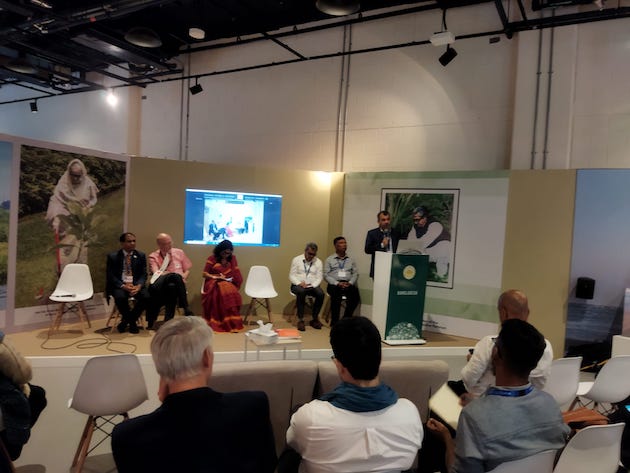
Saber Hossain Chowdhury, Special Envoy for Climate Change, Prime Minister’s Office Bangladesh, addresses an event on climate change at Bangladesh pavilion at COP28 in Dubai. Credit: Umar Manzoor Shah/IPS

Saber Hossain Chowdhury, Special Envoy for Climate Change, Prime Minister’s Office Bangladesh, addresses an event on climate change at the Bangladesh Pavilion at COP28 in Dubai. Credit: Umar Manzoor Shah/IPS

Here are edited excerpts from the interview:

IPS: In terms of climate change and the government’s actions, where is Bangladesh?

Chowdhury: Bangladesh is giving most importance to the Global Stocktake because it has two dimensions—one is looking back and the other is looking forward. We all know how bad things are when we look back because we know we are nowhere near where we are supposed to be.

But what do we do with that knowledge? How do we move forward across the board in terms of mitigation, adaptation, funding, loss and damage, and, of course, the global goals? And one of the points we are stressing is the continual interconnectedness between mitigation, adaptation, and loss and damage.

The more effective our mitigation in terms of keeping temperatures in check, the more manageable the adaptation becomes, and the more manageable the adaptation becomes, the lesser the burden that we pass on the loss and damage.  And it is meaningless to talk about adaptation without the context of mitigation. Because of the rise in temperature to 1.5°C (the threshold to which world leaders pledged to try to limit global warming), there will be a certain level of adaptation that you can do, but if the temperatures are close to 3°C, as it is now said the temperature is likely to rise to, then all adaptation will become loss and damage because there are limits to adaptation and there are limits to resilience.

IPS: What are your views on the ongoing COP 28?

Chowdhury: We got off to a great start. The fact that the Loss and Damage Fund was agreed upon on the first day. In terms of context, we only had this in the agenda last year and it was approved and within a year, the funds have started coming in.  That was a huge positive. We know that funds are nowhere near what the needs are. But it is a good start and we are hoping that the same spirit will be seen in other challenges such as mitigation, adaptation, funding, etc.

Also, I believe the presidency has tried to be very inclusive. But at the end of the day, it depends on global solidarity. If members of the conference come together, then we will have the deal we need. Let me say that this COP is a hugely important COP because we don’t have the luxury of tradeoffs.  We have to deliver across the board, and mitigation (to keep to the Paris Agreements) of 1.5°C is an absolute must, and if we go beyond that, I think we have lost the game. To what extent we can mitigate will then determine what our adaptation requirements are. The better we manage adaptation, the lesser the burden will be on loss and damage.  It is a litmus test. Bangladesh being at ground zero for climate change impact, this is a hugely important event for us.

IPS: Bangladesh is often termed a ‘victim of climate change’ across the globe. Why is that?

Chowdhury: One in seven people in Bangladesh will face displacement because of climate change, and that adds up to about 13–14 million people. We have a huge food security problem because we are losing agricultural land due to sea level rise.  The biggest challenge we will have is the melting of the glaciers in the Himalayas, which means flooding in the short term and sea level rise in the long term. We will lose about one-third of our agriculture GDP between now and 2050, and we can lose up to 9 percent of our GDP by 2100. For us, it is not just one sector of our economy; it is an existential challenge for Bangladesh.

IPS: What do you believe is the responsibility of wealthier nations towards Bangladesh?

Chowdhury: Climate justice is all about wealthier nations. They must deliver the finance so that we can adapt; they must rein in the emissions. They need to act as per science and not have any excuses. It is now or never because the window of action is closing very fast. If we don’t get it right in COP 28, whatever we do in subsequent COPs may well be too little, too late. We have to reduce emissions by 43 percent by 2030. We must reduce emissions by 60 percent by 2035, then we can get to net zero. With that, you also must have tripled the amount of renewable energy and doubled your energy efficiency. So, it has to be a package of responses. It is for the wealthier nations to mitigate, to provide funds for loss and damage as well as for adaptation.

IPS: How responsive do you find these developed nations to the climate crisis?

Chowdhury: Responses must be taken at two levels: one is making pledges, and the other is delivering on pledges. There is no point saying we will do this and then, as in the past, not do it. Pledges are the first step, and therefore everybody has to realize that this is the question of global solidarity.  It is not the question of Bangladesh and the developed world. What is happening in Bangladesh today will also happen in those countries that we call developed. Greenland will become greener again because the ice is going to melt. They will also face sea level rise. So it is not the question of “if,” it is the question of when.

IPS: Bangladesh has advanced warning systems for the climate. Please tell us about it.

Chowdhury: We have what we refer to as an ‘early warning system’ If you look at the cyclone that hit Bangladesh in the early 1970s, up to a million people died because of it. But now, when the cyclone hits Bangladesh, the number of deaths is in single digits. The reason for that is that through an early warning system, we can evacuate people to cyclone shelters. That has saved lives, and Bangladesh is a model for that.

Our honorable Prime Minister has this program where we are building cyclone shelters all around the coast of Bangladesh so that people can be evacuated there. We cannot stop a storm or a hurricane from coming, but we can prepare ourselves so that the loss of lives is minimal, and that is what Bangladesh has achieved. Also, the early warning system is very basic, and it is community-based.

IPS: What is Bangladesh doing about the agrarian crisis?

Chowdhury: Bangladesh has a huge success story in terms of food production. From a deficit nation, we are now a surplus nation, but climate change threatens that.  This is something we look at in terms of food security, so all of the advances and progress that we have made over the years are now at risk because climate change is impacting this sector.

IPS: What is the role of NGOs in terms of tackling climate change and offering support to governments?

Chowdhury: NGOs need to have partnerships with governments where they can take those ideas and scale them up. That is the reason that NGOs need to have a very close relationship with the government. The whole issue is not how much money I have spent; it is what impact I have generated through spending that money.

But the message at the end of the day is that whatever money is spent must be spent on those who are most marginalized. So how do we get funds for the people who are most in need? I think that must be an overriding issue. This is a learning process, and we are all on the learning curve. When we go back to Bangladesh, we need to have a brainstorming session with NGOs and CSOs and find out what is working, how we can make their job easier, and how we can make the collaboration a win-win between various ministries, government departments, and NGOs.
IPS UN Bureau Report